Which European economy stands to suffer the most from US tariffs?

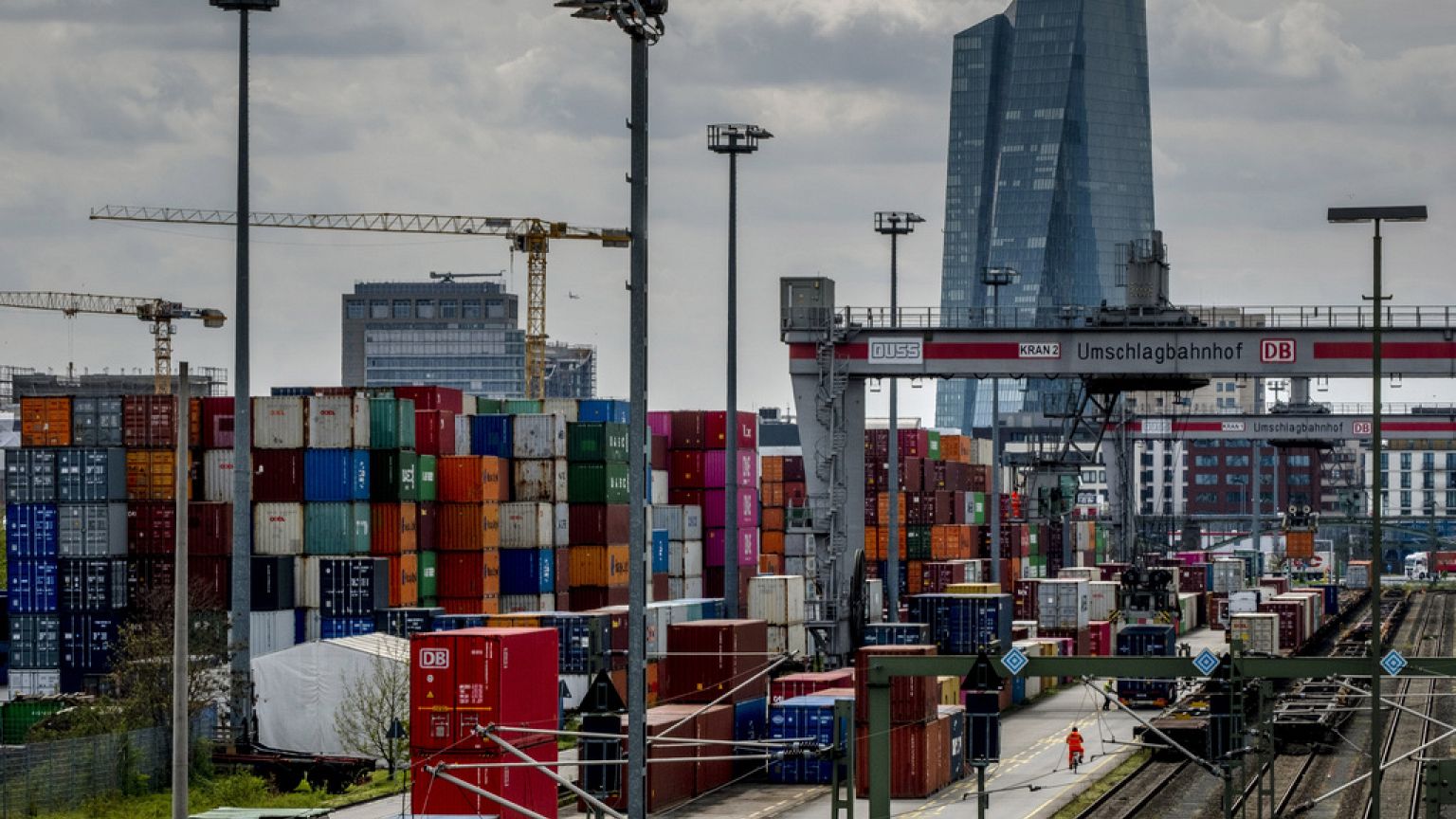
 Containers are piled up at a cargo terminal of Deutsche Bahn in Frankfurt, Germany, Wednesday, April 26, 2023.

How many times will Trump diddle around with his tariff hide and seek. It’s mot a game, Mr. “President.” It’s not “The Apprentice.”

Copyright Michael Probst/Copyright 2023 The AP. All rights reserved

By Doloresz Katanich

Published on 11/07/2025 – 7:30 GMT+2

Share this articleComments

One-fifth of the EU’s exports are heading to the US. Tariffs on the carmaking sector hit the German economy the most, but potential tariffs on the pharmaceutical one could cost substantially to the Irish economy.

Germany and Ireland are standing out as the two most exposed EU economies threatened by higher US tariffs, as Brussels works towards a trade deal with Washington, amid reports that pharmaceutical tariffs could be as high as 200%.

When US President Donald Trump imposed a new 25% tariff on auto imports and car parts in April, Germany was identified as the EU country with the most to lose. Brussels-based think tank Bruegel’s estimation at the time was that tariffs could cost 0.4% of the country’s GDP in the long term.

While awaiting a new EU-US trade deal, other details emerge that could put Ireland, Denmark, and Belgium, as well as other countries, in the crosshairs should Washington target the pharmaceutical sector next. 

Countries with the largest exposure to the US market

The overall impact on the European economy will depend on the actual tariff rate the US settles on and the EU’s response, but the blow will not be spread evenly. 

According to Bruegel, the EU economy is facing significant but manageable macroeconomic consequences.

They estimated in a report in April that, regarding the possible scenarios, the damage could be approximately 0.3% of the EU’s GDP, depending on the outcome of the negotiations. This compares to the 1.1% real GDP growth expected in the bloc in 2025, by the European Commission’s Spring Forecast.

Trade with the US is significant. In 2024, the United States was the largest partner for EU exports of goods, making up 20.6% of all EU goods exports outside the bloc.

Pharmaceuticals account for 15% of the EU’s goods exports to the US. They are followed by the auto sector.

Until there is more clarification on potential US tariffs on the pharma sector’s products, “the auto sector seems to be the most vulnerable to US tariffs as there doesn’t seem to be any major exemptions planned,” said Savary. The industry has been slapped with a 25% tariff in April. 

“Tariffs alone could shave around 8% off total EU trade volumes over the next five years,” said Rory Fennessy, Senior Economist at Oxford Economics, in a recent report.

Countries with the highest value in goods exports to the US, facing the biggest threat to their economies, include Germany, Ireland, Italy, France and the Netherlands. 

The German economy relies heavily on exports, boosted by the country’s motor vehicle sector. Nearly one-quarter (22.7%) of the total German exports are heading to the US. 

“Germany stands out as the major European economy likely to be hit hardest by US tariffs, and we expect GDP growth to slump in the second and third quarters,” Andrew Hunter, Associate Director and Senior Economist at Moody’s Ratings, said to Euronews Business.

Hunter also added that smaller economies, including Austria and others in central and eastern Europe, “which are heavily integrated into Germany’s industrial supply chains, will also be hit hard”.

According to Bruegel, after 2025, the long-term negative impact of the tariffs could be around 0.4% of the GDP in Germany, once “the effect has fully built up and initial short-term effects dissipated,” said Niclas Frederic Poitiers, Research Fellow at Bruegel. “For France, the average effect would be around 0.25% of GDP.”

Related

Uncertainty could lead to lost investments and jobs across the entire 27-member bloc. Hunter said that, “even for those countries where direct exposure to US exports is relatively limited, such as France or Spain, growth is still likely to be weighed down by global weakness and uncertainty.

Regarding long-term impacts, Ireland stands out as one of the most affected countries, as more than half of its goods exports (53.7%) are directed towards the US market. 

A lot depends on whether the pharmaceutical sector will be hit with tariffs. If so, “Ireland will be the EU economy most at risk from these tariffs,” said Mathieu Savary, chief strategist for our European Investment Strategy at BCA Research.

How pharma tariffs could hit the European economy in particular

The research-based pharmaceutical industry is a key asset of the European economy. It is one of Europe’s top-performing high-technology sectors.

It contributed €311 billion in gross value added (GVA) and 2.3 million jobs directly and indirectly to the European Union’s economy in 2022, according to a recent study by PWC. 

And the US market is crucial to the European pharma sector. According to the European Federation of Pharmaceutical Industries and Associations, in 2021, North America accounted for 49.1% of world pharmaceutical sales compared with 23.4% for Europe.

And more than one-third of EU pharma exports are going to the US. 

If the pharma sector is hit by a 25% tariff, as it is expected by Moody’s in the coming months, “most exposed would be a number of smaller European economies like Denmark, Belgium, Slovenia and Ireland, which are generally where we think the risks of recession in Europe are highest,” Hunter said. 

BCA Research’s chief strategist added that in this case, “Ireland is particularly exposed to this risk,” citing that exports to the US represent 18% of Ireland’s GDP, and pharma exports represent nearly 55% of Irish exports. According to BCA, the impact “could curtail 4% to 5% to growth over time”.

Bruegel estimated that Ireland’s cumulative real GDP loss could be 3% by 2028.

The think tank also singled out the country as the most vulnerable regarding the impact of the US tariffs on employment.

Regarding how vulnerable a country is to job losses in light of US tariffs, Bruegel said that Italy was the second most-exposed country, with a high exposure in transport equipment and a high level of exposed employment in fashion and car manufacturing. Italy would also have high exposure in pharmaceuticals.

Would there be a 200% tariff on pharma products?

Trump said on Tuesday that pharmaceutical products imported to the US are facing a 200% tariff, without disclosing any further details. 

According to BCA’s Savary, it is not likely, because “that would massively increase the cost of healthcare for US consumers, which is already a major issue for voters.” 

He sees it as a “strong message to foreign pharma companies to adjust their pricing down and invest into producing their drugs in the US.” Savary expects “that FDIs into the US and drug prices reduction announcements will be the end result of these talks and threats”.

“The pressure is now on for drug companies to expand US production facilities so they are effectively on the doorstep of American customers,” said Dan Coatsworth, investment analyst at AJ Bell.

Trump Doubles Metal Tariffs as He Presses Canada to Become Part of U.S.

BLOG EDITOR: Canada Says it will have None of this! Let see if the delusional Donald will handle this. We are in an alternative universe from anything we’ve seen. The question is who will suffer more but for the U.S. more like what will this first wave of retaliation do to his odd and destructive administration.

The president said he would double tariffs set to go into effect on Wednesday and threatened further levies, as he ramps up economic pressure on America’s closest ally.

Ana Swanson

By Ana Swanson

Ana Swanson covers international trade and reported from Washington.

  • March 11, 2025Updated 11:23 a.m. ET

President Trump escalated his fight with Canada on Tuesday, saying that he would double tariffs on steel and aluminum imports and threatening to inflict even more pain on one of America’s closest traditional allies as he pressed Canada to become part of the United States.

His comments sent jittery markets tumbling, with the S&P 500 down about 1 percent in early morning trading.

In a post on his social media platform, Mr. Trump wrote that Canadian steel and aluminum would face a 50 percent tariff, double what he plans to charge on metals from other countries beginning Wednesday. He said the levies were in response to an additional charge that Ontario placed on electricity coming into the United States, and he threatened more tariffs if Canada didn’t drop various levies it imposes on U.S. dairy and agricultural products.

“If other egregious, long time Tariffs are not likewise dropped by Canada, I will substantially increase, on April 2nd, the Tariffs on Cars coming into the U.S. which will, essentially, permanently shut down the automobile manufacturing business in Canada,” he threatened.

Tariffs in Trump’s second term in office

As of March 6

StatusCountryDescription
In effectFeb. 4China10% on all imports ›
In effectMarch 4Mexico25% on all imports ›
In effectMarch 4Canada25% on most imports, lower rate for energy ›
In effectMarch 4ChinaAdditional 10% on all imports ›
SuspendedMarch 6Canada and MexicoReprieve for goods that fall under the USMCA trade pact ›
PlannedMarch 12World25% on aluminum and steel ›
PlannedMarch 12CanadaAdditional 25% on aluminum and steel ›
PlannedApril 2WorldUnspecified tariff on all agricultural products
PlannedApril 2WorldUnspecified tariff on all foreign cars ›

Source: Peterson Institute for International Economics, Wells Fargo Economic Insights 

The New York Times

Mr. Trump went on to say that “the only thing that makes sense” is for Canada to become the 51st U.S. state.

The moves will significantly escalate a confrontation with one of America’s largest trading partners, and call into question Mr. Trump’s intentions for one of its closest allies. Canadian officials first thought Mr. Trump’s idea of absorbing Canada into the United State was a joke, but they have more recently begun to take the president’s threats seriously.

Mr. Trump spent much of his social media post on Tuesday essentially cajoling Canada to become part of America, writing: “This would make all Tariffs, and everything else, totally disappear. Canadians taxes will be very substantially reduced, they will be more secure, militarily and otherwise, than ever before, there would no longer be a Northern Border problem, and the greatest and most powerful nation in the World will be bigger, better and stronger than ever — And Canada will be a big part of that.”

“The artificial line of separation drawn many years ago will finally disappear, and we will have the safest and most beautiful Nation anywhere in the World,” he added.

Editors’ Picks

Big Drama Cannot Distract From Irrelevant ClothesHelp, I’m Marrying My Co-Worker and No One at Work Knows!Jam Like a King: Charles Releases a Playlist

President Trump said Canadian steel and aluminum would face a 50 percent tariff when coming into the United States.Credit…Nick Iwanyshyn/The Canadian Press, via Associated Press

Last week, Mr. Trump hit Canada and Mexico with sweeping 25 percents on all imports, before walking some — but not all — of those levies back a few days later.

Mr. Trump said the higher metal tariffs on Canada would be a response to a surcharge on electricity it exports to the United States. On Monday, Ontario, Canada’s most populous province, retaliated against Mr. Trump’s tariffs by adding a 25 percent surcharge to the electricity it exports to Michigan, Minnesota and New York.

Canada is in the middle of a political transition as it prepares to swear in a new prime minister, Mark Carney, an economist and central banker, to replace Justin Trudeau, who announced in January that he would be resigning after almost 10 years in office. Mr. Trump’s move would punish the entire country for a retaliation measure taken on by one province.

Vjosa Isai and Danielle Kaye contributed reporting.

Ana Swanson covers trade and international economics for The Times and is based in Washington. She has been a journalist for more than a decade. More about Ana Swanson

So What’s Wrong With Inequality?: the Case for Elites

Image Image


Image            Image


This website has from the outset seemed dedicated to the proposition that after a conservative interregnum of almost 50 years (1980-2008) the country was returning and would Inevitably return to a more Progressive-New Deal- Great Society mentality, updated for the decades 2 through 5 of the Twenty First Century. And this is certainly true.


But we will be less interesting, and just one of dozens of blogging talk-athons about the evils of socio-economic inequality and the selfishness of the rich, if all we did was present thought-clips promoting progressive ideas and agendas. Progressives cannot prevail, their progress will be sluggish—mark or words—if we cannot get inside the heads of the following: conservative Republicans (are their any other kind), Tea Party “Republicans,” Independents wary of too much Obama and Clinton (Hillary And Bill) kinds of changes, and last—but not least—the great 40-50% of adults who do Not regularly vote.

So we offer the following “contrarian” thought bullets using the voice of someone who is making a good case for “enlightened” or realistic elites—elites of wealth and accomplishment and the desire that government and academia not try to tamper with this existing order:


  • Item- Historically, from Egyptian, Mesopotamian and early Chinese times, an elite class has governed: this has been the natural order of things; they have held a vastly disproportionate share of their societies’ wealth, they were true one per-centers in every sense of the word


  • This elite class has been responsible for much of what we study in history: the building of great temples and public buildings, the forging of ever larger states and empires, the development of agriculture, irrigation, ever larger urban areas, learning and especially writing, making their territories safe for the religions and social practices of their choice…i.e. Pyramids, jungle and desert Temples, fortified towns, cathedrals and castles, great chateaux and manor houses: all of these are elite, one percent undertakings and accomplishments
  • Eventually something that would be called universities and physical infrastructure: roads, bridges, harbors, and facilities to foster trade and exploration would be promoted by this elite class, as would, of course, the arts of warfare: defensive and offensive
  • Many of the wealthiest “elite” Americans, and more so than Europeans or other population “zones—are only a few generations, perhaps only one—away from humble, even poor origins. Yet the Henry Fords and Andrew Carnegies, with no silver spoon-feeding, built great industrial empires and spread wealth and ingenuity+- around in different but impressive ways
  • It can be argued that to a degree outstanding talent and drive have fueled social mobility in America, the “Horatio Alger” phenomenon, though it is more accurate to say that these exceptional cases nourish a kind of cultural narrative that Americans seem to Need to believe in because there are many outstanding examples, and also many examples in which poverty, race, gender, and importantly bad luck or timing Prevented or impeded social mobility in spite of themselves
  • There is a plausible argument that concentrations of capital, from the Pyramids to cathedrals to railroads to Silicon Valley have made possible critical masses of construction, urbanization, exploration, invention and technology, economies of scale – to offer a somewhat random sample of wealth generated social “goods;” and of course it can be argued in all of these cases that the wealth concentrations have been abused, wasteful in many conspicuous consumption (read T. Veblen) cases
  • The flaws in the Iron Law of Oligarchy (Michels) and the tendency of wealth—not always fairly earned—to perpetuate itself, will be teased out in future posts, but we emphasize that the wealthy, the Social Darwinist’s, the “aristocrats or plutocrats” depending on your point of view have some compelling points to make, and these points must be taken seriously… Marx himself stood in awe of  “just pre-Gilded Age capitalism” as the most powerful social force of history to that time (the 1840’s to 1870’s) and then went on to critique it in devastating fashion, focusing partly on the cost to the working classes, who did not rise up—at least in the way he predicted… So we end with recognition of the considerable accomplishments of elites and then capitalist elites, and we will want to fast forward to the 21st Century and examine both the rationale for concentrations of wealth, for “neo-laissez faire”, and the considerable costs to the poor and middle classes and the unique Dysfunctions of many forms of inequality

ALSO SEE “THE RICH SHALL INHERIT THE EARTH” Atlantic Monthly, June 2014

p 36    ATLANTIC HOW THE RICH SHALL


PREDICTIONS FOR AMERICAN POLITICS 2030

2030logoPREDICTIONS FOR AMERICAN POLITICS 2030


It is dangerous to make predictions about American politics a few years in advance, about American society and economy and culture, as well. It is doubly dangerous to do it 15 years in advance. Yet, we will attempt to picture in bullet form, some broad trends we see coming by 2030 (note that one of the blog’s major projects is to construct a book which forecasts a gradual but inevitable return to progressive politics in America: 2013-2040, or, if you like, starting with the Clinton period, 1990-2040.

Even the Republican Bush interlude at least began with and featured fairly progressive (my recent republican standards) programs in some areas: an expensive prescription entitlement for Medicare, extensive foreign aid increases to combat AIDS, etc. “Compassionate Conservatism.” The theme came undone almost as soon as Bush took office, in no small part because of the 9/11 Catastrophe, but it is true that no Far Right Conservative has been or is likely to be elected President of the United States. Even a relatively moderate conservative Republican like Romney was soundly beaten in 2012, as had a Relative moderate, McCain, been trounced in 2008.


On the risks of prediction: Anyone who in 1965—the midst of the Civil Rights and Great Society movements, Medicare etc.– had predicted that in 15 years, a doctrinaire far right (for that time!, not by today’s standards), Ronald Reagan, would be elected would have been seriously questioned. That such a movement to the right would be seismic, and Lasting (at least until Clinton in 1993), would have been even more remarkable. The closest serious writer predicting such a movement, or at least the best known one, would have been Kevin Phillips, with his Emerging Republican Majority. But this book was not actually published until 1969, after the Democrats were defeated, in effect, by a conservative 1968 presidential vote that gave Richard Nixon a narrow victory, but a Truly conservative third party candidate, George Wallace, over 12% of the vote.

First we will lay out some landmark changes that will have occurred in American politics and society, by 2030, with only a brief, and mostly undocumented rationale fore these changes. (one of the nice things about ‘forecasting the future” is that you do not have to cite and footnote as meticulously!). In the following predictions, which we will expand and enlarge in subsequent articles, the basic “reform” is italicized in the first sentence, and developed a bit further after that.


PREDICTION ONE:  Healthcare will have been folded in the national political psyche for long enough (15+ years) that people will wonder what the controversy was about. Costs will have been brought down and benefits enjoyed by Democrats and Republicans alike. The still and always potent conservative money machines will have moved on to other issues, (slightly) less immediate ones, such as climate change. Odds are even that a single payer system will have been introduced or that a form of Medicare will be extended to the entire population. A certain segment of the population will be able to pay for healthcare out of pocket, but a small segment indeed. These will be catered to by boutique physicians with excellent, personalized and overpriced care, not unlike today. A valid question is: where will the money come from (?) for care expanded not only for more medical services, and more people, but more people because a larger percentage of the population will be “gray”—in the 65 yr. and older bracket. Some of the potential “dis”-economies discussed, e.g., in the Time Magazine March 12, 2013 issue (e.g. vastly overpriced in-hospital items like simple bandages and aspirin) will be modified and preventative medicine will begin to foster a healthier population through a variety of incentives. Economies in national defense will yield more funds, even if the U.S. “world mission” has not been substantially reduced. Energy and food waste costs will also begin to drop.


PREDICTION TWOStemming from the above, foreign policy doctrines like American exceptionalism and humanitarian in intervention are hard to predict, but it is safe to assume that in the next 15 years the fraying national infrastructure, urban decay, especially affecting the quality of public schools, income in equality leading to a “dual economy”, will be modified by incremental measures to produce a leaner, “meaner” military. As with prediction number one, this will only represent and acceleration of trends now in their infancy but underway.


PREDICTION THREETaxation will never reach 1950s-1960s levels, but taxes will cease to be a dirty word, the American tradition of pay as you go will come back in to style, modestly at first, and the Grover Norquists and Americans for Tax Reform will be less influential, more marginalized.  This simply equals moderately higher taxes. The simple and often asked poll question variants of “would you be willing to pay a small amount more in taxes for certain improved public services?” will be answered more in the affirmative.


PREDICTION FOUR: Supreme Court-  The morbid reality is that Justices Scalia and Kennedy will be 92 in 2030. If they have not died or retired, and our predictions about presidential and national more progressive politics come true, they will be very close to leaving the scene. They will be replaced by more liberal (especially in the case of Scalia) people more on the model of Sotomajor than some others. The equally important downside is that Justices Ginsburg and Breyer, moderates, will be 95 and 90, respectively, and will probably be replaced by people of similar views. Summing up, the court should move modestly to the left, all told, but this depends on a one or two term Conservative NOT being elected president in 2016, 2020, and 2024. Trends point in that direction.