5 BIG QUESTIONS FOR 2014

1. Will the progressive movement, well organized–especially on the web– be able to translate its messages and goals into electing actual Progressives?

2. How serious and lasting will the fragmentation in the Republican/Conservative camp be?

3. Assuming Sec. Clinton is the candidate to beat and that the election is hers to lose in 2016– there are no comparable Republicans, what will happen if she does not Run?

4. How do we explain the gap between the demographic trends toward progressive voters and the lock the Republicans seem to have on the House and to some extent the Senate?

5. As is common with 6th year second term presidents, interpretations of Obama on the progressive scale seem to vary widely. What can be said of him other than he was far more progressive than the alternatives and that he seems to have compromised broadly without much in return?  He may know something we do not.

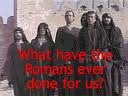
OBAMA AND MONTY PYTHON: WHAT HAS HE EVER DONE FOR US?

OBAMA AND MONTY PYTHON: WHAT HAS HE EVER DONE FOR US?

 ImageImageImage

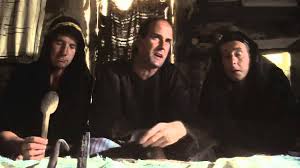
The 1979 movie “Life of Brian” featured the Pythons as “Jewish occupy-ees” in the catacombs grouchily debating the merits of Roman rule. The refrain “what have the Romans ever done for us” (soon to be echoed in “what has Obama and his pragmatic progressives done for us?”) is answered by tentative Jewish malcontents under Roman rule in Jerusalem venturing (in very British non Hebrew English): “the aqueduct, sanitation, roads, irrigation, medicine, education, wine, baths, safety to walk the streets, order, Peace”.  http://www.youtube.com/watch?v=9foi342LXQE .


The humor is there of course and the “rebel leader” (John Cleese) poses the kinds of arch questions, in a sense that Obama faces from left center and right—especially right! With the healthcare website woes, NSA controversies, and neat year end perceptions of weakness and “Annus Terribilis” the president and his sputtering “change you can believe in” may be being written off as in a what’s he done for us lately second term slump.


It pays to remember some of the following accomplishments—the list is partial—of the past few years. In fact rather than re-invent the wheel, let me list 50 accomplishments cited by Daily Kos blogger “JoelGP” , and then zero in on the most easily defensible ones. Of the list below I have highlighted the most impressive accomplishments in red. A few comments on the most prominent Red Items:


A.  Healthcare/ affordable care: whatever the flaws, poison pill conservative amendments to harm the law or capitulate to special interests, whatever the compromises, the law still greatly expands coverage for the formerly uninsurable, for 26 year olds, for many of the 50 million uninsured.


    1. The Stimulus: The book The New New Dealby Michael Grunwald highlights the potent boost to the economy through infrastructure programs and research initiatives of the 2009 $800 billion stimulus package. Critics have charged that the money was too much, too little (Krugman), contained money benefit special interests (don’t they all!), some waste. But Grunwald stresses that without the stimulus, the economic recovery would have been weaker and many excellent projects untried. As usual, the president gets little credit (except in books like Grunwald’s) for monumental benefits, but the record is there.


    1. Elimination of Osama bin Ladn- No comment, speaks for itself, many ways to interpret.


    1. Turned around U.S. Auto industry—there is little dispute about the fact of this, just that there were limits and flaws to the impact it had; its reality and boost for Detroit may have helped in the 2012 election,


    1. America’s image abroad, has fluctuated with Obama’s Cairo speech, where abroad you are talking about (certainly Africa and for a good while Europe saw large gains),  but the overall improvement in American esteem is rarely and weakly disputed, and made easier by the wasteland of American Image left by the Bush administration.


    1. Federal student loans have surely been improved
    2. Unconscionable veterans treatment / programs have indeed been improved if not optimized


+

1.      Passed Health Care Reform
2. Passed the Stimulus

3. Passed Wall Street Reform.
4. Ended the War in Iraq
5. Began Drawdown of War in Afghanistan
6. Eliminated Osama bin laden
7. Turned Around U.S. Auto Industry

8. Recapitalized Banks
9. Repealed “Don’t Ask, Don’t Tell
10. Toppled Moammar Gaddafi
11. Told Mubarak to Go
12. Reversed Bush Torture Policies
13. Improved America’s Image Abroad

14
. Kicked Banks Out of Federal Student Loan Program, Expanded Pell Grant Spending
15. Created Race to the Top.
16. Boosted Fuel Efficiency Standards
17. Coordinated International Response to Financial Crisis
18. Passed Mini Stimuli
19. Began Asia “Pivot”
20. Increased Support for Veterans

21. Tightened Sanctions on Iran
22. Created Conditions to Begin Closing Dirtiest Power Plants
23. Passed Credit Card Reforms
24. Eliminated Catch-22 in Pay Equality Laws
25. Protected Two Liberal Seats on the U.S. Supreme Court
26. Improved Food Safety System.
27. Achieved New START Treaty

28. Expanded National Service: Signed Serve America Act in 2009
29. Expanded Wilderness and Watershed Protection.
30. Gave the FDA Power to Regulate Tobacco.
31. Pushed Federal Agencies to Be Green Leaders
32. Passed Fair Sentencing Act
33. Trimmed and Reoriented Missile Defense
34. Began Post-Post-9/11 Military Builddown.
35. Let Space Shuttle Die and Killed Planned Moon Mission
36. Invested Heavily in Renewable Technology.
37. Crafting Next-Generation School Tests.
38. Cracked Down on Bad For-Profit Colleges.
39. Improved School Nutrition.

40. Expanded Hate Crimes Protections.
41. Avoided Scandal.
42. Brokered Agreement for Speedy Compensation to Victims of Gulf Oil Spill.
43. Created Recovery.gov.
44. Pushed Broadband Coverage.
45. Expanded Health Coverage for Children
46. Recognized the Dangers of Carbon Dioxide
47. Expanded Stem Cell Research.
48. Provided Payment to Wronged Minority Farmers.

49. Helped South Sudan Declare Independence.
50. Killed the F-22


Originally published DAILY KOS, JUNE 29, 2013

BOOK NOTE; Twilight of the Elites by Christopher Hayes

TWILIGHT OF ELITESTwilight of the Elites by Christopher Hayes

  • Hayes is an editor at The Nation magazine and has a program on MSNBC

Here is a highly reviewed book, well written and punchy, and focused less on partisan politics than in the rot and gridlock in the political system and dysfunction in the economic system—one of increasing inequality and, also, dysfunction.

We will review all of the books we have alerted you too in greater depth, but for now let’s settle for bullet points that  will take you to the book—an important one—and link it to Our Book’s projected themes.

**He starts out by pointing out that the system has failed by allowing median household incomes to Fall by 7% between 1999 and 2010. This is just the tip of a statistical iceberg that highlights the grinding of the middle class by a 1 or 10% of earners who have done far better than the 90% below them.

**He states that there is an existential failure of nearly “every pillar” of society: presumably government—including Congress the executive and bureaucracy and the courts, business, the press, educational institutions, medical ones, etc.


** He points out that the Iraq war killed 4500 American soldiers and 100,000 + Iraqis (almost certainly a too-low estimate), and cost $800,000,000 (no the figure is closer to 2 trillion when accounting for a broader range of expenses) and tops it off by observing the abject failure of response of all levels of government to Hurricane Katrina in 2005.

** He cites egregious failures within the business community/”Private Sector” that go beyond the general inequalities: Enron, WorldCom, the big three auto companies, Lehman brothers, the credit default swaps, Bernard Madoff etc.

  • He notes that the jump-starting of the auto industry under the bail-out, by the Obama administration in 2009, was “stunningly successful” but was perceived in a way that showed modest gains, hiding the fact that thing would have been far worse without these interventions

This is all in the Introductory Chapter 1. Chapter Two deals with Meritocracy and shows how a promising concept has been tainted by a wealth driven higher education system that increasingly favors more prosperous students, thus perpetuating the elites, among other effects. More on this fascinating book later: it serves to reinforce our argument that income inequality, which increasingly after the past 40 years, has wrought multiple ill-effects within the U.S. socio-economic system—and its politics.

NEW POSTS COMING

WE'RE BACK


AFTER A BRIEF HIATUS http://progressivefutureusa.com IS HAPPY TO ANNOUNCE 3 AREAS WHCIH WILL BE COVERED IN THE NEXT FEW DAYS. ONE IS A BOOKS ALERT FOR C. HAYES’S TWILIGHT OF THE ELITES (2012). ANOTHER IS A RFEVIEW OF SOME RECENT POINTS MADE BY PAUL KRUGMAN IN THE NY TIMES AND HOW THESE RELATE TO OUR RESERACH PROJECT. AND A THIRD IS A ROUND UP OF SOME RECENT DEVELOPMENTS IN THE NEWS CYCLE THAT AFFECT PROGRESSIVES AND WHY SHORT TERM UPS AND DOWNS ARE LESS IMPORTANT TO OUR PROJECT THAN THE “BIG PICTURE.” FLS

JOHN CASSIDY ON WHY OBAMACARE WILL WORK (ON ITS OWN TERMS)

Aside

This Blog site is really not about the day to day of Pres. Obama, or the 24-hour news cycle of his healthcare role-out woes. It is about the big picture of the inevitability of a New Progressive arc in American politics. But it does help to look in on the pulse of What’s Happening Now, from time to time, learning from mistakes and studying the often bumpy path to enlightenment. More features and book reviews will come soon on related topics.
From John Cassidy’s Blog reprinted in the New Yorker ONLINE Oct 23 2013
October 22, 2013

Why Obamacare Will Work (on Its Own Terms)

Posted by
doctor-obamacare-580.jpegEvery day, it seems, more damaging details emerge about the rollout of the federal online insurance exchange at the heart of the Affordable Care Act. Today’s revelation, courtesy of the Washington Post: days before the launch, officials and government contractors conducted a test of the new Web site, during which it crashed when just a few hundred people tried to log in simultaneously. But the Obama Administration went ahead with the rollout anyway, only for the site to seize up just hours into October 1st.

Until the Administration gets the site working properly, this story will dominate the news and overshadow the underlying reality about Obamacare: judged on its own terms, the new health-care system is likely to work. In the coming decade, tens of millions of Americans will end up using the new health-insurance marketplaces—both the federal one and the state ones—and the number of uninsured will drop quite dramatically. Not everybody will end up being covered, but, excluding unauthorized immigrants, who won’t be eligible to use the new system, it seems likely that, at a minimum, the proportion of people who are uninsured will be cut in half.

What is the basis of these statements? Not any particular affection on my behalf for the new system, which largely preserves the private-insurance model that has proved so costly and inefficient. As somebody who grew up using the British National Health Service, I’ve always been more attracted to a single-payer system that guarantees coverage. (No, my Republican friends: introducing such a system wouldn’t amount to imposing an alien European-style socialism on the American public. Under the rubric of Medicare, almost fifty million Americans already enjoy, and value greatly, precisely this type of system.)

My confidence that the Affordable Care Act will meet its coverage objectives is based on a belief, shared by most economists, that financial incentives, if they are big enough, tend to work. Obamacare, once it gets up and running, will provide very large incentives for people to get coverage—subsidies of as much as ten thousand dollars a year for some low-to-middle-income families. Over time, the presence of these incentives, which include substantial fines for individuals who refuse to buy coverage, will almost certainly overcome any glitches or difficulties in the system of enrolling. When people think they are getting a good deal, they are willing to put up with a bit of hassle. And for many of the uninsured, Obamacare is a very good deal.

To make the new system work, the Administration is spending a great deal of money—about $1.4 trillion over the next ten years, according to the latest analysis by the Congressional Budget Office. About half of this will go toward subsidies for people who buy insurance policies on the new exchanges. The rest will go toward expanding Medicaid, the health-care system for the poor and indigent, which is jointly funded by the federal government and the states.

(Note, though, that despite the substantial expenditures it involves, the Affordable Care Act won’t increase the budget deficit by $1.4 trillion, or anything near it. That’s because it also features hefty cuts to the Medicare budget and a number of tax increases that will raise substantial amounts of new revenue. Indeed, the C.B.O. says that, over all, the Act will reduce the deficit slightly during the next ten years.)

The price of obtaining coverage on the new exchanges, and the precise subsidies on offer, vary from city to city and state to state. But with the aid of a very helpful online “subsidy calculator” from the Kaiser Family Foundation, I obtained a few representative figures. Take, for example, a family consisting of two parents (both age thirty-five) and three children that has an annual income of forty thousand dollars and lives in Nashville, Tennessee. According to the calculator, a silver insurance plan for such a family—i.e., one that provides more coverage than a bronze plan but less than a gold one—would cost $10,148 a year. The federal government would cover eighty-five per cent of that sum, which is $8,662. The actual cost to the family would be $1,485, or about a hundred and twenty-five dollars a month.

Generally speaking, smaller families will get less help from the government, but many of them will still receive sizeable subsidies. Consider a single mother of one living in Denver, Colorado, and earning thirty thousand dollars a year. A silver plan for her and her child would cost $4,366 a year, according to the calculator, but a federal subsidy of $2,567 would bring her actual cost down to $1,799, which is a hundred and fifty dollars a month. With these sorts of subsidies in place, it is hardly surprising that the new online exchanges have received a lot of visitors—in some cases, too many for them to handle.

Many single people and folks who earn a decent salary won’t get any subsidies at all. (If you are a single person living in New York or Los Angeles and earning fifty thousand dollars a year or more, that’s you.) But thanks to the individual mandate, such people will face substantial penalties if they don’t buy insurance. For 2014, the Obamacare “fine” has been set at a lowly introductory figure of ninety-five dollars per adult. Thereafter, though, it will climb steeply. From 2016 onwards, it will be six hundred and ninety-five dollars per person or two and a half per cent of family income—whichever is greater. For a single person earning eighty thousand dollars a year, that’s two thousand dollars. In some parts of the country, such a person would find it almost as cheap to buy coverage as pay the fine.

Maybe I’m wrong, but my feeling is these carrots and sticks will be sufficient to persuade most Americans to sign up for health insurance. Indeed, one of my concerns is that the new exchanges will prove too popular, and end up costing taxpayers a lot more than planned. As municipalities and private companies gain more knowledge about how the Affordable Care Act works, they will have an incentive to shift some of their employees and retirees from their existing plans onto the exchanges, where they may be eligible for federal subsidies. Chicago and some other cities have already indicated that they are thinking along these lines.

And let’s not forget Medicaid, which frequently gets ignored in the debate, and which is the cheapest and most effective way to provide low-income people with health care. Under the Affordable Care Act, Washington will provide states with enough money to cover almost anybody whose family earns less than a hundred and thirty-eight per cent of the poverty line. (For a family of three, that’s about twenty-six thousand dollars a year.) Last year, the Supreme Court decided that states could opt out of this expansion, if they wished to, and more than twenty G.O.P.-controlled states have done so. But the federal government is offering the states such a good deal (for newly eligible Medicaid recipients, it will cover all the costs until 2016 and at least ninety per cent of them thereafter) that Republican resistance is weakening.

On Monday, a panel of state lawmakers in Ohio approved the decision of Governor John Kasich, a Republican, to accept the additional money from Washington, which, according to a report by the Kaiser Family Foundation, will enable the state to cover an additional two hundred and seventy-five thousand residents, and cut the proportion of Ohioans who are uninsured by almost two-thirds. As time goes on, and voters in Republican states realize that their elected officials are leaving a lot of cash on the table that could be used to help their neighbors, it seems likely that other states will follow Ohio’s lead. Just how many more Americans across the country will end up being covered by Medicaid is anybody’s guess, but it’s sure to be a large number. (For what it’s worth, the C.B.O.’s estimate is thirteen million by 2023.)

If you put together the subsidies, the fines, and the expansion of Medicaid, you have a formula for substantially reducing the number of uninsured. Here, too, attempting to make precise predictions is perhaps silly. But the C.B.O., which is legally obligated to provide lawmakers with forecasts, reckons that between now and 2023 the number of uninsured Americans will fall from fifty-five million to thirty-one million. Excluding unauthorized immigrants, the agency says, the proportion of the population with coverage will rise from eighty-two per cent to ninety-two per cent.

Would such a jump justify all the cost and effort that has gone into the Affordable Care Act? Could it be accomplished more cheaply in other ways? And will the reforms slow down the over-all growth in health-care spending? These are questions that can be debated. But as far as I can see, there is little doubt that Obamacare will succeed in its primary aim of expanding health-care coverage.

Photograph by Brian Shumway/Redux.

Keywords

“PROGRESSIVE EDUCATION TESTING” NOT REALLY SO PROGRESSIVE

    1. Scroll down and check this out to watch a feisty New York teacher’s union lady give hell to the State Education Dept. head for the damage mandatory testing is doing to teachers and students. Lasts two minutes+ and is a funny look at democracy in action.
    What’s on your mind?
  1. .

http://thepjsta.org/2013/11/13/pjsta-president-beth-dimino-speaks-at-ward-melville-high-school/

JEB BUSH IN 2016? or…

HILLARY CLINTONjeb bushJEB BUSH IN 2016?

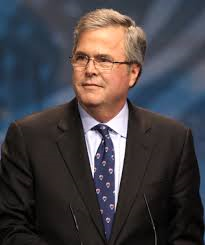
In our ongoing series on provocative political articles and opinion pieces that may help inform the reader of the thrust of our research and eventual book, we turn to a just unearthed from a pile of papers, Frank Bruni column from the Sunday New York Times, August 18th of this year (p. 58, Week in Review ) , entitled the “The Past’s Future Republican.”  It is a portrait of Jeb Bush, who carries—some might say is burdened by—the dynastic Bushes, the last name of the last two Republican presidents, Bruni reminds us. The op-ed piece is as valid now as it was two and one half months ago.

The thesis of the article, with our own gloss added, is that a conservative Republican—read “Romney and rightward”– has next to no chance of beating a strong Democrat to the White House. The names mentioned, apparently seriously, by the press as possible contenders for the Republican nomination are people like Marco Rubio, Ted Cruz, Rand Paul, and Paul Ryan, at least from the Congressional wing of the party. New Jersey’s Gov. Chris Christie, is thought more electable. Bruni implies and we say outright, that none of the potential contenders listed or anyone remotely that conservative has Any chance of winning against a strong Democrat. Increase that by a power of three if that strong Democrat is the overwhelming current favorite, Hillary Clinton

Our argument, based on Bruni’s case for Bush as a moderate pragmatist, critical of the scorched earth orientation of many Congressional Republicans, is that a Tea Party or even traditional Far Right Reagan-Goldwater-Buckley style Republican can be reasonably sure, barring scandal or felony revelations during the campaign, of winning 35 to 40 % of the (2012 based) national electorate. Hard core support for such a candidate we would put in the 30% range.

The same could be said of a respectable moderate to progressive Democrat such as an Elizabeth Warren or a Joe Biden (perhaps someone younger). At least 30% Bar-Nothing national support from the left-center-progressive end of the voter spectrum and, quite likely, 40% of the vote against any Republican, except perhaps, a Jeb Bush. Bruni notes that Bush’s appeal is enhanced by his Mexican wife, his command of Spanish, and his strong showing with Hispanic voters in Florida.

So imagine a Bush race (and he does have both the baggage and limited appeal of his older ex-president brother) against Any-Democrat-But-Hillary and, in our polarized political culture, a probable 20% of the electorate truly “in play”—in theory “undecided.” A dusted off, thoughtful, politically adult (at 63 in 2014) like Bush would be markedly more likely to cut into that “independent”, at play 20% than the others. (Clint Eastwood, having been born 20 years too early). Bruni notes that the dynastic factor of a “Third Bush” would be offset by a likely Second Clinton candidacy.

Which brings us to the obvious sunglasses favoring towering woman (“elephant” we avoid) in the room, Hillary Clinton, clear “heir-apparent”—mangled metaphor we suppose—to Pres. Obama. Now we get to progressivefutureusa.com’s deeper interest in such a contest. Clinton, clearly has the early advantage, the unbeatable Democratic resume’, it is conceded that the nomination is hers if she wants it, and that she would be  very difficult to beat for reasons we need not repeat here. Any Democrat with rock star name recognition such as hers, and a “redeemed—for some” “never that problematic—for others” husband, former President Bill, would surely unite Republicans, but then look how Obama united Republicans—or Romney for that matter—and consider the results. Given her senatorial and Secretary of State “latest careers”, that she is a woman forced to step aside in 2008, barely, for a magnetic African-American (post racial?) candidate (a sort of echo of the 1870 failure of women to get the vote along with black males in amendment XV.

In short, she would be a candidate that, barring the unforeseen (the latter does happen), could count on scoring in the high 40+ percent range with even a front porch (Chappaqua?) campaign, except these are nostalgic relics of the political past (1956? 1984?). But caution: some polls show NJ Gov. Chris Christie running a respectable 4-6 points behind her in a very early trial heat. Citizens United etc., may facilitate the reintroduction of Jeb Bush as a viable alternative to Christie. For progressives, it is unthinkable that either of these two relative lightweights would stand a chance against Sen./Sec./Ms. Clinton in a rational political universe.

But, to invert a droll political nostrum about Reagan and Nixon (and others): the Landscape may be littered with the corpses of those who, three years from now, think that Hillary’s will be a coronation not an election. Consider that John McCain and Mitt Romney were solidly beaten by Obama, but they suffered no landslides. We will have occasion to discuss this further, it is enough now to say that 1. Hillary Clinton will be hard but not impossible to beat if facing a Jeb Bush, and 2. the rosiest scenario for Democrats would be the nomination of Any-of-the-Above Hyper-conservative Republicans. The country might, we say Might, still be center-right, but it is moving leftward, if ever so slowly. Our book in progress says that the pace of this shift will increase, that the shifting of political tectonic plates will be just that, Tectonic, by the 2030’s.

The first part of the cited Frank Bruni August piece follows below:

Op-Ed Columnist

The Past’s Future Republican


Ben Wiseman

By FRANK BRUNI

Published: August 17, 2013 340 Comments

  •  

LET Rand Paul have his epic filibuster and Ted Cruz his scowling threats to shut down the government. Let Chris Christie thunder to a second term as the governor of New Jersey, his hubris flowering as his ultimate designs on the White House take shape.


Earl Wilson/The New York Times

Frank Bruni

Readers’ Comments

Readers shared their thoughts on this article.

Jeb Bush, lying low in the subtropics of Florida, has something they don’t: the unalloyed affection of many of the Republican Party’s most influential moneymen, who are waiting for word on what he’ll do, hoping that he’ll seek the 2016 presidential nomination and noting with amusement how far he has drifted off fickle pundits’ radar, at least for the moment.

Politics today has a shorter memory than ever. It also has a more furious metabolism, which Bush hasn’t fed much since March, when he was promoting a new book on immigration and created enormous confusion about whether he does or doesn’t support a pathway to citizenship for immigrants who came here illegally. (He later clarified that he does, with caveats, and even later praised immigrants for being “more fertile.”) That awkwardness gave some of his supporters pause, as they wondered whether he’d been too long out of the fray and was too clumsy for the split-second hyperscrutiny of the Twitter era. He hasn’t run for anything since 2002, when he was re-elected as the governor of Florida, an office he left in early 2007. A whole lot has changed since.

But with the exception of that immigration mess, Bush has been a more articulate advocate of a new tone and direction for the Republican Party than have Paul, Cruz, Christie or others currently in the foreground of the 2016 race, which has already begun, on both sides of the aisle. (Hillary Clinton gave a big policy speech last week and has another already announced.)

He has signaled more willingness for fiscal compromise with Democrats than Paul Ryan and Marco Rubio, for example, have. He has rightly emphasized the importance of social mobility to America’s fortunes and has rightly sounded an alarm that such mobility is on the wane.

At 60, he’s older than any of the five potential Republican presidential candidates I’ve already mentioned or than Scott Walker (don’t forget him), Bobby Jindal or Rick Santorum. His face is less fresh, thanks largely to a surname shared with the party’s last two presidents.

But here’s the first great irony, oddity, oxymoron or whatever you want to call it of the 2016 race: if Republicans care about safeguarding their future, their wisest and best bet may be to reach back into their past. In a pack not exactly brimming with moderate, sensitive voices, Bush’s stands out as less strident, more reasonable and more forward-looking than his potential rivals’.

Lately the news media’s attention has focused on Paul, Cruz and especially Christie, who was just on the cover of New   York magazine and has drawn headlines with veiled and unveiled swipes at fellow Republicans. He’s serving notice, as he did with his embrace of President Obama during Hurricane Sandy, that he puts less stock in party etiquette or ideological purity than in the practicalities of governing and the necessities of winning.

But he’s also scaring some Republican power brokers, and not solely or even mainly because he’s iconoclastic. It’s because he’s so very loud, so very proud, a ticking time bomb of self-congratulatory bellicosity and gratuitous insult. Would he really be the best nominee?

In a meeting with Republicans in Boston last week, he prematurely lashed out at several possible competitors, including Jindal, whom he no doubt had in mind when he reportedly said, “I’m not going to be one of these people who’s going to come and call our party stupid.” No, Christie’s much, much too tactful for that.

Bush has registered concern with the way the party can come across as “anti-science.” He has also referred to it as “the party of no,” correctly noting that Republicans right now are defined negatively, by all they’re against.

Copyright 2013 NYT

  •  

ARE THE REPUBLICANS BECOMING TWO PARTIES?

a-party-divided1It is risky to speculate from a short time victory for Obama in reopening the government and raising the debt ceiling, But there is evidence that this might be a critical case illustrating the tension caused by the Tea party faction in undermining republican unity. We have predicted that the Tea Party faction would become increasingly marginalized and become largely a deep south and isolated redoubt over time. But, to its political, if not moral credit, the faction revealed continued influence in  the mainstream trajectory of Republican strategy during the shutdown crisis. The question is this: will the zealous but energized far right faction ultimately be a drag on the party’s national prospects in 2014 and 2016? We think yes. In fact we will be on the watch for signs, identified by some, that the power of this faction may drag the party down disastrously. The Democrats’ problem is as always, skill at softball in a hardball game. So far this seems to be working– but barely. Can progressives take advantage of conservative tactical errors? Here’s what the WASHINGTON POST’S AARON BLAKE AND SEAN SULLIVAN HAD TO SAY TODAY (ITEM FOUR IN A FIVE POINT LIST OF CONSEQUENCES OF THE BUDGET SETTLEMENT):

“4. The Republican Party increasingly looks like two parties. A Pew poll this week laid bare a worst-case scenario for the GOP — that their party is, in fact, two parties riding under the same banner (at least for now). Case in point: Republicans who back the tea party view Sen. Ted Cruz (R-Tex.) favorably by a 74-8 margin, but among all other Republicans, views of Cruz are 25 percent favorable and 31 percent unfavorable. That’s a massive split, as it’s very rare that any segment of one party views one of their own more negatively than positively. The Pew poll also suggested more moderate Republicans are tiring of the tea party. None of this is to say the GOP is going to split in two, but it’s clear there are two wings of the party that are on hugely different pages right now.” Washington Post, BLAKE/SULLIVAN, 10-18-2013 
http://www.washingtonpost.com/blogs/the-fix/wp/2013/10/18/the-five-biggest-takeaways-this-week-from-the-budget-and-debt-ceiling-standoff/?wpisrc=nl_politics

TEXAS AS A PURPLE, THEN BLUE STATE?

Texas-as-a-Blue-StateA major game changer for 2024 ? (3 presidential election cycles from now). We do not often reprint in full projections or articles from other sources entirely, but though the debate about the impact of rapidly increasing Hispanic populations and aging white conservative populations in Texas has fascinated progressive pundits. And, we suspect, caused some unease among conservative ones! Here is a sample from the “Chachy” blog in DAILY KOS, citing some other sources, that forecasts the possibility of Texas becoming a presidential swing state by 2024 and possibly blue by 2028. Because this weblog is dedicated to interesting projections of progressive / New progressive/ read: usually Democratic prospects for the next 30-40 years it is highly relevant.

With Texas as the second most populous state, a rather long term (12-16 years) projection of Democratic presidential potential would be a major game changer. With NY and CALIFORNIA as predictably Democratic, a Democratic Texas would radically alter the presidential landscape. But can this happen? read on and in upcoming posts we will weigh the credibility of this. Note that the “KOS” blog-post and the NEW REPUBLIC and other more skeptical commentary originally appeared in July of this year. Nothing major has changed.

The other day I wrote a comment in which I tried to project future voting trends in Texas. This diary is a lot like that comment! But with more words. And a few images.

First, a little bit of background on Texas demographics. As of the 2010 census, the state was about 45% white, 38% hispanic, 11% black, and 6% other, mostly Asian. That’s compared to 53/32/11/4 in 2000. State’s getting less white, more hispanic. But you knew that.

(Map is from the NY Times.) People look at such numbers sometimes and say Whaaaaa?? How are Democrats not competitive in Texas with numbers like that? That’s f’ed up, dog! Well, there are a couple of reasons. For one thing, about 10-15% of the Hispanic population are non-citizens. Here’s where the undocumented population lives, in case you’re curious:

(This and the next image are from a presentation (pdf) by the state demographer.) You’ll notice that most undocumented immigrants live in the Houston and Dallas metros, whereas the vast majority of hispanics that live in the border counties are citizens. This goes a long way towards explaining, incidentally, why hispanic turnout always seems so feeble in Texas’ two biggest cities.

All right, so there’s that. But an even more important factor is the age structure of the state:

Setting aside the citizenship issue, the hispanic population skews very young – a lot of them are just too young to vote. (Plus the ones who are eligible are less likely to vote, just because young people are more likely to stay home on election day. Whereas old folks like nothing more than to vote. Man, they just vote, vote, vote! Vote like there’s no tomorrow (which there isn’t for old folks, of course). And just look how white old folks in Texas are!) All of which is to say, the citizen voting age population substantially lags the demographic change which Texas has seen in recent years.

*     *     *

Okay, so. Here is a study from the William C. Velazquez Institute that looks at the demographic future of the US, California, and Texas, including predictions of citizen voting age population by demographic group. And here’s a graph they made for Texas:

CVAP-wise, here are the percentages they give for whites/hispanics/blacks/others by year:

2010: 57/26/13/4
2015: 51/31/14/4
2020: 45/36/14/5
2025: 35/44/14/7

(The numbers for whites are inferred, because hispanics overlap with whites somewhat in the census data WCVI is using – that’s why numbers for whites are higher here than they are in the graph above.)

You can see the discrepancy from overall population figures – a white/hispanic ratio of 45/38 in the overall population becomes 57/26 in terms of CVAP. But the question I want to answer is: what do these numbers say about future voting patterns in Texas?

Well, in 2008, Obama won 26% of whites, 63% of hispanics, 98% of blacks, and, let’s say, 60% of others (just guessing on that one). In 2010 as a gubernatorial candidate, Bill White got 29% of whites, 61% of hispanics, 88% of blacks, and who knows how many of the others. So if we’re looking at expected performance for a fairly generic democratic candidate for federal office in Texas in a neutral year, I think we can expect they’d get about 27% of whites, 62% of hispanics, 90% of blacks, and that made up number of 60% for others.

So if we plug in those numbers to the demographic profile, this is the percentage of the two-party vote the Democrat would get:

2010: 45.6
2015: 48.0
2020: 50.1
2025: 53.5

This makes it seem that Dems ought to be competitive in Texas statewide races by the end of this decade, and solidly favored by the mid-’20s. However, this forecast would basically represent turnout nirvana for Democrats, because hispanics do not vote at anywhere near their CVAP numbers.

(As an aside – this is generally treated as a problem of “getting out the hispanic vote.” But I wonder about this. The hispanic population is disproportionately young and poor, and if you corrected for these two variables, I wonder if there would be any depressed turnout effect attributable simply to hispanic identity. Someone should look into this!)

Anyways, to illustrate the point: according to this report, the CVAP breakdown in Texas ca. 2008 was about 58/26/13/3, but according to exit polls turnout was 63/20/13/4. Given the numbers I used above, that works out to 43.5% for the Dem – just slightly less than Obama’s actual share, since he of course totally dominated the black vote.

So what would be more realistic turnout projections? Maybe something like this:

2010: 64/19/13/4
2015: 58/24/14/4
2020: 52/29/14/5
2025: 42/37/14/7

Here I just added 7% to the white vote share and subtracted the same amount from the hispanic vote share. Pretty crude, but it’s consistent with continuing underperformance for hispanic turnout, yet slowly improving hispanic turnout relative to population share. (Also I should mention that these are predictions for turnout in presidential elections, though obviously 2020 is the only year that will actually have such an election.) So what do these numbers yield given the same assumptions given above about Dem performance among each group? The following:

2010: 43.2
2015: 45.5
2020: 47.6
2025: 51.1

So if we assume Dem performance remains static among each demographic group for the next 12 years, Texas ought to be a genuine swing state by the 2024 election. We might even have a shot in Texas by 2020, depending on how that year plays out.

But I wonder about these numbers a bit. In particular, I’m surprised at the rate at which the CVAP in these projections approaches overall population numbers. As I mentioned above, in 2010 Texas was 45% white, 38% hispanic, 11% black, and 5% other, meaning the white CVAP was 12 points higher than overall population, but for 2025 the population breakdown should be about 34/48/11/7, implying a white CVAP only 1 point higher than total population. That don’t make no sense! (Or at least, it seems unlikely to me.)

I’m thinking, then, it would be prudent to bump up the white numbers for expected turnout by a bit – say, +2 for 2015, +4 for 2020, and +6 for 2025, and subtract the same for hispanics. Then we get turnout that looks like this:

2010: 64/19/13/4
2015: 60/22/14/4
2020: 56/25/14/5
2025: 48/31/14/7

Which yields Dem vote shares of:

2010: 43.2
2015: 44.8
2020: 46.2
2025: 49.0

Okay, there you go. If this diary is offering a prediction, this is it. And what this prediction says is that Texas ought to be on the cusp of competitiveness by 2024 – and, though the numbers don’t go this far out, it’s clear that the state ought to have a gen-u-ine Dem+ PVI by 2028. A slight one, but still.

And if you’re wondering if there are precedents for this sort of demographics-based partisan shift – I think there are. California and Nevada have been undergoing many of the same demographic trends as Texas: rapidly growing minority populations, especially hispanics, etc. These states just may be a bit farther ahead on the curve (and of course they started from a much higher Democratic base). And here are what the Democratic margins have been in California relative to the national vote over the last four elections (1996-2008): +4.4, +11.3, +12.4, +16.8; for Nevada the numbers are -7.5, -4.1, -0.1, +5.2.  Whereas I’m predicting that between the elections of 2012-2024, Texas could go from roughly -12.4 to -9.8 to -7.6 to -3.1. As you can see, the changes in voting tendencies that have actually occurred in California and Nevada are greater than what I’m predicting for Texas. It can and does happen!

*     *     *

And, since I haven’t yet procrastinated enough from what I should be doing right now, here’s one more thing to consider: there is, of course, no reason to assume that party performance won’t change at all among these different demographic groups over the next 15 years. Shoot, that’s enough time to form totally new party coalitions. So these assumptions about party performance are hardly set in stone. Nonetheless, if we were going to predict a way party performance might change, we could look at how in-migration is changing the character of the Texas electorate. Non-whites are already factored in, since hispanics, blacks, etc. who move to Texas figure to vote about the same as those who already live there. On the other hand, along with all the junk in their U-Hauls, white migrants to the Lone Star state might bring along some new voting patters as well. And these are not trivial numbers of people:

The trends you see here have continued into this decade. And the number one source of these migrants is California, followed by states like Arizona and Florida, as well as the big cities of the northeast and midwest. These are places where white voters vote more like 40-50% for Dems.

Now, I actually think (contrary to some) that Democrats may have a bit farther to fall with rural whites, at least in east Texas. But let’s say they gain that back and a little more with the more moderate leanings of new migrants, so that the Dem share of the white vote goes up about a point every three years. (This might be optimistic, but whatever – I’m ending on a high note.) That would give us the following Dem performance:

2010: 43.2
2015: 45.9
2020: 48.1
2025: 51.4

Boom. Over 50% by the 2024 election. There you go.

Okay, I’m done. Jesus, that took for goddamn ever. I’m never writing a diary again.

Update: Just came across a post that looks at hispanic CVAP for each of the top 35 cities in Texas. It affirms what I said toward the beginning of this diary: very low CVAPs in Houston and DFW, considerably higher numbers elsewhere. Bonus observation from Greg:

Interesting differences among the major cities, to be sure. What’s even more interesting is applying a bit of algebra to the numbers provided, which show that Houston’s <18 population is 87.3% citizen [compared to 47.3% of the 18+ population). The trend is replicated throughout the state, with the statewide number for all cities being 92% for <18 Hispanics.

What this means is that the present hispanic population is something of a paper tiger in voting terms (as I’ve emphasized here) but that future growth in hispanic population most certainly will not be.

POST-2012 UPDATE: In 2008, whites were 63% of the electorate and went 73-26 for McCain. Blacks were 13% and went 98-2 for Obama. Hispanics were 20% and went 63-35 for Obama.

But Obama clearly did better with hispanics this year – almost every overwhelmingly hispanic county swung towards him, even though he did worse overall in the state.

And Lisa Falkenberg said this:

In Texas, the best data so far show a 70-30 split for Obama among Hispanic voters, according to Rice University political science chairman Mark Jones. Romney performed several points worse than Sen. John McCain did in 2008. At the same time, Jones points out, Hispanics became a larger share of the vote in Texas, going from 20 percent in 2008 to 25 percent in 2012.

That’s a big bump. So if this is right, what percentage of whites did Obama win? Well, Romney won the two-party vote 58-42. So if the electorate was 25% hispanic (70-30 Obama), 13% black (95-5 Obama), 3% other (60-40 Obama), then whites would be 59% and they would have voted…

82-18 for Romney.

Yikes. That’s pretty ugly.

But Falkenberg’s claim that the electorate was 25% hispanic seems a bit high to me, especially given that turnout was generally down in the state. Based on the numbers above, I would have expected hispanics to be about 21-22% of the electorate this year. If they were 22% and going 70-30 for Obama, then Obama would have won more like 20% of the white vote. That’s still lower than any other recent Dem presidential or senate candidate has done, but still seems believable to me.

Assuming a future composition of the Texas electorate of 56/25/14/5 W/H/B/O for 2020 and like 50/30/14/6 for 2024, then if 70-30 for hispanics and 20-80 for whites becomes the “new normal” in Texas, the republican would win 56-44 in 2020 and 53-47 in 2024.

In 2028 the state would be a toss-up.

Meanwhile, The state is out with population projections through 2050. They offer three migration scenarios; taking the middle one, and filtering for the over-18 population, here are white/hispanic/black/other percentages (2010 is based on the census):

2010: 50/34/11/5
2015: 47/36/11/6
2020: 44/38/11/6
2025: 41/41/11/7
2030: 39/43/11/7
2035: 36/45/11/8

…well, you get the idea. The CVAP numbers will of course be lower for hispanics and others, and higher for whites and blacks, but the gaps between VAP and CVAP will probably gradually narrow over time, as young hispanics are far more likely to be citizens.

Alternatively, if immigration remains as high as it was from 2000-2010, you get:

2010: 50/34/11/5
2015: 46/36/11/6
2020: 42/39/11/7
2025: 38/42/11/8
2030: 35/45/11/9
2035: 32/47/11/10

Though in this scenario I would imagine the gap between VAP and CVAP wouldn’t narrow so much. At any rate, though the hispanic population will pass the anglo population around 2017 or 2018, that probably won’t happen for the 18+ population until about 6-7 years later, and later still for CVAP (and later still than that for actual turnout, of course)
ORIGINALLY POSTED TO CHACHY ON MON JUL 30, 2012 AT 07:11 AM PDT.

ALSO REPUBLISHED BY TEXKOS-MESSING WITH TEXAS WITH NOTHING BUT LOVE FOR TEXANSSOUTHERN ACTIONCOMMUNITY SPOTLIGHT, AND DAILY KOS.

PREDICTIONS FOR AMERICAN POLITICS 2030

2030logoPREDICTIONS FOR AMERICAN POLITICS 2030


It is dangerous to make predictions about American politics a few years in advance, about American society and economy and culture, as well. It is doubly dangerous to do it 15 years in advance. Yet, we will attempt to picture in bullet form, some broad trends we see coming by 2030 (note that one of the blog’s major projects is to construct a book which forecasts a gradual but inevitable return to progressive politics in America: 2013-2040, or, if you like, starting with the Clinton period, 1990-2040.

Even the Republican Bush interlude at least began with and featured fairly progressive (my recent republican standards) programs in some areas: an expensive prescription entitlement for Medicare, extensive foreign aid increases to combat AIDS, etc. “Compassionate Conservatism.” The theme came undone almost as soon as Bush took office, in no small part because of the 9/11 Catastrophe, but it is true that no Far Right Conservative has been or is likely to be elected President of the United States. Even a relatively moderate conservative Republican like Romney was soundly beaten in 2012, as had a Relative moderate, McCain, been trounced in 2008.


On the risks of prediction: Anyone who in 1965—the midst of the Civil Rights and Great Society movements, Medicare etc.– had predicted that in 15 years, a doctrinaire far right (for that time!, not by today’s standards), Ronald Reagan, would be elected would have been seriously questioned. That such a movement to the right would be seismic, and Lasting (at least until Clinton in 1993), would have been even more remarkable. The closest serious writer predicting such a movement, or at least the best known one, would have been Kevin Phillips, with his Emerging Republican Majority. But this book was not actually published until 1969, after the Democrats were defeated, in effect, by a conservative 1968 presidential vote that gave Richard Nixon a narrow victory, but a Truly conservative third party candidate, George Wallace, over 12% of the vote.

First we will lay out some landmark changes that will have occurred in American politics and society, by 2030, with only a brief, and mostly undocumented rationale fore these changes. (one of the nice things about ‘forecasting the future” is that you do not have to cite and footnote as meticulously!). In the following predictions, which we will expand and enlarge in subsequent articles, the basic “reform” is italicized in the first sentence, and developed a bit further after that.


PREDICTION ONE:  Healthcare will have been folded in the national political psyche for long enough (15+ years) that people will wonder what the controversy was about. Costs will have been brought down and benefits enjoyed by Democrats and Republicans alike. The still and always potent conservative money machines will have moved on to other issues, (slightly) less immediate ones, such as climate change. Odds are even that a single payer system will have been introduced or that a form of Medicare will be extended to the entire population. A certain segment of the population will be able to pay for healthcare out of pocket, but a small segment indeed. These will be catered to by boutique physicians with excellent, personalized and overpriced care, not unlike today. A valid question is: where will the money come from (?) for care expanded not only for more medical services, and more people, but more people because a larger percentage of the population will be “gray”—in the 65 yr. and older bracket. Some of the potential “dis”-economies discussed, e.g., in the Time Magazine March 12, 2013 issue (e.g. vastly overpriced in-hospital items like simple bandages and aspirin) will be modified and preventative medicine will begin to foster a healthier population through a variety of incentives. Economies in national defense will yield more funds, even if the U.S. “world mission” has not been substantially reduced. Energy and food waste costs will also begin to drop.


PREDICTION TWOStemming from the above, foreign policy doctrines like American exceptionalism and humanitarian in intervention are hard to predict, but it is safe to assume that in the next 15 years the fraying national infrastructure, urban decay, especially affecting the quality of public schools, income in equality leading to a “dual economy”, will be modified by incremental measures to produce a leaner, “meaner” military. As with prediction number one, this will only represent and acceleration of trends now in their infancy but underway.


PREDICTION THREETaxation will never reach 1950s-1960s levels, but taxes will cease to be a dirty word, the American tradition of pay as you go will come back in to style, modestly at first, and the Grover Norquists and Americans for Tax Reform will be less influential, more marginalized.  This simply equals moderately higher taxes. The simple and often asked poll question variants of “would you be willing to pay a small amount more in taxes for certain improved public services?” will be answered more in the affirmative.


PREDICTION FOUR: Supreme Court-  The morbid reality is that Justices Scalia and Kennedy will be 92 in 2030. If they have not died or retired, and our predictions about presidential and national more progressive politics come true, they will be very close to leaving the scene. They will be replaced by more liberal (especially in the case of Scalia) people more on the model of Sotomajor than some others. The equally important downside is that Justices Ginsburg and Breyer, moderates, will be 95 and 90, respectively, and will probably be replaced by people of similar views. Summing up, the court should move modestly to the left, all told, but this depends on a one or two term Conservative NOT being elected president in 2016, 2020, and 2024. Trends point in that direction.