

PREVIEW OF COMING TOPICS ON https://progressivefutureusa.com/

unions  RACHEL MADDOW


PLAYBOOK FOR 2014 PROGRESSIVE  ACTIVISTS


  • How to “bring unions back,” updated if need be, so that they are more of a force to reckon with in U.S. politics… (this will probably involve beefing up left-to-center think tanks and gradual infiltration into the essentially passive and spineless media)


  • Related: Progressives: Democrats, Independents, and (if there are any left) Republicans need to recruit millionaires/billionaires, 1%-ers, 10%-ers to bankroll publicity, websites, newspapers, journals, electronic media (radio, TV, I-Net) for progressive causes: environment, education, poor, women, minorities, Labor, infrastructure, you-name-it… offset or “mine” Citizens United for their own purposes


  • Related- Progressives need to stop playing softball; they can occupy the center ground, and in reddish states even move a bit right but comfortably to the left of the hard-Red intransigents (of which there are plenty)… Rachel Maddow and Thomas Frank are a good examples of people who can play “hardball” and administer the kind of sane medicine to the public, as an antidote to the  Conservative talk-meisters, not to mention radio nut-cases


  • Related- In the near future, the climate of, say, the mid-1960s—1970’s, the 1930s, or the T. Roosevelt-Taft-Wilson period, 1901-1915, may not be attainable in the U.S., with its present extreme polarization and federal government dysfunction… but the tide is turning, especially in the Executive branch… keeping an eye on Texas, the White House may well be out of reach for the Republicans by 2020 (and likely in 2016)… it will take winning hearts and minds for the Congressional districts/ House elections to turn the country around for the progressives


  • Related-  Progressives have to realize that while their agenda is, without doubt, the sane way to go, and that in today’s political climate “fair and balanced” is a myth if, for example, that means Intellectually buying into the idea of splitting the difference between the climate-change deniers and the cutting edge climate environmentalists, STILL politically they have to face the fact that there are a lot of conservative folks out there, voters who have been Reaganized and have little memory of the party of Dirksen or Javits… We’re not just talking about the 20-25% Tea Party types who have drunk the kool-aid and are out of reach, but the next 25% who voted for McCain and Romney… they must be coaxed into reason (did someone say Bill Clinton?) a bit at a time and we, at https://progressivefutureusa.com/ , are staking our reputation on the slow steady leftward drift of the Zeitgeist in the U.S. from now through 2050 and beyond… “marriage equality” is a good sign, maybe in ten years or so, flag lapel pins for politicians will become “declasse


  • We have to face up to the fact—and make this palatable—that at least some increase in taxation, especially at the higher levels, has got to happen, to shore up Medicare and Social Security, for starters… the Grover Norquist and company argument that taxation is outdated are not mentally living on this planet, but too many people buy their pitch… this is fundamental change, let’s face it, and it will be an uphill climb.




ILLUSIONS OF WEALTH IN AMERICA: PAUL KRUGMAN AND OTHERS

PAUL KRUGMANhere-comes-the-one-percenters

Bullet points in a recent op ed piece by Krugman in the New York Times with my commentary in brackets; note that I paraphrase and interpret Krugman rather than quoting him:
1. Beyond the 1 % there is a group of very, very rich Americans with spectacular concentrations of wealth: 25 men, in this case hedge fund speculators who (combined) earned $25 billion in 2013

2. These men and others like them in different financial sectors, made money, “educatedly” guessing what direction market prices, currencies, etc. would take and buying and selling paper at huge profits… they produced nothing, or rather little but identifying potential windfalls for themselves and clients

3. The finance industry in general went of of control in 2006 and 2007 (especially) and the huge bank bailouts in effect stabilized the system but also saved those who were making some mischief

4. The $ 25 billion made by these speculators was more than the sum of salaries of all kindergarten teachers in the US combined; most if not all of the income they moved around in their direction [benefited people who were already wealthy and to the top financiers themselves],

5. There are many defenses for financial “heroes” who detected shifts in market forces, acted in some ways as entrepreneurs: they generated money for investors, they were just exercising their powers of prediction, they also had a lot to lose etc. Trillions of dollars were lost in savings and jobs as a result of their mistakes [they took a disproportionately lit hit compared with millions of more vulnerable Americans]

INCOME INEQUALITY INCREASING, YES! BUT HOW BIG A PROBLEM? 1st in a series

US WEALTH DISTRIBUTION 2007          MAP OF USA WEALTH OWNERSHIP

Income inequality

Much has been written about income and wealthy inequality in the United States. You probably know the round figures (illustrated in the graph above for 2007, but not much has changed in 7 years): 1% of the population owning 34% of the wealth and the next 9% owning 36%, for a total of 70% of the wealth held by 10% of Americans. The Bottom 50% of the population holds 2.7% of the wealth. (perhaps the 9% who share roughly the same % of the wealth as “the 1%” – about 35% each—should be jealous!).

We will be discussing the closing gap of income inequality between the U.S. and Brazil, the latter another very large economy with the reputation for even more inequality. Using the Gini index of inequality Brazil ranked 120th of 133 countries studied, but the U.S. was 80th. This gap has closed somewhat. Neither country is at all competitive with countries like Canada or most of the European countries.

But wait—a contrarian question might be “so what”? Throughout history a very small percentage of the population owned vastly disproportionate shares of the material resources of society, particularly in the post hunter-gatherer populations, and dramatically so in most of the centuries since the rise of the first urban civilizations about 3000 to 2500 BCE. Between about 1895 and 1995, there was a gradual shift toward slightly more widespread dispersion of wealth throughout the industrializing world (mostly Europe and North America), but in the U.S. the trend has reversed in the past 20 years.

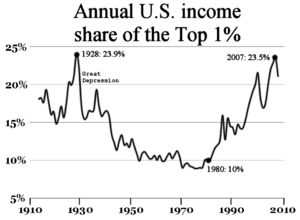
 ANNUAL SHARE OF THE T0P 1 % 1910 TO 2010

A particularly striking statistic is the trend for “1%” followers is to look at their share of the national income over the last 70 years. Between 1940 and 1980 this share fluctuated between 10 and 15% of INCOME (not wealth). Between 1980 and 2007 that share went from about 10% to 20%. Otherwise put, in 1980 income from wages, salaries, and investment yield increases for every $1000 of American income went from $10 for the top 1%– one out of every hundred Americans—to $20, an approximate doubling. Although it may be even more troubling in fairness and utilitarian terms that similar increases in income occurred for the top 10% of Americans, the focus of the left to center commentators (and Occupy Wall Streeters) was on the ONE PERCENT. That seems to be where the drama lies. Think again now: 1%+> 20% of income, 10% => 40% of income and the bottom 40% (2 lowest quintiles) shared 9% repeat 9% of the income of the country. This is a lot of numbers to absorb, and more detailed breakdowns and explanations and conclusions can be found in numerous sources.

What we want to argue HERE is that yes, clearly there is a dramatic shift of wealth going on in the direction of a small group at the top. America in this sense MIGHT be said to not only becoming more like a typical Third World country, or like many societies throughout history going back through the Middles Ages to ancient times, but also that the U.S. is becoming dramatically less equal in income along several lines of measurement in the past 30 years and compared with the 60 years before that.

Again we pose the question, “So what?” It may seem self-evident that this is not a good thing, that more equality is better, but this is not universally agreed upon. It will be good to hone in on the arguments (the very most important ones—and unusual) for both or several points of view on this!

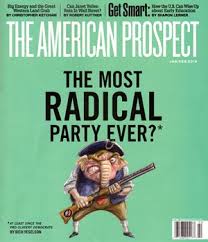
DETROIT LANDSCAPE   AMERICAN PROSPECT


BLOG RESURRECTION ENTRY: “Back in Business!”

To the “Rescue of our Capitalist Culture”?

In spite of the embarrassments on Capitol hill and debates that make many—not just those of us somewhere left of center—want to avert our eyes, there has recently been a near avalanche of hopeful critiques of our outlandish corporate economy. Suspended in a kind of Obama to Clinton wishful state, vaguely anesthetized given how much is still wrong with our approach to unions, education, corporate shareholder (all of Us?) driven knavery, we can at least find comfort and inspiration in the works we’ve presented like those of Thomas Frank and Robert Reich—and Barbara Ehrenreich, although we’ve not reviewed her. Oh yes, and, of course, Thomas Piketty’s CAPITAL in the 21st CENTURY.


Magazines like The American Prospect and The Nation also furnish lively summaries of what has gone awry in the American economy and business culture. An article by Steven Pearlstein in the March-April issue of “..Prospect” titled, “When Shareholder Capitalism Came to Town,” is typical. If I may conflate some of his major points on what is/has gone wrong with the business economy and its government and media enablers with my own “amens,” well here goes!:


  1. The pieces of the puzzle have been fit together with small variations, but the essence is that corporations have changed over the last 50 years from focusing on profitable success but within a social contract recognizing obligations to the community, to a focus on optimal profit at almost any cost, justified by the doctrine of maximizing returns to the stock-holder,
  2. What this means, of course, in plain English is that companies must cut corners as opportunities arise, often innovatively: outsourcing jobs, depressing wages and benefits (which are known to have been static among the workforce since the early 1970s)
  3. Part of the reason for the move from a more “symbiotic connection between business and society”—corporations providing stable and increasingly productive jobs, accepting some government regulation, paying rather higher taxes than today in return for a public that respected labor with a capital L and a domestic workforce with the spending power to keep healthy consumption in the United States
  4. As foreign competition increased dramatically, technology triggered sweeping workplace changes, structural forces like international trade pressures and suctioning out jobs from the U.S. (to) abroad in the name of free trade and Global market survival, all buttressed by profit at any cost dominated think tanks and even some university economics departments, some of the following occurred;
  5. This is an overview and there are better places to find causal explanations for American job loss*, weakening of Labor, income inequality, we are offering a compact laundry list of complicated RESULTS:
  • The dramatic and undeniable migration of millions of American jobs overseas, whatever the rationale
  • The corporate culture of increased insecurity and impersonality regarding employees who are not infrequently fired, laid off, handed the pink slip after years of service, often good service, with devastating individual psychological and collectively “negative multiplier effects”
  • A plant shuts down, it is cheaper to produce in Mexico or the Philippines, and while workers may eventually find work elsewhere (WALMART, service industries, other big box stores to name a few), the short term effect is of course that local businesses suffer, fewer local stores survive, economic and “social Darwinism” unfolds, and across the country for reasons—again—to complex to detail here (but read Stiglitz, Thomas Frank, Kevin Phillips, Robert Reich, Paul Krugman, Piketty, and, in the UK, for example, Robert Skidelsky, among a host of others—whole states, counties, small towns, empty out fall into decay (variants on Detroit)
  • Health and retirement benefits decrease, and again, wages remain stagnant, government programs do not fill the gap, purchasing power is compromised and speculation (read Wall Street, but not all of it and not Only it!)
  • An equally robust, but perhaps endangered literature, touting the virtues of so called hidden hand market economy advantages, neo-social Darwinism with the virtues of the survival of the fittest (why not WALMART and AMAZON with titanic economies of scale, capable of putting air conditioners, housewares, and books into the hands of consumers at Permanent Bargain rates?)

We have presented nothing new here that cannot be found articulated in more depth and with far more back story and empirical examples. What we are doing is reaching small but increasing numbers of readers, reinforcing a complex (that word again) blockbuster message that pushes back against malign forces and pulls people Toward awareness, questioning institutions and practices at the local level, holds officials, businesses and the media accountable… in a world awash with information, blogs, platforms, overlapping media, we are in the business of consciousness raising—one reader at a time—and making the case that the excesses of the Second Gilded Age, roughly 1985-2005, are, more gradually but still inexorably, paving the way for a progressive backlash and, for example, a new youth culture and worldview that questions the greed-is-good “core creed” more harshly than the increasingly hollowed out “nanny state.”


UKRAINE/WATCH IT! WANTED TO WAIT TIL AFTER APRIL FOOL’S DAY!

FROM ODESSA WITH LOVE, Must be seen, stick with it to the end (no endorsement  of the website, BUT CREDITING — only the video):

Official (Официальное) – Flash mob (Флешмоб): Odessa (Одесса) Musicians Privoz (Музыканты Привоз)

Flash mob: Odessa Musicians for Peace and Brotherhood. Флешмоб: Одесские Музыканты за Мир и Братство. (Official Video).

PROGRESSIVE QUOTABLES: Narnia and Nietzsche

THIS BLOG HAS BEEN A BIT DORMANT LATELY, NO EXCUSES, BUT WE WANTED TO START A SECTION PROVIDING FOOD FOR THOUGHT– ORIGINAL, STRIKING QUOTES FROM PROGRESSIVE TYPES FROM AROUND THE WORLD FOR THE LAST FEW CENTURIES.

We’ll start with is one from C.S. Lewis (1863-1929), the Anglo-Irish folklorist, Oxford scholar, and fantasy novelist famous for THE CHRONICLES OF NARNIA, THE SCREWTAPE LETTERS and much else. Attribution goes to the Inspiring Quote” from the website The Thoughtful Mind, March 30, 2014. To them goes all of the credit


CS LewisNietzsche


for this gem, but to us comes the opportunity to deconstruct it for future discussion– so very relevant to our times

And we have added below Lewis, same source, April 3, 2014, a gem from Friedrich N., who needs no introduction. Is there a connection?

   We all want progress, but if you’re on the wrong road, progress means doing an about-turn and walking back to the right road; in that case, the man who turns back soonest is the most progressive.― C. S. Lewis
  All things are subject to interpretation. Whichever interpretation prevails at a given time is a function of power and not truth.

― Friedrich Nietzsche


A TRUE BLUE PROGRESSIVE AT THE HELM OF THE FED???

ImageImage

THE AMERICAN PROSPECT on Janet Yellen

This Feb. 2014 edition of one of our leading progressive journals features an in-depth profile of Fed. Bank chief Janet Yellen, one smart cookie—wonder how she got installed without Republican flack. The appointment is notable because Yellen is a true progressive, or at least relatively so compared with her predecessors. One of the gutsiest Obama selections to date. A fine intellect who does not easily ruffle feathers. As FED chief for at least 4 years, she will have plenty of opportunity to do just that.

As you may read for a while in the link here, http://prospect.org/magazine or google AMERICAN PROSPECT , Yellen is in principle free of some of the TARP and Bernanke-Summers-Geithner baggage Other Obama mop-up operators of the past four years (the latter two of these having departed the administration. There is potential in Yellen’s shaking up some of the paradigm of the Bank. As a labor economist and recently deputy head of the bank she is known to focus on unemployment as much as money supply and probably will be as potentially formidable antagonist or at least skeptic of Wall Street activities as any individual at the top level of the government, including the president. She of course will be freer than he is, it seems, to influence those features of “The Street” that rankle many on the left AND, ironically, in the Tea Party movement at the same time. More on her as event develop. This blog must move on  to other business and is not equipped to discuss her as eloquently as the Robert Kuttner article which begins on page 40 of “The Prospect.”


SOME BRIEF THOUGHTS FROM BLOG COLLEAGUE ART LERMAN, PH.D.

Some brief thoughts from Art Lerman
CVSCHARLES BLOW
……………………………………………………………….

CVS deciding to stop selling tobacco products: Is this an example of the hypothesis that capitalistic interests and progressivism will be coming together more and more in the future?

…………………………………………………………………

I’m recommending Charles Blow’s NYTimes column on the Republican party becoming the bastion for insecure men who see their traditional privileged social position under threat from

a.       progressive trends—trends promoting equality of people of all genders, colors, ethnicities, and sexual orientations—as well as from

b.      an economy no longer providing men with a secure “head of the household” income.

Indeed, without the secure income, the traditional privileged male position is all that is left to support such male self-esteem–all the more reason to feel threatened by progressive equality trends.

Of course, there are alternatives for psychological support. Instead of modeling one’s psychology on Archie Bunker or Ralph Kramden, one could take Thomas Jefferson, Abraham Lincoln or Pete Seeger as a model.

And maybe this is a way for progressives to reach out to insecure male—promote “masculine” images of progressive/liberal men. Maybe a new TV series or blockbuster movie about such guys?

Here’s the link to the Charles Blow article: http://www.nytimes.com/2014/02/01/opinion/the-masculine-mistake.html?ref=charlesmblow.

………………………………………………………………………..

Time to get serious about supporting progressive candidates for the 2014 Congressional elections. I’ve been reading lots of pessimistic predictions (for example: http://www.nytimes.com/2014/01/27/us/politics/2014-elections-likely-to-keep-capitals-split.html), but there is time to turn things around.

For myself, I have to reinvigorate the website, Obamaandacongress.org. We have to use all of our media outlets to promote a more reasonable Congress for Obama—and the rest of us. And don’t forget more traditional campaigning—like knocking on doors.

‘Faith is the badness of government leads to—bad government”~

rove_4_02c0d‘Faith is the badness of government leads to—bad government”~

ronald_reagan_quote

BLOG POST FROM THOMAS FRANK’S

take-no-prisoners book THE WRECKING CREW a previously reviewed send up of the deliberate and sometimes methodical Reagan/Bush/ Republican Conservative dismantling of government, government programs to aid the less fortunate, to protect the environment, the consumer, safety regulations—the list is long, he makes the following memorable comment:

             The chief consequence of the conservative’s unrelenting faith in the badness of government is…. bad government. [let’s repeat: The chief consequence of the conservative’s unrelenting faith in the badness of government is…. bad government.     And Frank goes on to say:] ..The one follows the other not as a casual happenstance, but as a rule…


Frank goes on to discuss the Bush (II) administrations propensity for hiring anti- or much limited government tops, not always of the greatest talent for key posts. Then he notes:


It is a classic self-fulfilling prophecy and today (2007) we behold its fulfillment all          around us, in the prodigies money-burning bungling enacted by an anti-government president working with an anti-government Congress. (Frank, p. 141)


       He points to the the second Bush administrations deliberate staffing of agencies like FEMA (Brown, Katrina) and other with apparatchiks more interested in administration priorities than the mission of their organizations. But this was just the culmination of a long history of “defunding the left,” privatization, extracting regulatory agency teeth, etc.


Today (2014) we no longer have an anti government President, but, perhaps not unrelated, an even More anti-government Congress, especially in the House.

Today (2014) we no longer have an anti government President, but, perhaps not unrelated, an even More anti-government Congress, especially in the House.

AFFORDABLE HEALTH CARE: Correcting Misperceptions

OBAMACAREPICWhat often gets lost in the public dialogue and media coverage of “Obama-care” is, well, the Truth. Facts. Empirical knowledge. Real Information. Take for example a study (based on Kaiser Foundation and other studies, of the Real Savings and impact on health insurance policy holders presented by Jonathan Cohn in THE NEW REPUBLIC. Read the full article at http://www.newrepublic.com/article/114302/kaiser-study-obamacare-tax-credits-worth-thousands-lots-people   .

The Big Savings Obamacare Critics Miss

                      BY JONATHAN COHN @citizencohn

Obamacare critics keep insisting that Obamacare is a bad deal for most people buying insurance on their own. And a big reason is that they don’t think much of the subsidies.

I know. You’re getting tired of hearing about the subsidies. Bear with me, because today we have some new and important information, thanks to a new study from the Kaiser Family Foundation.

To review: Obamacare provides offers tax credits to offset the cost of insurance. If your income is less than four times the poverty line, and if you’re buying through one of the new insurance exchanges, then the tax credit will operate like a discount. The less money you have, the bigger the discount. Nowadays, most Obamacare critics acknowledge that the subsidies exist. But they tend to dismiss them as trivial. “Some low-income people will get subsidies,” Rich Lowry of the National Review wrote on Monday. “But that doesn’t change the essential facts.”

Actually, it does change the essential facts—by quite a lot. The study, by Larry LevittGary Claxton and Anthony Damico, shows it.

Kaiser Family Foundation

The authors start by figuring out what the initial, upfront cost of insurance will be for people buying coverage on the exchanges. Based on Congressional Budget Office projections, the average across all households—that is, individuals and families, of all ages—works out to $8,250 a year. That’s not a bad price for comprehensive coverage: It’s in the same ballpark as policies that employers provide employees. Still, it’s more than some families buying coverage on their own might pay today, because they have skimpy policies or benefit from preferential pricing for the healthy that Obamacare prohibits. That’s why conservatives insist people won’t want to sign up for Obamacare’s insurance options.

But, again, those are the initial premiums. According to the Kaiser study, the subsidies on average will reduce premiums by $2,672, or about a third of the price. The averages mask a lot of variation, with more affluent people getting less assistance and less affluent people getting more assistance. People with incomes of more than four times the poverty line, or about $94,000 for a family of four, get no discount at all. That’s one reason why some people really will pay more for their insurance next year.

Still, the number of people receiving discounts is a lot larger than even many analysts seem to realize. It turns out that about half the people who buy their own insurance today will be eligible for subsidies. For them, the subsidies will be worth an average of $5,548 per household, effectively discounting the price by two-thirds. The study defines the “typical” plan as the second cheapest silver option. (Silver plans cover about 70 percent of the average person’s expenses.) Keep in mind that people who choose less expensive options, like those that cover fewer expenses, will pay even less for their coverage.

“It makes sense to look at what people will pay for health insurance after taking tax credits into account, just like we do for things like 401(k) plans, child care, or educational expenses,” Levitt told me. “The law provides a surprising amount of financial relief for people who are buying their own insurance today, not to mention the uninsured, who tend to have lower incomes.” Len Nichols, a health economist at GeorgeMasonUniversity, agrees. “In many ways, what the ACA is about is extending premium tax breaks to those without good employer offers today, and doing so through a sliding scale that provides the most help to those who need it most.”

Of course, Lowry and other critics downplaying the subsidies aren’t just making a statistical argument. They’re also making a philosophical claim—that subsidies simply hide the cost of insurance, by transferring it to taxpayers, rather than reduce it. But that’s a separate question, to discuss at another time.

For now, we should at least agree on the arithmetic, which the Kaiser Foundation study lays out nicely. A large portion of people who buy individual coverage through Obamacare are going to be eligible for subsidies. And those subsidies are going to be worth, on average, thousands of dollars per person.

~~~~~~~~~~~~~~~~~~~~~~~~~~~~~~~~~~~~~

Obamacare: Healthcare Reform Facts


1. No lifetime limit on coverage for 105 million Americans.

*2. Up to 17 million children with pre-existing conditions can no longer be denied coverage     by insurers.

*3. 6.6 million young adults up to age 26 have taken advantage of the law to obtain health insurance through their parents’ plan.

*4. Free coverage for comprehensive preventive services for millions of women starting in August.

*5. 86 million Americans, including 32 million seniors in Medicare, have already received free preventive services.

*6. 5.3 million seniors have already saved $3.7 billion on their prescription drugs.

*7. Since the health care law was enacted in March 2010, 4.2 million private sector jobs have been created – many of them in the health care industry.

*8. The Small Business Health Care Tax Credit has already been used by 360,000 small businesses to help insure 2 million workers.

*9. $1.1 billion in rebates from health insurance companies this summer will benefit nearly 13 million Americans.

*10. The health care law reduces the deficit by $124 billion over the next 10 years and over $1 trillion over the following decade.

Question: ARE THESE VALID CLAIMS FOR THE AFFRODABLE CARE ACT?