fshiels

Progressive Future USA

fshiels

2016 Presidential Campaign Lessons Neglect (Even Benign) No Longer an Option: A. Lerman

TRUMP AND ANGRY VOTERS.jpg    SANDERS ANGRY


We offer here an essay by Professor Arthur Lerman that is really worth getting into. Why are so many people so Angry in this election?. More than usual. “Angry Populism.” This has been “used” in very different ways especially well by Bernard Sanders and The Donald Trump.

Some explanations have been offered in previous pieces in this blog, like the review of Thomas Frank’s LISTEN, LIBERAL!. Is it true that a kind of anarchism or at least obstructionism is growing among us? And see what you think of Lerman’s solutions or solutions “out there” that he identifies.

Note: this will be re-blogged with further comments and perhaps Dr. Lerman’s and Your “comments on those comments!”

Also note: Prof. Lerman stresses that this is a Draft, that may be influenced by comments and his own further thinking

2016 Presidential Campaign Lessons Neglect (Even Benign) No Longer an Option ©

In the past, there were cases in which groups or individuals could be ignored and/or exploited by ruling classes, because the ignored/exploited had learned to accept their difficult position as part of the natural or religious order, or because they saw no hope of change–including the prediction that any attempt at change will make their situations even worse–e.g., severe/immediate repression from the ruling classes, for example.
Of course, throughout history, there were many cases in which groups or individuals did not accept their difficult positions as inevitable, so history is full of rebellions and revolutions—upsetting and overthrowing numerous ruling elite regimes.

In our modern world, with the spread of the power of groups and individual to threaten and ultimately disrupt the peace and security of socially privileged classes and, more importantly, with the spread of the consciousness of this power, this ability to blithely ignore and exploit is even less of an option.
This increased disruption capability, and awareness of such capability, has come with such new conditions as:

  1. the spread of rights of peaceful political action–voting and communicating about voting to others.
  2. the spread of technology for communicating to wide audiences.
  3. the increase in social complexity, making it easy for individuals or groups to “throw a monkey wrench into the works”, e.g., putting an orange traffic cone in front of an entrance to the George Washington Bridge.
  4. the increasing availability of the tools of violence to allow individuals and groups to wreak havoc.

(Interesting side note: In the mid-1960s, in graduate school, I remember a renowned sociology professor saying that social control has become so intense that the individual was already incapable of independent action that could disrupt society in any way. Seems the above conditions, especially b, c and d would reverse this judgment.)

So in our day, it is ever more perilous for political elites to allow groups (or even individuals) to fall into difficult social circumstances. And, therefore, we come, during the current presidential campaign, to the phenomenon of Donald Trump.

Of course, he is not unique. Angry populist movements abound in recent history. What is interesting is, that the workings of democracy should have precluded the rise of angry populism.

One could conceive of the workings of democracy as parallel to the workings of a market economic system—if there is a demand, producers will automatically act to supply it. So, if there is a political demand, political producers—i.e., creators and implementers of policy—should automatically act to meet the demand.

In such a case, the political producers would be continuously surveying the demands of all voting groups (if not the demands of isolated, unrepresentative individuals) to make sure they are supplying what is necessary to keep these groups supporting them..

Moreover, similar to a market system, it’s not just one political producer in play. Like in a competitive economy, anyone can present him/herself as a political producer, proposing ways to meet demands. In the U.S. that has pretty much meant that two organizations of political producers—the Republicans and the Democrats—have been the ones to respond to demands, keeping groups needs met and ensuring social stability.

In the recent U.S. past, for example, political producers responded to the Great Depression of the 1930s with Social Security and the Federal Deposit Insurance Corporation, to the 1950-1960’s demand for racial equality with the civil rights bills of the 1960s, and to the 1960’s health problems of seniors with Medicaid and Medicare.

But, as with economic markets, the theory does not always work out in practice.

Markets are plagued by lack of accurate knowledge, so producers may produce what is not demanded, or neglect to produce what is in demand.

(Of special note—one of the most difficult areas of the market economy is those who have demands, but do not have the resources [money, goods, services] to make their demands effective.)

Political markets are also plagued by lack of accurate knowledge. Some of this is simply lack of information about groups and their needs—perhaps because of poor information gathering, or, perhaps because of not knowing where to look or what to look at, or, preconceptions about what exists. And there is also the difficulty that, one may know what exists, but one’s ideology suggests an improper response.

So, we have the rise of angry populism, personified by the candidacy of Donald Trump, presumably because our political producers—the Republicans and Democrats—lacked the requisite information about how to meet the demands of Trump supporters, or have offering the wrong “product” for meeting the demands.

(There is also a “Blame the Victim” angle here. Perhaps political producers have been offering the proper product, but those making the demand do not realize their demand is being met–i.e., economic progress during Obama’s administration?)

So let us explore the groups and the demands involved.

Trump’s support is coming from white voters with a high school education or less. Their clear economic demands are for secure, well-paying jobs. The analysis is that many of their jobs have been transferred overseas, leaving them unemployed, or employed at lower wage, less secure—often retail—jobs.

The obvious response of political producers would be to find other ways to provide secure, well-paying employment. Ways to do this would be to:

  1. Create alternative venues to work in—or promote private sector efforts to do so.
  2. One example is rebuilding the country’s infrastructure—everything from transportation (roads, bridges, mass transit facilities) to public buildings (hospitals, schools.
  3. And there are the new tech industries that are coming out of the Silicon Valleys of our land.
  • And there is the possibility of reclaiming industries that have moved abroad through new technologies, including robots, which can compete economically with foreign sweat shops.
  1. Afford opportunities to upgrade skills to fit oneself into such new industries.
  2. And the government could always be an employer of last resort. The idea that there is nothing worth paying the unemployed to do is false. And given that the country as a whole (though our companies that offshore their production) is still making immense, profits, indicates that the means do exist to employ individuals elsewhere where they are needed—for example, putting more teachers in the classroom or healthcare workers in our hospitals and clinics.

Yet, our two main political producers—at least the more typical, “Establishment” Republicans and Democrats—have not placed these employment products on the political market—resulting in the angry populism that is supporting the “anti-establishment” Donald Trump.

The question is why? Is it not an axiom of the market place—economic or political—that the self-interest of the producer will move him/her to provide the product to meet the demand?

Above, we have noted some explanations—lack of information, misperception, interpretation. To these we may add lack of ability to produce.

For the Republicans, some of this is interpretation. The Republican ideology is that government—including the political producers running the government—is not supposed to be responding to economically based demands. The ideology is that when government gets involved, things get worse—the government creates and runs incompetent and corrupt programs, and the individual becomes dependent on government, becoming a burden instead of an asset to society. . It is for the individual to respond to the market on his own, creating the economic opportunity to respond to such things as international economic competition.

(On thinks of articles by Thomas Friedman in the NY Times, urging individuals to retool themselves through advancing their education to meet the modern economy. Of course, Republican ideology does not promote government support for such, or government guidance on what retooling for what end. And then, what if in a few years, new products and competition from abroad necessitate another course of retooling. And how many times can an individual go through such a process. What of the psychological burden?)

The Democrats (full disclosure—I’m a loyal Democrat) do believe that the government can effectively meet these demands—but they have only limited ability respond—since they don’t control the Congress. Yet, since they control the executive, they still get lots of blame, since it’s the executive that’s the “face” of the “not-responsive” government.

Also, there is the analysis of Thomas Frank, brought home in his most recent book—Listen Liberal, that the Democrats have written off the white, high school educated working class—seeing them as having turned against the Democrats for their devotion to non-White minorities—who are as threatening to them as are overseas sweatshop workers—and having become a party of the meritocratic upper-middle classes—leaving the needs of the white working class to no one to respond to.

Oh! Yes, the Republicans have responded—but not with an economic product. They have responded to the psychology of the white working class that sees itself as having lost its status as having defined American. The white working class was psychologically supported, not only though solid economic jobs, but also with identification with the greatness of America. I’m great because America is great.

But now, America is more and more depicted as a mélange of whites and non-whites, in which white workers are just one more of America’s mélange of social groups. Loss of economic status (a secure, well-paying job) has been accompanied by loss of prestigious identification. And Obama, a black president, becomes the notorious symbol of this loss—explaining some of the vehement opposition to him—and anything he does, even when trying to compromise with the Republicans.

The Republicans have responded to this by their campaign of the loss of America’s power and prestige in the world and the loss of American morality at home—even before Trump—corralling the white vote for itself.

But, till Trump, the Republicans have not been able to improve things for the white working class—it only continued to play on the theme of resentment for loss of status.

Thus, they were open for someone who plays much more clearly and openly on these resentment themes.

So we have the angry populism that the Republicans were promoting—more clearly and angrily presented by Trump—he’s got the product and the white working class are buying.

Do the Democrats have an alternative? Hillary and Bernie both offer more concrete economic products, but is the white working class even looking at them?

Certainly some are—though many have long been in the Republican fold, seeing the Democrats as the friends of the minorities and sweatshop foreigners, as well as of elite upper-middle class types. So they are not listening.


A great challenge would be for Hillary (maybe riding on Bill’s charisma) to get them to listen again.

And Bernie—in his clear dedication to the workers—if he can get them to listen.

This is important, to go back to our beginning. Both producers in our political market place have neglected—failed to respond to– a major part of our society. And, given the easier ability for social groups to disrupt and threaten—not just the social elites, but everyone else—it is important to provide a product that will meet their own needs, while being compatible with the needs of all others in society.

Alternatively, they can be led by a demagogue—either to continuing ineffectual venting of anger (which the Republicans have been leading them on to do for years), or, more dangerously, to much more disruptive social action.

From Political Science and History courses: words to students


A little self indulgence here. This is a list constructed for American foreign policy (HISTORY-POLITICS 367) students. But it is shared with students of all my courses. Not to be read at one sitting, but let me know what you think. And questions/ suggestions to add.

Some Serious Questions to Think About from This Course


  1. The U.S. has surely done some good in the world: WWII, WWI, United Nations, idea of League, foreign aid, Marshall Plan. How does this measure up against “Not Good” things we have studied—or will? For you. Say “Vietnam or the Philippines 1901”.


  1. Kissinger and McNamara have said in different ways that foreign policy choices are often choices between the lesser of evils? Do you agree? An example might be the use of bombing to hasten the end of war and the slaughter on the ground going on in Europe. Or Vietnam.


  1. The US has crossed borders to intervene in far more foreign countries than, say, the USSR or China in the last 80 years. It might be argued that US interventions have often been for good causes or had good effects. Yet others disagree and say most interventions have not been worth it—or legal. What for You think—are some interventions beneficial and others not? Which?


  1. Much of the debate in this class and in the conversation nationally about American foreign policy has been carried on with the assumption that the US has a moral compass and a sense of fair play that make Its military interventions more reasonable and less self-serving than most. What do You think?


  1. Have American students and the American public been “lied to” by the media and by common national beliefs and history books. Can you think of an example of something you have been read or taught about American conduct that you have come to see as misleading or just wrong.


  1. I say, as your professor, that the US has a better than average record as a great power in the moderation of its ‘big power maneuvers’. I also say that, for whatever the reason, my research and the record demonstrates clearly that the US government and military, with the general approval of the US people and media, have been responsible for the deaths of at least 7 million foreign civilians in the 20th and 21st So….?


And I say that whatever you think the justification or necessity for these civilian casualties has been, the bodies we’ve created are just as dead as those killed by Russians, Germans, Chinese, Napoleon, Genghis Khan and so on. So are there defensible deaths, “good deaths” caused by great powers? Are there necessary civilian deaths?


  1. You are the president. You are faced with the choice of killing foreign individuals to save American lives. This could be Obama targeting suspect terrorists (but hitting some civilians) in Yemen with drones, or Clinton and Bush starving Iraqi civilians with an embargo (1990-2003) put in place as retribution for Saddam’s invasion of Kuwait (1990), or Roosevelt-Truman choosing to firebomb Japanese and German cities and hundreds of thousands, Millions of civilians, in the hope of ending the war sooner and perhaps saving tens of thousands of American MILITARY lives. Good practice? Fair? Moral?


  1. What area of the World has provided the most challenges for the US in its history (decade by decade. What area will be most likely to present future problems for American foreign policy and why? China/North Korea? Why? Latin America? Why? Africa? Why? The Middle East? Why? Australia? Why? (no just kidding?).


  1. Ask yourself: why do I feel about politics and the world as I do? (and do the same every 5 years for life). Parents? Peers? Travel? Where you grew up? Your personal finances? Significant other? Influential book? You might even try to construct a mental pie-chart of how much you think some of these things have influenced you. This is about self-awareness, consciousness, “going deep.” You do not have to be a politics or history “junkie” to benefit from this. Remember that many of our political views come from the gut, not the head—or at least the Unconscious,


  1. The analyst Ian Bremer has written a book that projects 3 models of foreign relations for the US (you might even so foreign Conduct) for the near future, the post Obama decades: 1. The US continuing as Superpower and doer of great and constructive deeds on the world stage (“INDISPENSIBLE AMERICA”), 2. The US as a practical traditional power mainly focused on economic advantage and developing its own well-being …”MONEYBALL AMERICA” The  US as a state mor detached from other countries, cooperating in trade and moral causes, but refraining from active use of its military (which may still be very strong) INDEPENDENT AMERICA.  

 http://www.amazon.com/Superpower-Three-Choices-Americas-World/dp/1591847478/ref=sr_1_1?s=books&ie=UTF8&qid=1460386587&sr=1-1&keywords=ian+bremmer


  1. What about the theory mentioned in the first class about HISTORY as a saga of criminality. This need not be depressing and it does not deny human goodness, achievement, ingenuity. It is just a useful mental exercise, I think especially for 21st Century Americans, to remember the effects of war, disease, imperialism, or more specifically, the consequences of personalities such as Stalin, Hitler, Napoleon, the German Kaiser, Theodore Roosevelt (usually you either like him a lot, or you don’t), conquests, interventions, human rights violations against: indigenous people, women, children, people of certain races and ethnicities, The Other.


  1. Most Americans are weak on world geography. Don’t be one of them! A mark of an educated person and respect for the world community is to know the names and whereabouts of as many countries as you can. Then brush up on mountain ranges, rivers, bodies of water, deserts, etc. You may end up going to some of these places. Or flying over them! This is not about memorization. It’s about exploration: try a globe or an atlas. Get away from behind that computer if you can. Not like this list. All typed out on a laptop.

A VOICE FROM THE MIDDLE EAST: LISTEN

Libyans studying dentistry sit for an exam at Al fatah University in Tripoli June 30, 2011. REUTERS/Louafi Larbi (LIBYA - Tags: POLITICS EDUCATION) - RTR2OAM3


Taking a break from the hurly burly news cycle of domestic politics, it might be good to look at the wider world and the assumptions Americans tend to make about the chaotic Middle East and what, if any, the U.S.’s future role should be there. ISIS, Muslim extremists and stereotypes continue to haunt the American view of the region, from the expertocracy on down to the person in the street. So here we offer a gentle riposte to stereotypes from a hypothetical  educated Middle Eastern woman who wants us to examine our assumptions.


 I am Aysha, not my real name, a doctoral student at the American U. in Cairo. I have lived 18 of my 31 years in the West as a diplomat’s daughter. I know New York, Washington, Ottawa, Chicago and Canberra. The men there are not bad. The ones I met at McGill and Princeton are almost as smart as I am. Enough about me.

I will call the following, “A Few of My Impressions and a Few Things You Should Know About Muslims and the Middle East,” as seen by one educated young 21st century adult. There are plenty of sites on the Web about “Why Muslims Hate Us” and the like. Try: http://www.theblaze.com/stories/2012/09/21/why-do-they-hate-us-its-a-pretty-long-list/

 But this is more personal. These are my observations, a few:

   As a Rule (and all of the following can be prefaced by ‘As A Rule’), Muslims from Morocco to Afghanistan, Sunni, Shi’a, Wahabi, Alawite, share in common a desire to be in control of their countries and region. We have big problems and are diverse— from Taliban and Hezbollah to wannabe transplant Westernized intellectuals. But we resent the US/EUR spectrum of attitudes that somehow we need to be taken care of, that “West knows Best”

  1. We know you mean well, and we do not speak with one voice, and we have appreciated those with good will who have arranged cease fires, Camp David, and other agreements. We have not appreciated numerous wars and such assistance as the Iraq War, patronizing of Arab Palestine, relentless support for Israel, Sykes-Picot, no fly zones, embargoes that starve children, you know the drill,

2. We in this region have our faults, but note that our alcoholism and drug use is far below yours, overall our cities are safer—but watch those pickpockets—our suicide rate far lower, many of us prefer the Koran to psychiatrists, and our extended family support system (your term) is something you might envy

 3. Yes our leaders are often corrupt and bull-headed. I supposed we have more Political prisoners per 1 million of the population, but with a few exceptions we cannot compete with 3 million American inmates for a country of 320 million people. Pretty impressive. 1 in every 100 Americans is in prison. If you know 100 people, then statistically, you know someone behind bars.

4. Yes some of our zealots—sometimes angry at your attitude about and disrespect for Islam—have done some crazy things and the 9/11 spectacular was surely one of them. But in Iraq alone from 2003 to 2010 you got some nice revenge with a low-ball estimate of 156,339 dead civilians. Just Us. https://www.iraqbodycount.org/


Book Alert!: THOMAS FRANK/ “LISTEN LIBERAL””

THOMAS FRANKLISTEN LIBERAL

listen to an interview with him on the book at http://www.wnyc.org/story/democratic-party-still-peoples-party/, post and book and link suggested by blog contributor Prof Arthur Lerman of Mercy College

Thomas Frank, who we featured many posts ago as the author of THE WRECKING CREW, a frontal assault on the Republican and Conservative dismantling of much of the liberal infrastructure in Ideas, Politics, and Government Policy Programs starting in the Reagan years, has come out with a new book.

It is LISTEN, LIBERAL!, an equally pointed, though less damning, skewering of how the Democratic Party– post-Johnson, post-Carter– has been increasingly identified with Big Money, meritocracy (rule of a professional elite, privileged, though often from less privileged origins). This meritocracy and need to depend on big donors, banks, “High Finance,” etc., does not sufficiently have the interests of the hard pressed middle class, lower middle class, working class, poor, in mind. Ditto unions.

He surely does not equate the sins of Democrats with those of Republicans, but he does achieve a sort of balance by shaking up their privileged position, and their shared responsibility for the flaws of Free Trade, “welfare reform,” rampant prison building, etc. He does say some good intentions morphing into Untended Consequences, many dire for, especially, the bottom 60% (well over 200 million people!) of the population economically/numerically.

The Democrats would be well advised, and this is a good year to do it as the Republican train-wreck finally unfolds, go consider these charges by Frank. One would hope that if Hillary Clinton is the Democratic nominee (super-likely) and she is being “educated” or “reeducated” by her opponent Sen. Bernard Sanders, and non-candidate influential like Sen. Warren and former Labor Secretary Robert Reich, she will also give this book a close read. Let’s send her a copy just to make sure.

A flaw I’ve detected in the Frank book, not big, but not small either, is his seeming belief in the power of individual politicians to ignore their “times, the public mood, the Zeitgeist, the fact that they sit on top of an evolving structure that conditions their need to respond to Money, the need to have plenty of it to win. Still this does not excuse the elitism and freq1uent tone-deafness  to large numbers of voters– some lured by Trump– who are being evicted, figuring out the well intended Affordable [Health]Care Act, struggling with the long term flatness of wages and declining benefits.


Fact-checking the 12th GOP debate: Washington Post

The WASHINGTON POST, no progressive beacon as in former years, has done a light fact check on the MAR 10 GOP debate. I would like to add some deeper problems with Republican arguments, but wanted to get this 12 point moderate right newspaper commentary out quickly.
I would just add the following:
1. The media seem young and fairly ahistorical and uninformed in their questions and follow-ups.
2. When discussing things like “Saving Social Security”, really creative ideas are not even on the table. Rubio complains that the program will implode in 20 years if drastic measures like raising the retirement age on younger citizens to 68 (his cohort) from the present 66 yrs and to 70 for HIS children’s cohort. WOW! He would leave present retirees– who will mostly die off in the next 20 years, to enjoy social security unmolested.
What never gets put on the table in “saving social security” is the idea of a means test for receiving benefits OR taking the cap off of social security tax. At present all Americans 62 or older, regardless of income can get social security, the standard age is 66, and the required age is 70. You can have an average lifetime annual income of $25,000 a year and get the maximum benefit (around $2400 a month give or take) or you can have an income of $250,000 a year and get this same benefit of $2400 a month.
Rich or poor.
Also if you make, say, $400,000 a year, your MAXIMUM social security tax is $106,000. If you make $400 Million a year (1000 x as much) your maximum is also $106,000. Fair? Rising the social security maximum withholding proportional to earnings on the top 10% as well as everybody else could bring in billions of additional money to shore up the program. This will not happen. Much less a means test, in which those with annual incomes post retirement of over, say, $300,000, would forfeit, say 1/2 of their Social Security. This would be political kryptonite in the post Reagan era. Only Bernard Sanders would touch it.
So then, hmmm, the solution is not to tax the 10% richest with 45% of the nation’s disposable income more for social security to “save the program.” Naw. The solution for the Rubio’s. et/ al. would be to bravely raise the retirement age on All, 40 year olds (today) to 68, and 25 year olds to 70. Wage earners would thus work longer and keep SS solvent. The 1 % who have 20% of the nation’s disposable income would keep their hard earned SS checks, retiring at 62, 66 or 70 as they please.
The 10% who control 45% of disposable income (less equal than Brazil) would also receive full benefits. So to save the program, the Bottom 50%, repeat 50% of the population who make 13% repeat 13% of the nation’s income would pay, proportionately, the same or MORE of their taxes to sustain the program. An Eisenhower or JFK would roll over in their coffins if apprised of this. Go figure. The Gilded Age has returned. Go Marco! At least Trump, oblivious to almost any facts at all beyond soundbites, blew it all off with “I wouldn’t touch the program.”


Violence at Trump rallies is nothing new
Th


 March 11 at 12:29 AM   

The 12th Republican debate, in three minutes


Play Video3:01
At the CNN debate in Miami, GOP candidates sparred over immigration, social security, how to talk about Muslims and more. Here are the key moments. (Sarah Parnass/The Washington Post)

CNN aired the 12th GOP presidential debate on March 10, a prime-time event starring the four remaining aspirants for the Republican nomination.

Not every candidate uttered statements that are easily fact checked, but the following is a list of 16 suspicious or interesting claims. As is our practice, we do not award Pinocchios when we do a roundup of facts in debates.

Common Core is “education through Washington, D.C.
I don’t want that.”

— Donald Trump

Trump continues to say Common Core is flawed because it is a federally run program enacted from Washington, imposed on local governments. But it has been, and still is, a state-led effort where governors and school chiefs set the standards. It has been a state-led effort, and states have opted into adopting the standards.

Campaign 2016  Email Updates

There was something revealing during Thursday night’s debate: When moderator Jake Tapper pushed back, Trump agreed that Common Core is, indeed, a state-led effort. But it’s been “taken over by Washington,” Trump continued, and is a “disaster.” But the federal government didn’t “take over” Common Core.

It remains a state-led program. States revise the standards to fit their state, and then allow state and local school districts to shape the curriculums for themselves. And in December, Congress actually took measures to scale back the federal government’s power when it comes to local governments. This federal education law explicitly states that the federal government can’t influence local decisions about academic standards, according to our colleague Lyndsey Layton.

More than 40 states and the District of Columbia have adopted the Common Core K-12 academic standards in math and reading.

“Very importantly, the Disney workers endorsed me.”

— Donald Trump

There were 250 tech workers at Walt Disney World who lost their jobs afterthe company allegedly replaced them with foreign workers with temporary H-1B visas. Two workers, Leo Perrero and Dena Moore, have filed lawsuits in federal court seeking class-action status. Perrero and Moore have endorsed Trump, but it would be wrong to suggest that all of the Disney workers have endorsed Trump.

“I actually got the budget balanced when I was a member of the Congress, the chairman of the budget committee.”

— John Kasich

Kasich likes to make this claim, but it really overstates the role of the Congress in which he served.

Kasich actually voted against two big deficit-reduction deals advanced by Presidents George H.W. Bush and Bill Clinton in 1990 and 1993, which raised taxes and helped set the stage for the dramatic increases in revenue that eliminated the budget deficit. But even those deals were not intended to achieve balanced budgets.

When Republicans took control of Congress in 1994 — and Kasich became chairman of the Budget Committee — they did put the notion of a balanced budget on the policy agenda.

But Washington also got lucky because there were economic forces that had little to do with either Democrats or Republicans: A gusher of tax revenue emerged, primarily from capital-gains taxes, because of the run-up in the stock market, as well as taxes paid on stock options earned by technology executives.

From 1992 to 1997, the Congressional Budget Office estimated, tax revenue increased at an annual average of 7.7 percent in nominal terms, or about 2.4 percentage points faster than the growth of the gross domestic product, the broadest measure of the economy. CBO Deputy Director James L. Blum in 1998 attributed only one percentage point of that extra tax revenue to the 1993 budget deal. The rest, he said, came from capital gains.

Between 1994 and 1999, realized capital gains nearly quadrupled, the CBO concluded, with taxes on those gains accounting for about 30 percent of the increased growth of individual income tax liabilities relative to the growth of GDP. There were other factors as well, such as lower-than-expected health costs that reduced an expected drain on the budget.

Bush also had kicked in motion a huge decline in defense spending (which Clinton accelerated) and also had overseen a painful restructuring of the banking industry. Even a potential shock, such as the Asian financial crisis in 1997, brought the silver lining of lower oil prices that bolstered the U.S. economy.

“Ted [Cruz] did change his view on ethanol, quite a bit.”

— Donald Trump

Actually, Cruz has not changed his view on the ethanol mandate; he consistently has opposed it.

Many have criticized Cruz for flip-flopping because he initially supported ending the program in 2020, then told Iowa voters he supports a gradual phase-out of the program with ultimate repeal by 2022. Since 2014, Cruz hasproposed a five-year phase-out of the federal renewable-fuel mandate, which sets the minimum amount of corn-based ethanol to be mixed into gasoline to reduce or replace the amount of fossil fuel.

But Cruz had not specified when the phase-out would begin. Now, he says he wants it to start in 2017, his first year as president if elected. The phase-out would be completed with an ultimate repeal by 2022.

“As an example, GDP was zero essentially for the last two quarters.”

— Trump

This is wrong. The gross domestic product — the broadest measure of the economy — increased at a rate of 1 percent in the fourth quarter of 2015 and 2 percent in the third quarter, according to the Bureau of Economic Analysis. That’s not great, but it’s better than zero.

“The devaluations of their currencies by China and Japan and many, many other countries, and we don’t do it because we don’t play the game.”

— Trump

Trump is way out of date here. China has been spending hundreds of billions of dollars in recent months — $90 billion in January alone — to prop up the value of its currency as its economy slows. The Japanese yen is also very strong, and with brief exceptions, Japan has not intervened to devalue its currency since 2004.

“Eighty-three percent of the federal budget in less than five years will all be spent on Medicare, Medicaid, the interest on the debt.”

— Marco Rubio

Rubio is off the mark, and overstates the 83 percent figure by nearly 20 percentage points.

Medicare, Medicaid, interest on the debt and Social Security are estimated to take up 61 percent of the spending by 2022, and 65 percent by 2026,according to the Committee for a Responsible Federal Budget’s analysis of the Congressional Budget Office projections. When you include all mandatory spending programs, the share would be 75 percent in 2022.

Rubio’s estimates would have been more accurate if he were talking about the share of spending growth going to such budget items over the next five years, according to CRFB. Total spending on Social Security, Medicare, Medicaid and interest will account for 83 percent of the growth in spending ($1 trillion of $1.2 trillion), CRFB says.

“One out of five Americans works in a job connected to trade; 38 million Americans are connected to it.

— Kasich

Kasich appears to be citing a statistic touted by a group known as Trade Benefits America, a coalition of business groups. It’s not entirely clear from the group’s website how this figure was calculated, but one should generally take a jaundiced view of claims made by trade groups. Notably, a 50-page White House report issued in 2015 to tout the benefits of trade did not make such sweeping job claims.

The United States has “the smallest Navy in a century.”

— Rubio

This used to be a staple claim during GOP debates that went away for a few debates, but it returned thanks to Rubio. This zombie claim about the shrinking Navy just won’t go away. Fact checkers have repeatedly debunked this Three Pinocchio claim in the 2012 presidential elections.

The current number of ships in the Navy is 272. It is the lowest count since 1916, when there were 245 ships. A lot has changed in 100 years, including the need and capacity of ships. After all, it’s a now a matter of modern nuclear-powered fleet carriers, versus gunboats and small warships of 100 years ago. The push for ships under the Reagan era (to build the Navy up to 600-ship levels) no longer exists, and ships from that era are now retiring.

There are other ways to measure seapower than just the sheer number of ships, according to Navy Secretary Ray Mabus: “That’s pretty irrelevant. We also have fewer telegraph machines than we did in World War I and we seem to be doing fine without that.… Look at the capability. Look at the missions that we do.” Plus, the Navy is on track to grow to just over 300 ships, approximately the size that a bipartisan congressional panel has recommended for the current Navy.

“The Ayatollah Khomeini wants nuclear weapons to murder us.”

— Ted Cruz

Officially, Iran has denied any intention to develop nuclear weapons. In fact, the Obama administration has often noted that Ayatollah Ali Khamenei, the successor of Ayatollah Ruhollah Khomeini as Iran’s supreme leader, has issued a fatwa against the development of nuclear weapons. (A fatwa is a ruling by a religious authority, often with judicial implications.)

The Fact Checker in 2013 looked closely at whether the fatwa actually was issued, and determined the evidence for it is rather fuzzy. It appeared to exist mainly as part of Iran’s diplomatic portfolio to insist its nuclear ambitions were innocent in nature.

In any case, the international agreement on Iran’s nuclear program has, at least for the moment, halted and reduced the scale of the program. Moreover, Khamenei has not threatened to use nuclear weapons against the United States.

“They drown 40, 50, 60 people at a time in big steel cages, pull them up an hour later.”

— Trump

Trump exaggerates a horrific practice by the terrorist group known as ISIS. The group in 2015 released a seven-minute video that showed a cage with five men being drowned. The graphic video, which is very difficult to watch, depicted punishments by drowning, grenade launcher and explosive cables tied around prisoner’ necks. The section on the cage drownings used underwater cameras that purported to show the men thrashing around until they lost consciousness.

“One of the things I’m proudest of in my time in the U.S. senate is working with Jeff Miller of Florida in a bipartisan way – I’ll give him credit, Bernie Sanders was a part of this. We passed the VA accountability bill.… Because of the law I passed, it gives the VA secretary … the power to fire people who aren’t doing a good job.”

— Rubio

Rubio does not often get credit for this, as he was not a member of the Senate Committee on Veterans’ Affairs. But he did, indeed, introduce legislation in February 2014 to give the secretary of the Department of Veterans Affairs authority to fire or demote senior managers for incompetence or misconduct.

Florida was one of the states where early reports of mismanagement within the VA surfaced, prior to the high-profile scandal that erupted in April 2014. Rubio and Rep. Jeff Miller (R-Fla.), chairman of the House Committee on Veterans’ Affairs, had worked on giving then-VA Secretary Eric Shinseki this authority since early 2014.

The bill ultimately was included in the larger legislation that Congress passed later in 2014 to overhaul the VA. Rubio was on a bipartisan House-Senate conference committee that negotiated the broader VA bill.

“This administration started with President Obama sending back the bust of Winston Churchill to the United Kingdom within the opening weeks.”

— Cruz 

This is a complicated tale, but Cruz really overstates the case. We had previously given him two Pinocchios for this line.

The Winston Churchill bust in question was originally provided in July 2001 by then-Prime Minister Tony Blair as a loan to President George W. Bush. The bust, now about 70 years old, was made by English sculptor Sir Jacob Epstein, and Bush said he would keep it in the Oval Office. Various news reports at the time said the bust would be returned once Bush left office.

The White House residence, meanwhile, has another bust of Churchill, also sculpted by Epstein, which was given to President Lyndon B. Johnson on Oct. 6, 1965. (Here’s Lady Bird Johnson’s diary entry about the  gift, which was facilitated by Churchill’s wartime friends, including Averell Harriman.)

When Obama took office, the Epstein bust loaned by Blair was returned to the British government, and the U.K. ambassador installed it in his residence. According to a 2010 interview with White House curator William Allman, the decision to return the bust was made even before Obama arrived, as the loan was scheduled to last only as long as Bush’s presidency.

But the British press, always eager for any sign of rockiness in the U.S.-British relationship, had a field day with the return of the bust.

There is no evidence that Obama personally decided to return the bust; given the economic crisis at the time, one imagines he had bigger issues on his mind. Perhaps someone on his staff should have recognized the symbolic value in retaining the bust, but the odds are the machinery of the transition just moved forward on its own.

Cruz, without evidence, states that this was clearly Obama’s decision — “within the opening weeks” — and then imbues great significance to that fact. But he’s really creating a mountain out of a molehill.

 “I said that is a strong, powerful government that put it down with strength. And then they kept down the riot. It was a horrible thing.”

— Trump

Trump referred to the massacre of pro-democracy protesters at Tiananmen Square on June 3, 1989, as “a riot.” But the protests, while large, were mainly peaceful. However, when martial law was declared, protesters blocked the army from advancing to clear the square. The military opened fire on demonstrators, with unofficial estimates suggesting as many as 1,000 were killed. (The official tally is closer to 300.)

The Chinese government, which was condemned by most countries around the world for its actions, at the time referred to the protests as a “counterrevolutionary riot.”

“Other than very small donations where people are sending in $200, $15, $20, and we have some of that, but it’s not a large amount. No, I’m self-funding my campaign, and the reason is that I’ve been in this business a long time and I was on the other side — until eight months ago I was on the or side.… The other thing is, I beat Hillary, and I will give you the list, I beat Hillary in many of the polls that have been taken.”

— Trump

Trump continues to assert that he’s “self-funding” his campaign, but that’s not correct. Anyone who goes to donaldjtrump.com will see the “Donate” button prominently featured on his home page.

Trump has provided the majority of funds raised by the campaign committee so far. Of the $25.5 million raised as of Jan. 31, 2016, 70 percent ($17.8 million) was money from Trump. At least $12.6 million of that was a loan from Trump to his campaign.

The rest came from mostly individual contributions, according to the most recent Federal Elections Commission data maintained by the Center for Responsive Politics. While Trump says most of the contributions that came from other donors are in smaller amounts, 1,911 donors gave between $200 and $2,700, data show.

As of Feb. 22, 2016, outside groups had contributed $1.9 million to the Trump campaign. As for polling for general election matchups, it’s unclear just how many is “many” to Trump. But most general election polls show Trump losing to Clinton. And it’s not just Clinton; her rival, Sen. Bernie Sanders (Vt.), also beats Trump in most general election matchups, according to a list of election polling maintained by RealClearPolitics.com.

“I think whoever gets to the top position as opposed to solving that artificial number that was by somebody, which is a very random number, I think that whoever gets the most delegates should win.”

— Trump

Trump falsely claimed that the requirement to have 1,237 delegates to win the Republican presidential number is a “random number.” He’s wrong. There are 2,472 total delegates to the convention, so the number is a simple majority — 50 percent (1,236), plus 1.

Careful!: The GOP Establishment Now Faces Its Nightmare Scenario: Trump Versus Cruz

Is it maybe too early to start the victory war dance? It has never looked better for the Democrats but History has already thrown a number of spitballs into this election. Watch out!

  • from The Nation

The GOP Establishment Now Faces Its Nightmare Scenario: Trump Versus Cruz

Republican elites wanted an appealing alternative to Trump, But they now face the prospect of a race between an unsettling billionaire and a scary senator.

The only prospect more daunting to savvy Republicans than that of a November ticket headed by Donald Trump is that of a November ticket headed by Ted Cruz.

Every bit as extreme as Trump on the issues, equally combative and at least as ethically challenged, Cruz is Trump with an extra helping of meanness. So unappealing is the prospect of Cruz as the party’s nominee that there has long been a quiet consensus among Republican and Democratic strategists that the selection of the Texas senator as the party’s standard-bearer could lead to a Democratic landslide in the fall.

If Trump’s a bad dream, Cruz is a nightmare. As the Washington Post observedin January (when establishment Republicans in Iowa were scrambling to upend the senator as the front runner in that state’s caucus competition): “There’s an opportunism to Trump’s positions, of course, just as there is to Cruz’s softened position on ethanol. But Trump’s pliability is obvious; Cruz’s isn’t. For lobbyists and senators and members of the Republican National Committee, pliability is important.”

Since January, the threat posed by Trump has become increasingly unsettling to GOP leaders — and the great mass of Americans. And recent days has seen an aggressive effort to block the billionaire.

But the last thing that the Republican establishment wanted to come from a week of maneuvering to manage the Trump surge that was so amply illustrated on “Super Tuesday” was a Cruz surge on “Super Saturday.”

The hope was that political careerist Marco Rubio, the Florida senator who has never shown any penchant for saying “no” to campaign donors or corporate lobbyists, would somehow gain traction.

Unfortunately for the GOP insiders who cannot seem to catch a break this election year, “Super Saturday” was super for Ted Cruz.

The Texan swept the Kansas an Maine caucuses Saturday, and came within five points of beating Trump in the Kentucky caucuses and the Louisiana primary. Though Trump claimed it was a huge night for him, Cruz won more delegates on “Super Saturday” — taking 62 to 49 for the billionaire.

And what of Rubio? He finished a weak third in Kansas, Kentucky and Louisiana. And in Maine he was in fourth place, trailing behind the only serious (and thus most marginalized) candidate left in the Republican race: Ohio Governor John Kasich.

The nightmare scenario of a Trump-Cruz race is now looking more likely than ever.

Republican leaders have to be asking: How did the party of Abraham Lincoln, Teddy Roosevelt and Dwight Eisenhower end up faced with the choice between a narcissistic billionaire who keeps saying awful things and a narcissistic senator who keeps doing awful things?

If the Republican elites who stopped listening long ago to their better angels really want an answer to that question, of course, they need only they look in the mirror.

In Republican ‘Debate’, a Feisty Marco Rubio Lays Into Donald Trump

Photo

Senator Marco Rubio turned the tables on Donald J. Trump. CreditEric Thayer for The New York Times

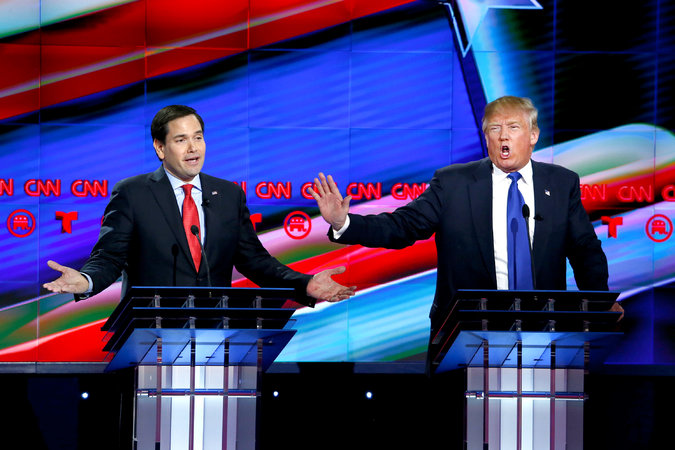
Senator Marco Rubio, alarmed by Donald J. Trump’s ascendancy and worried that his presidential chances were slipping away, unleashed abarrage of attacks on the real estate mogul’s business ethics, hiring practices and financial achievements in Thursday’s debate, forcefully delivering the onslaught that Republican leaders had desperately awaited.

In a series of acid exchanges, a newly pugnacious Mr. Rubio, long mocked for a robotic and restrained style, interrupted Mr. Trump, quizzed him, impersonated him, shouted over him and left him looking unsettled. It was an unfamiliar reversal of roles for the front-runner, who found himself so frequently the target of assaults from Mr. Rubio and Senator Ted Cruz that he complained they must have been a ploy for better television ratings.

From the opening moments of the debate, Mr. Rubio pounced. Deploying his own up-by-the-bootstraps biography, the Florida senator assailed Mr. Trump for hiring hundreds of foreign workers at his tony resort in Florida and passing over Americans who had applied for the same jobs.


“My mom was a maid in a hotel,” Mr. Rubio said. “And instead of hiring an American like her, you’ve brought over 1,000 people from all over the world to fill in those jobs instead.”

Moments later, Mr. Rubio moved to cast Mr. Trump as a huckster who outsourced the manufacturing of the clothing that bears his name to countries like Mexico and China even as he promised to wage a trade war against those countries.

When Mr. Trump tried to protest, Mr. Rubio interrupted right back.

“Make them in America!” he demanded.

The acerbic and urgent tenor of the exchanges reflected the panicked state of a Republican field determined to halt Mr. Trump, whose crudely freewheeling style, abundant self-assuredness and durable popularity have produced three consecutive early-state victories that threaten to put the nomination out of reach for his two biggest rivals, Mr. Rubio and Mr. Cruz.

The two-hour rumpus frequently devolved into unmediated bouts of shouting, name-calling and pleas to the moderators for chances to respond to the latest insult.

“This guy’s a choke artist,” Mr. Trump declared, pointing to Mr. Rubio. “This guy’s a liar,” he said, swiveling toward Mr. Cruz.

The timing of Thursday’s debate in Houston, days before 595 delegates are awarded in voting across the country on March 1, made it among the most anticipated and consequential debates of the Republican campaign season and the first to feature a shrunken field of five candidates.

After resounding defeats at the hands of Mr. Trump in the past two primaries, both Mr. Rubio and Mr. Cruz walked onto the stage confronting treacherous paths ahead and a pressing dilemma: whether to keep trying to destroy each other, their comfort zone in past debates, or to aim their fire at Mr. Trump.

They chose war with Mr. Trump. But amid the relentless back and forth, a question hovered: Was it too late

Trump and Clinton cement their claims to front-runner status

Image

TRUMP S CAROLINA


A BIG WEEK-END?

BUSH S CAROLINA LOSS
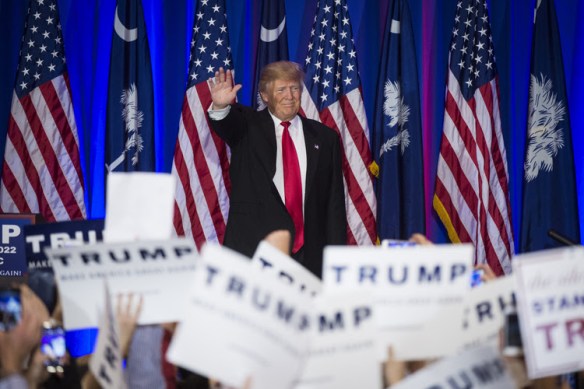
Donald Trump takes the stage in Spartanburg, S.C., last night.&nbsp;(Photo by Jabin Botsford/The Washington Post)</p>

THE BIG IDEA:

Good morning from GREENVILLE, South Carolina.

Marco Rubio will edge out Ted Cruz for second place in the Republican primary here. With 100 percent of precincts reporting, the Florida senator received 165,881 votes to the Texas senator’s 164,790. Jeb Bush dropped out after getting less than 8 percent of the vote.

But the big stories out of last night are Donald Trump’s decisive 10-point win and Hillary Clinton’s 5.5-point victory in the Democrats’ Nevada caucuses. The billionaire and the former Secretary of State are now each in the driver’s seat, front-runners to win their party’s respective nominations. Both won two of their first three contests and are strong favorites to win the fourth (Nevada for Trump this Tuesday; South Carolina for Clinton next Saturday).

— The deeply-divided anti-Trump factions in the GOP really only have three weeks to get their act together if they’re going to stop the first-time candidate. If Donald wins Cruz’s home state of Texas on March 1 and then Rubio’s home state of Florida on March 15, it’s difficult to see how the convention in Cleveland does not become his coronation. “Let’s put this thing away and let’s make America great again,” a confident Trump said last night.

— Cruz failed to carry a single county, including here in the deeply-religious Upstate, which should be tailor-made for someone with his profile. As National Review executive editor Rich Lowry put it, “If tonight is any indication of his strength versus Trump, how is Cruz going to win any March 1 state besides Texas?”

— While Rubio got his groove back after the fifth-place finish in New Hampshire and benefits from Bush being out, it’s not at all clear which will be the first state he actually wins. Remember only a few weeks ago top people linked to his campaign were saying they could win South Carolina outright.

— “As the campaign moves soon from a series of isolated contests in single states to primary days with multiple contests across a much wider terrain, Trump holds some key advantages,” Dan Balz explains in his column today. “The principal one is that the race will become ever more nationalized, favoring someone who has shown mastery for dominating media coverage at the expense of his rivals. A second is that his coalition appears similar to that of past winners of the nomination, as he is doing better than the others among Republicans who call themselves ‘somewhat conservative’ or ‘moderate,’ rather than those who say they are ‘very conservative.’ … A third is that against a divided opposition, Trump can continue to win primaries and caucuses with less than half the vote. That could become significantly more valuable starting on March 15, when states award delegates on some version of a winner-take-all basis.”

— NBC’s Chuck Todd notes that Trump won by double digits despite defending Planned Parenthood, saying George W. Bush lied about weapons of mass destruction as a pretense to invade Iraq and getting into a war of words with Pope Francis.

‘The Rise of the American Taliban


EXETER, NH - FEBRUARY 04:  Republican presidential candidate Donald Trump speaks during a campaign rally at the Exeter Town Hall on February 4, 2016 in Exeter, New Hampshire. Democratic and Republican Presidential candidates are stumping for votes throughout New Hampshire leading up to the Presidential Primary on February 9th.  (Photo by Joe Raedle/Getty Images)

TRUMP DUSSELDORF

[REPORTED IN FOREIGN POLICY FEB 4, 2016]: I guess if Pakistan is bewildered by Trump and Putin is enthusiastic (perhaps not the endorsement that Trump needs) and his effigy is a hit in Dusseldorf,and he’s “Taken New Hampshire”, the dude is having a very good week… shiels/2/11/16

DISPATCH
‘The Rise of the American Taliban
Pakistan’s elite on the Trump phenomenon.
BY LAWRENCE PINTAK FEBRUARY 4, 2016
‘The Rise of the American Taliban’
KARACHI, Pakistan — In the strongholds of hard-line Pakistani Islamist thought, they are talking about Donald Trump and laughing. Then they shake their heads with concern. “He doesn’t belong in the White House, he belongs in a mental hospital,” 46-year-old Hafez Tahrir Ashrafi, a Muslim cleric who is head of the country’s Ulema Council, told me with a throaty roar. An obese man with a wild dark beard, Ashrafi is an advisor to the Pakistani government and a former jihadi who fought in Afghanistan as a youth — Pakistani media has quoted him endorsing suicide bombing against U.S. troops in Afghanistan. “We do not believe the Americans will elect a man like that with his very dirty statements,” Ashrafi continued. “But if that happens, then he creates the problem not for the Muslims, but for the Americans and for himself.”

Ashrafi is not alone in that view. Sen. Ted Cruz may have won Iowa, but it’s Trump who has Pakistan’s elite simultaneously amused and concerned.Sen. Ted Cruz may have won Iowa, but it’s Trump who has Pakistan’s elite simultaneously amused and concerned. Ten days of interviews in late January with a broad cross-section of Pakistani intelligentsia — Islamists, liberals, policymakers, and bloggers — can be summed up in a single sentence: Trump is a clown, but he is a dangerous clown who could cause long-term damage to U.S. relations with the Muslim world.

Pakistan’s relationship with the United States is complex. It has been a vital ally in the Afghan war, but its intelligence services have played both ends against the middle, supporting some extremists for its own geopolitical aims, while battling others. The country is in a virtual state of civil war and there are deep divisions between the civilians and military leadership. The army has been locked in a major offensive against militants in the tribal areas and a simultaneous operation to wrest back control of Karachi, the commercial capital, from militias and criminal gangs, and there are ongoing rebellions in several parts of the country. But Pakistan’s importance to U.S. foreign policy is seen in both its efforts to help broker a deal in Afghanistan and its efforts to mediate between Saudi Arabia and Iran.

And it’s that positive side that makes Trump’s campaign rhetoric so problematic. “When people who are not sophisticated hear his comments and see Americans voting for him, that translates into anti-U.S. sentiment,” says Dr. Ishrat Husain, a former central bank governor under the early 21st-century regime of Gen. Pervez Musharraf. “We can only hope he doesn’t get the nomination. That would be a disaster.”

But many Pakistanis who are “sophisticated” also question what Trump’s success so far says about the direction of American society. They fear they are getting a glimpse into the dark side of the American psyche — and seeing it reflected back in their own. More than 4,600 people died of violence in Pakistan in 2015, according to the country’s Centre for Research and Security Studies — which in itself is a sharp drop from the more than 7,600 people who died in 2014.

“We’re living in a world where we seem to be competing for the space from which you can preach or promote intolerance of the other,” says Zohra Yusuf, chairperson of the nonprofit Human Rights Commission of Pakistan, with exhaustion in her voice.

Inside the heavily fortified walls of the Lahore University of Management Sciences, some of the country’s best and brightest study business, computer science, and engineering, with images of careers in the United States dancing in their heads. “Social media is full of posts about Trump,” a graduate student, who asked not to give her name, told me when I asked if Pakistanis are paying attention to the campaign. “Positive or negative?” I teased, just to see the reaction. She and her friends erupted in laughter. “Negative, of course!”

In Pakistan these days, one hears much talk of visas denied and dreams quashed. The daughter of a close friend recently earned her medical degree. She just returned home to the city of Lahore after three months looking for opportunities in the United States where she had always dreamed of being a doctor. Now she is having second thoughts. An Australian or New Zealand accent may be in her future. “She just didn’t feel comfortable with all she was hearing and seeing on television,” my friend told me. “She felt like people were judging her wherever she went.”

Trump may be a fixture on the social media feeds of educated Pakistani youth, but he has been largely AWOL from the mainstream media. Ditto the primaries as a whole. “It barely comes up in our editorial meetings,” Fahd Husain, executive director of Express News TV, one of Pakistan’s dozens of often-sensational news channels, told me, sitting in his Lahore newsroom.

At the Karachi headquarters of Geo TV, one of the country’s largest networks, I heard much the same. Geo has aired most of the GOP and Democratic debates with Urdu translations, but the broadcasts have elicited relatively little comment. “People are more concentrated on what’s happening in Pakistan,” says Azhar Abbas, Geo’s news chief. Not surprising given that the nation is still reeling from the deaths of more than 20 people, most of them students, in a January attack on a university — just the most egregious recent example of the daily carnage. “Now we will not kill the soldier in his cantonment, the lawyer in the court, or the politician in parliament, but in the places where they are prepared, the schools, the universities, the colleges that lay their foundation,” a Pakistani Taliban leader warned after the attack.

Badr Alam, the self-effacing editor of The Herald, an English-language newsweekly, sheepishly notes that another reason for the lack of coverage of Trump — and the campaign in general — is that many Pakistanis, including editors, simply don’t understand the U.S. primary system. “In the media I think there will be 10-15 people who would really know how the election happens.”

But Hameed Haroon, Pakistan’s most influential publisher — and Badr’s boss — says there is also a conscious decision on the part of some editors not to stir the international relations pot. The Pakistani media does not normally hesitate to publish anti-American rants, but Haroon, whose family owns the Dawn media group, says those opinions are usually tied to specific U.S. policy actions and include “a retreat mechanism,” by which he means that when policies or policymakers change, the framing of the United States in the media changes.

Trump, says Haroon, endangers that fail-safe “retreat mechanism” in U.S.-Pakistani relations. “It’s not a conscious censorship as such, [but] to enshrine Trump as an example of how bad America is would open up darker perspectives and dis-balance the possibility of any positive perception of America in this region,” he told me.

Not everyone is so grim. “The Europeans have become more tolerant [toward Islam], but tolerance can be condescending,” says Muneer Kamal, chairman of both the Karachi Stock Exchange and the National Bank of Pakistan, who thinks Trump is an aberration. “The Americans have moved to a completely different place — acceptance” of Muslims.

Still, Trump and Hillary Clinton are upending Pakistan’s policy worldview about relations with Washington: Since Dwight D. Eisenhower, according to the well-worn trope, Democrats tilt toward India, Republicans tilt toward Pakistan (and more problematically, Pakistani military dictatorships). Clinton may be a Democrat, but she’s a proven commodity — someone Islamabad can deal with. The battle of inflammatory soundbites on the Republican side has Pakistani heads spinning.The battle of inflammatory soundbites on the Republican side has Pakistani heads spinning. “This time around,” according to retired Ambassador Ali Sarwar Naqvi, head of the Center for International Strategic Studies think tank, which is close to Pakistan’s military and political leadership, “we can’t make sense of the Republican party.”

“You need a dose of Hillary to clean out a dose of Trump,” says Dawn’s Haroon. But he and others worry that isn’t enough, that something more fundamental is taking place in American society that will reshape U.S. foreign policy.

There’s that theme again: the dark side. Economist Kaiser Bengali, an advisor to the governor of the province of Baluchistan, calls it “the rise of the American Taliban,” which he says began in the Reagan administration and is now hitting critical mass with the Trumpites. “This is against the democratic values,” warns Dr. Farid Ahmed Piracha, number two in Jamaat-e-Islami, Pakistan’s largest Islamist group. “If there is such mindset, then there will be more difficulties for the United States and more terrorism.”

But let’s not be misled. As every foreign correspondent knows, there is one ultimate go-to source for the real ground truth in every country: the taxi driver.

Heading through the deserted, early morning streets toward the airport in the military capital Rawalpindi, fending off hawkers and beggars at each red light, my hotel driver Syed and I talked U.S. politics. On the other side of the world, Iowans were donning boots and parkas as they headed toward — well, wherever it is Iowans go in that bizarre quadrennial ritual.

“How many days lasts American election?” asked Syed.

“Ten months,” I replied, wondering how I was going to explain this.

There was a long, pregnant pause.

“Hillary is a nice lady,” he said.

And we drove on.

Image Credit: Joe