| AUGUST 30, 2023| |
| 1How U.N. Peacekeeping Accidentally Fuels Africa’s Coups Foreign funds can produce stronger and less accountable militaries.By Jamie Levin, Nathan Allen |
By Jamie Levin and Nathan Allen, an associate professor of political science at St. Francis Xavier University in Canada.
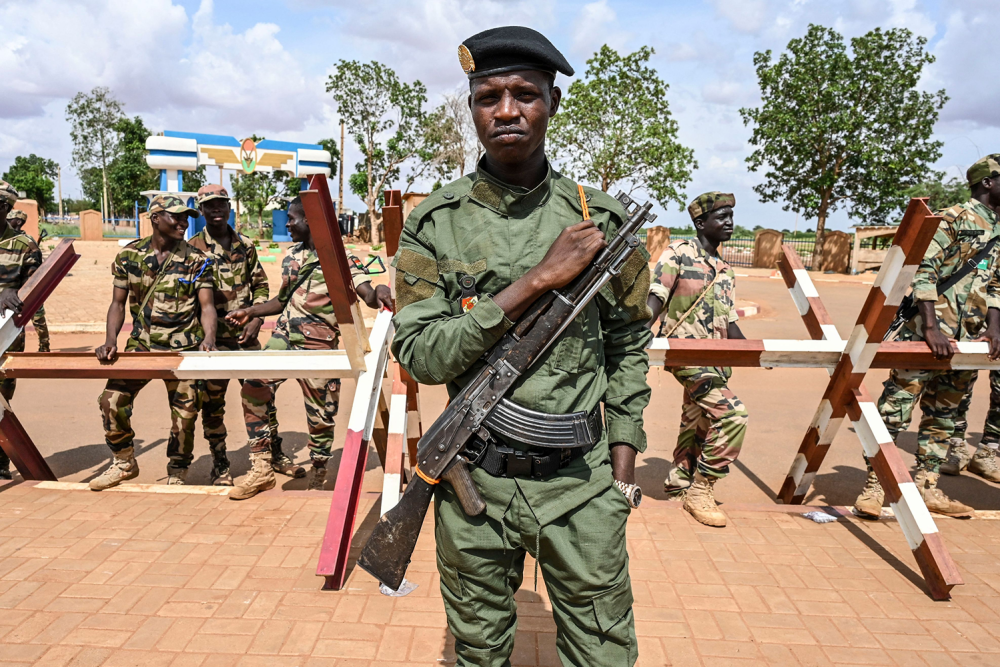
Officers of the National Police of Niger stand guard with Nigerien soldiers during a demonstration outside the Nigerien and French air bases in Niamey on Aug. 27 AFP VIA GETTY IMAGES
My FP: Follow topics and authors to get straight to what you like. Exclusively for FP subscribers. Subscribe Now | Log In
AUGUST 30, 2023, 4:06 PM
On July 26, Gen. Abdourahamane Tchiani detained Niger’s democratically elected president, Mohamed Bazoum, and installed himself as the head of the so-called National Council for the Safeguard of the Homeland, a military junta. Less than a week later, on July 30, the Economic Community of West African States (ECOWAS) issued the junta an ultimatum: Return the former president to power within one week or face the threat of additional sanctions and military force. The region has experienced a wave of coups in recent years, and ECOWAS is rightly concerned about their spread.
That ultimatum has since expired, with Tchiani remaining steadfast, sparking a crisis for ECOWAS. On Aug. 10, the bloc put its forces on alert, with member states Nigeria, Senegal, Benin, and Ivory Coast all pledging to contribute troops to restore democracy to Niger. Meanwhile, Burkina Faso and Mali—themselves both run by military juntas—have sent “solidarity” missions to Niger, bringing the region to the brink of war.
Not much is known about Tchiani himself, and the junta has been tight-lipped, leading to intense speculation about the motives for the coup. Much has been written about Tchiani’s role as the head of the presidential guard—charged with protecting Bazoum—and his alleged part in a previous foiled coup attempt. Rumors had been swirling that Bazoum had been planning to remove Tchiani, but little attention has been paid to his previous role as a United Nations peacekeeper.
Tchiani’s military career saw him serving on U.N. missions in Ivory Coast, the Democratic Republic of the Congo, and Sudan, in addition to several regional multilateral missions. His career is emblematic of a new crop of military professionals with significant international service records. Considering the historical evolution of peacekeeping allows us to contextualize these blue helmets-cum-coup plotters like Tchiani.
Since the end of the Cold War, the international community and the United Nations have increasingly funded the militaries of undemocratic or weakly democratic countries to feed the growing demand for peacekeeping. And countries such as Niger have been eager to pick up the mantle. In the five years enfolding the end of the Cold War, the United Nations authorized 20 new peacekeeping missions requiring an almost sevenfold growth in the number of troops, from 11,000 to 75,000. Today, that number tops 90,000 peacekeepers deployed worldwide.
At the same time, wealthy democracies retreated from peacekeeping, increasing dependence on countries such as Niger. Where previous missions largely involved observation along clearly demarcated cease-fire lines, post-Cold War missions—which are sometimes referred to as second-generation peacekeeping—were more demanding and typically bloodier. Troops are now regularly tasked with securing cease-fires between warring parties in ongoing civil wars.
In 1990, the top contributors of peacekeepers were Canada, Finland, Austria, Norway, Ireland, the United Kingdom, and Sweden—all liberal democracies. By 2015, they had been replaced by Bangladesh, Pakistan, Ethiopia, Rwanda, Nigeria, and Egypt, all less democratic states with histories of regime instability.
While the effects of peacekeeping on the countries where peacekeepers are deployed are positive and well-established, the effects on the states that send troops—like Niger—are heavily contested. Some analysts suggest that peacekeeping has salutary effects for democratization among sending states, socializing them to the norms of human rights and incentivizing them to follow the rule of law because “insubordination”—read, coups—would jeopardize future missions and the lucrative incentives that accompany them for the peacekeepers, who are compensated generously for the task. The U.N. spends more than $6 billion on peacekeeping annually, much of it going to troop reimbursements and material costs. Peacekeeping remuneration can make up a significant proportion of sending states’ military budgets as well as individual soldier take-home pay, particularly in less developed countries. Indeed, some countries are today alleged to peace-keep for profit.
But others caution that peacekeeping has more mixed effects, potentially entrenching autocratic rule and contributing to coup propensity in brittle democracies like Niger.
While peacekeeping may socialize sending states into the cosmopolitan values associated with the United Nations, there are all too many examples where abuses are tolerated and illiberal norms are instead strengthened.
And in reality, the international community has grown overly dependent on these countries for peacekeeping and has therefore been reluctant to sanction them, even when their behavior departs considerably from liberal norms. Indeed, some states have used peacekeeping to build more muscular armed forces. The result is often a more empowered military, throwing off the balance with civil authorities, often in countries with past histories of coups.

 fshiels