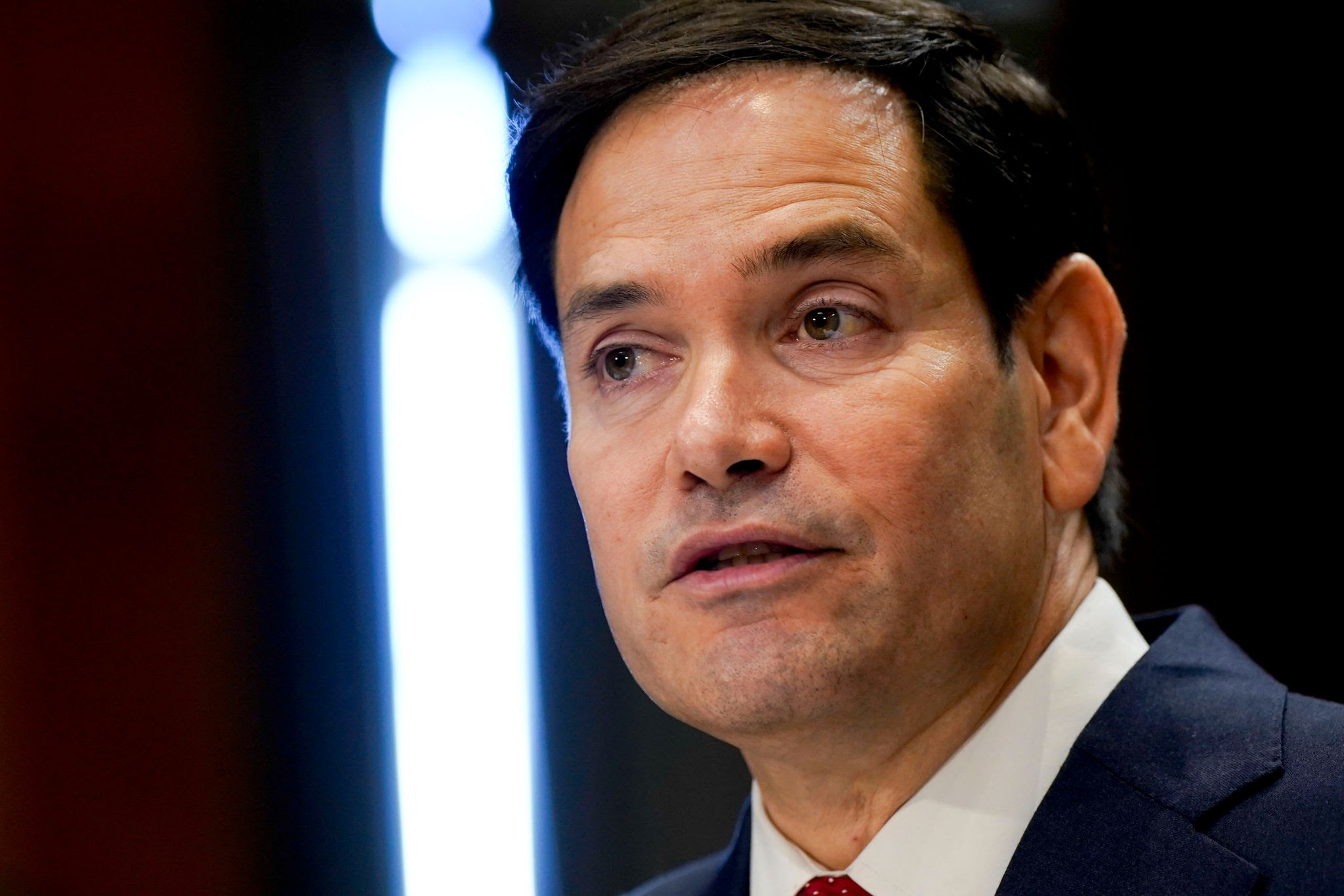
Secretary of State Marco Rubio on Sunday said the “best way” to end the war between Russia and Ukraine is through “a full peace deal,” but he clarified that a ceasefire is “not off the table.”
During an appearance on NBC’s “Meet the Press,” host Kristen Welker asked Rubio about President Trump’s past threats of “severe consequences” for Russia if it did not agree to stop its war in Ukraine after the president met with Russian President Vladimir Putin last week, a meeting that did not end with an agreement on Ukraine. She noted that Trump is now asking for a broader peace deal after the meeting.
“There’s no doubt about that,” Rubio said about a peace deal being the ideal outcome. “I mean, who would be against the fact if tomorrow we came to you and said, ‘We have a full peace deal and it’s done.’ I think that’s the best way to end the war.”
Rubio noted that the aim of the meetings are not for a ceasefire, but for an end to the war.
“Now, whether there needs to be a ceasefire on the way there, well, we’ve advocated for that,” he said. “Unfortunately, the Russians, as of now, have not agreed to that. But the ideal here, what we’re aiming for here, is not a ceasefire. What we ultimately are aiming for is an end to this war.”
FAST Weather hit 8/15/2025
Next
Stay
When pushed on Trump’s change in tune from threatening “severe consequences” against Russia, Rubio said the country is “already facing very severe consequences,” noting “not a single sanction” has been lifted.
“Ultimately, look, if we’re not going to be able to reach an agreement here at any point, then there are going to be consequences, not only the consequences of the war continuing, but the consequences of all those sanctions continuing and potentially new sanctions on top of it as well,” Rubio said.
Sign up for the Morning Report
The latest in politics and policy. Direct to your inbox.
By signing up, I agree to the Terms of Use, have reviewed the Privacy Policy, and to receive personalized offers and communications via email, on-site notifications, and targeted advertising using my email address from The Hill, Nexstar Media Inc., and its affiliates
Rubio warned that adding new sanctions on Russia won’t necessarily lead to a ceasefire.
“I don’t think new sanctions on Russia are going to force him to accept the ceasefire,” he added. “They’re already under very severe sanctions. You could argue that that could be a consequence of refusing to agree to a ceasefire or the end of hostility.”
When Welker asked why Trump hasn’t “punished” Putin since taking office, noting that critics may see his statements as “empty threats,” Rubio argued, “Every single sanction that was in place on the day he took over remain.”
“They face consequences every single day,” he continued. “But the bottom line is that that has not altered the direction of this war. That doesn’t mean those sanctions are inappropriate. It means it hasn’t altered the outcome of it. And here’s what we do think is important, and that is that we end this war. To end this war, you have to be able to engage with the Russians.”
Rubio’s comments come after Trump met with Putin on Friday in Alaska in a three-hour meeting alongside senior Russian and U.S. officials, Rubio and special envoy Steve Witkoff, and two Russian aides.
The strike set several aircraft on fire, video showed, and dealt a symbolic blow to Moscow’s relentless bombing campaign.
Ukraine Strikes Russian Air Bases in Large-Scale Drone Attack
This is great for Ukrainian morale– STUNNING. Its was a tactical tour de force. The effect on Russia– Russian Revenge might be another thing.
0:58Ukraine launched one of its broadest assaults of the war against air bases inside Russia, targeting sites from eastern Siberia to Russia’s western border.CreditCredit…Anatolii Stepanov/Reuters
Ukraine said it secretly planted a swarm of drones in Russia and then unleashed them in a surprise attack on Sunday, hitting airfields from eastern Siberia to Russia’s western border.
The strike set several Russian aircraft on fire, stunned the Kremlin and dealt a strategic and symbolic blow to Moscow’s relentless bombing campaign in Ukraine.
Russian officials said that there were no casualties and that other Ukrainian attacks had been repelled.
Russia’s Defense Ministry said on Sunday that Ukrainian drones had attacked airfields in five regions stretching across five time zones. Several aircraft caught fire in the regions of Murmansk, near the border with Norway, and Irkutsk, in eastern Siberia, the ministry said.
“Some participants of the terrorist attacks were detained,” it said.
Ukraine said that 117 drones were used in the attacks. An official in Ukraine’s security services, known as the S.B.U., said that dozens of aircraft had been damaged in the strikes. The person spoke on the condition of anonymity to discuss a sensitive intelligence operation.
It was not immediately possible to independently confirm the Ukrainian claim or the details from Russia’s Defense Ministry.
Want to stay updated on what’s happening in Russia and Ukraine? Sign up for Your Places: Global Update
, and we’ll send our latest coverage to your inbox.
The New York Times verified videos that showed successful strikes at Olenya air base in the Murmansk region and the Belaya air base in the Irkutsk region. It also verified damage to at least five aircraft — four of them strategic bombers.
What more did the Ukrainians say?
The plan was called Operation Spider’s Web. Drones were planted across Russia, near military bases, the Ukrainian said, and then activated simultaneously.
President Volodymyr Zelensky of Ukraine said on social media Sunday that planning had begun a year and a half ago. He called the results “absolutely brilliant.”
Those involved in the attack, he added, were withdrawn from Russia before it took place.
On Monday, the Ukrainians offered more details about the operation. Over many months, they said, dozens of drones were secretly transported into Russia. They were packed onto pallets inside wooden containers with remote-controlled lids and then loaded onto trucks, an S.B.U. statement said.
Ukrainian officials said the crates were rigged to self-destruct after the drones were released. There was no indication that the drivers of the trucks knew what they were hauling, Ukrainian officials said.
President Volodymyr Zelensky of Ukraine said on social media Sunday that planning for the strike had begun a year and a half ago. He called the results of the assault “absolutely brilliant.”Credit…Mindaugas Kulbis/Associated Press
The scale and details of the operation could not be independently verified.
A video verified by The Times shows two drones being launched from containers mounted on the back of a semi-truck less than four miles from the Belaya air base. Both drones fly in the direction of large plumes of smoke rising from the base. Footage recorded shortly afterward shows the same containers ablaze.
Another video shows drones flying less than four miles from the Olenya air base. The person recording could be heard suggesting that the drones had been launched from a truck parked just down the road. The Times could not confirm that those drones had been part of the assaults.
How much damage did Russia’s bombers sustain?
Ukraine said 41 planes had been hit, or about one-third of the strategic cruise-missile carriers at Russian air bases across three time zones. The Times verified that four Tu-95 bombers and one Antonov cargo plane were hit.
Russian military bloggers said the Ukrainian damage estimates were inflated. One influential Russian military blogger, Rybar, put the number of damaged Russian aircraft at 13, including up to 12 strategic bombers.
Western estimates suggest that Russia had slightly more than 60 active Tu-95s and about 20 Tu-160 bombers, according to Col. Markus Reisner, a historian and an officer in the Austrian Armed Forces. “Replacing losses will be very challenging,” he said.
The Ukrainian operation appears to have put a “real dent” in Russia’s ability to launch large salvos of cruise missiles, said Ben Hodges, a retired general who commanded the U.S. Army in Europe. “The surprise that they achieved will have a shock on the system as the Russians try to figure out how these trucks loaded with explosives got so deep inside of Russia,” he added.
Why are the strikes significant?
“This is a stunning success for Ukraine’s special services,” said Justin Bronk, a senior research fellow for air power and technology at the Royal United Services Institute in London.
“If even half the total claim of 41 aircraft damaged/destroyed is confirmed, it will have a significant impact on the capacity of the Russian Long Range Aviation force to keep up its regular large-scale cruise missile salvos against Ukrainian cities and infrastructure, whilst also maintaining their nuclear deterrence and signaling patrols against NATO and Japan,” he said in an email.
The attack in Irkutsk, on the Belaya air base, was also the first time that any place in Siberia had been attacked by Ukraine’s drones since the war began with Russia’s full-scale invasion in February 2022.
The Olenya base in the Murmansk region, which also came under attack, is also one of Russia’s key strategic airfields, hosting nuclear-capable aircraft.
Ukraine had executed ambitious drone attacks on Russian territory before, but Russia had defended against them. In late 2022, Kyiv targeted two airfields hundreds of miles inside Russia using long-range drones. But Russia adapted to such strikes, building protective structures around depots at bases, bringing in more air-defense assets and routinely repositioning its fleet.
Ukraine — which has banked on expanding the use of domestically produced drones — turned to a new approach and, in the process, put together a playbook that others facing off against a more powerful enemy may adopt, as well.
What did Ukraine hope to gain?
The idea behind Operation Spider’s Web was to transport small, first-person-view drones close enough to Russian airfields to render traditional air-defense systems useless, officials said.
The operation ranks as a signature event on par with the sinking of the Russian flagship Moskva early in the war and the maritime drone assaults that forced the Russian Navy to largely abandon the home port of the Black Sea Fleet in Sevastopol, Crimea, which Moscow said in 2014 that it had “annexed.”
Although the full extent of the damage from Ukraine’s strikes on Sunday is unknown, the attacks showed that Kyiv was adapting and evolving in the face of a larger military with deeper resources.
The Ukrainian strikes came a day before Russia and Ukraine met in Istanbul for further peace talks. While Kyiv shared its peace terms with Moscow ahead of the meeting, Russia presented its terms only on Monday. The Ukrainian delegation said it would need a week to review Moscow’s proposal, delaying further discussion.
At a NATO meeting of Baltic and Nordic countries, Mr. Zelensky said on Monday that the operation showed Russia that it was also vulnerable to serious losses and “that is what will push it toward diplomacy.”
But analysts say the attacks are unlikely to alter the political calculus of Russia’s president, Vladimir V. Putin. There was no indication that the attack had changed the Kremlin’s belief that it holds an advantage over Ukraine, as it counts on the weakening resolve of some of Kyiv’s allies and its ability to grind down outnumbered Ukrainian troops.
Marc Santora has been reporting from Ukraine since the beginning of the war with Russia. He was previously based in London as an international news editor focused on breaking news events and earlier the bureau chief for East and Central Europe, based in Warsaw. He has also reported extensively from Iraq and Africa.
Devon Lum is a reporter on the Visual Investigations team at The Times, specializing in open-source techniques and visual analysis.
Key question for this article: SHOULD PUTIN ACCEPT A NEGOTIATED SOLUTION IN UKRAINE, WOULD HIS NEED TO “DECLARE VICTORY” BE ACCEPTED ZELENSKY (Symbolic Victory with little loss of Ukrainian territory in reality)~ Blog Editor FLS
Despite its bravado in public, the Kremlin has indicated its interest in striking a deal to halt the war — so long as it could still declare victory.
President Vladimir V. Putin of Russia speaking at a rally in February at Luzhniki Stadium in Moscow.Credit…Nanna Heitmann for The New York Times
President Vladimir V. Putin’s confidence seems to know no bounds.
Buoyed by Ukraine’s failed counteroffensive and flagging Western support, Mr. Putin says that Russia’s war goals have not changed. Addressing his generals on Tuesday, he boasted that Ukraine was so beleaguered that Russia’s invading troops were doing “what we want.”
“We won’t give up what’s ours,” he pledged, adding dismissively, “If they want to negotiate, let them negotiate.”
But in a recent push of back-channel diplomacy, Mr. Putin has been sending a different message: He is ready to make a deal.
Mr. Putin has been signaling through intermediaries since at least September that he is open to a cease-fire that freezes the fighting along the current lines, far short of his ambitions to dominate Ukraine, two former senior Russian officials close to the Kremlin and American and international officials who have received the message from Mr. Putin’s envoys say.
In fact, Mr. Putin also sent out feelers for a cease-fire deal a year earlier, in the fall of 2022, according to American officials. That quiet overture, not previously reported, came after Ukraine routed Russia’s army in the country’s northeast. Mr. Putin indicated that he was satisfied with Russia’s captured territory and ready for an armistice, they said.
Ukrainian soldiers atop an armored vehicle last year in Ukraine’s northeastern Kharkiv region. Credit…Finbarr O’Reilly for The New York TimesThe bodies of Russian soldiers outside Lyman, Ukraine, in October 2022 after a railroad hub was retaken by Ukrainian forces.Credit…Nicole Tung for The New York Times
Mr. Putin’s repeated interest in a cease-fire is an example of how opportunism and improvisation have defined his approach to the war behind closed doors. Dozens of interviews with Russians who have long known him and with international officials with insight into the Kremlin’s inner workings show a leader maneuvering to reduce risks and keep his options open in a war that has lasted longer than he expected. While deploying fiery public rhetoric, Mr. Putin privately telegraphs a desire to declare victory and move on.
“They say, ‘We are ready to have negotiations on a cease-fire,’” said one senior international official who met with top Russian officials this fall. “They want to stay where they are on the battlefield.”
There is no evidence that Ukraine’s leaders, who have pledged to retake all their territory, will accept such a deal. Some American officials say it could be a familiar Kremlin attempt at misdirection and does not reflect genuine willingness by Mr. Putin to compromise. The former Russian officials add that Mr. Putin could well change his mind again if Russian forces gain momentum.
In the past 16 months, Mr. Putin swallowed multiple humiliations — embarrassing retreats, a once-friendly warlord’s mutiny — before he arrived at his current state of relaxed confidence. All along, he waged a war that has killed or maimed hundreds of thousands while exhibiting contradictions that have become hallmarks of his rule.
While obsessed with Russia’s battlefield performance and what he sees as his historic mission to retake “original Russian lands,” he has been keen for most Russians to go on with normal life. While readying Russia for years of war, he is quietly trying to make it clear that he is ready to end it.
“He really is willing to stop at the current positions,” one of the former senior Russian officials told The New York Times, relaying a message he said the Kremlin was quietly sending. The former official added, “He’s not willing to retreat one meter.”
Passengers waiting for delayed flights in August in Moscow. The airspace had been closed that morning because of drone strikes.Credit…Nanna Heitmann for The New York TimesA damaged skyscraper in a Moscow business district after a reported drone attack in August.Credit…Nanna Heitmann for The New York Times
Mr. Putin, the current and former officials said, sees a confluence of factors creating an opportune moment for a deal: a battlefield that seems stuck in a stalemate, the fallout over Ukraine’s disappointing offensive, its flagging support in the West, and, since October, the distraction of the war in Gaza. The officials spoke on the condition of anonymity, like others interviewed for this article, because of the sensitive nature of the back-channel overtures.
Responding to written questions after declining an interview request, Mr. Putin’s spokesman, Dmitri S. Peskov, said in a voice message that “сonceptually, these theses you presented, they are incorrect.” Asked whether Russia was ready for a cease-fire at the current battle lines, he pointed to the president’s recent comments; Mr. Putin said this month that Russia’s war goals had not changed.
“Putin is, indeed, ready for talks, and he has said so,” Mr. Peskov said. “Russia continues to be ready, but exclusively for the achievement of its own goals.”
Ukraine has been rallying support for its own peace formula, which requires Moscow to surrender all captured Ukrainian territory and pay damages. President Volodymyr Zelensky said Tuesday that he saw no sign that Russia wanted to negotiate.
“We just see brazen willingness to kill,” he said.
Early Talks
Mr. Putin first explored peace talks in the early weeks of the war, but they fell apart after Russia’s atrocities in Ukraine came to light. Then, in the fall of 2022, after Russia’s embarrassing retreat from northeastern Ukraine, Mr. Putin again sent messages to Kyiv and the West that he would be open to a deal to freeze the fighting, American officials say.
Some of Ukraine’s supporters, like Gen. Mark A. Milley, then the chairman of the Joint Chiefs of Staff, encouraged Kyiv to negotiate because Ukraine had achieved as much on the battlefield as it could reasonably expect. But other top American officials believed it was too soon for talks. And Mr. Zelensky vowed to fight on until the entire country had been freed from Russia’s grasp.
By early 2023, gloom had settled over Moscow. On eastern Ukraine’s frozen plains, much of Russia’s prewar professional force had been decimated, leaving poorly trained draftees and convicts recruited from prisons to be gunned down in haphazardly planned infantry storms.
Mr. Putin said little in public about the war, stoking questions about his plans and motivations. In private, though, Mr. Putin embraced his role as commander in chief with an almost messianic determination during these months, the people close to the Kremlin contend. One said last February that the president held two videoconferences a day with military officials who briefed him on the minutiae of movements on the battlefield.
The funeral for Garipul S. Kadyrov, a Russian soldier who was killed while fighting in Ukraine, last month in the village of Ovsyanka, Russia.Credit…Nanna Heitmann for The New York TimesRecruitment advertising for the Russian Army featuring the slogan, “People are not born heroes — they are self-made,” in May in Ivolginsk, Russia.Credit…Nanna Heitmann for The New York Times
The war was “impossible to stop,” the person said, describing a conversation with a top Russian military official, because Mr. Putin “remains consumed by all this.”
“People want to tell him only good news, and there’s not much of that,” the person said. “So you have to lie.”
Sergei K. Shoigu, the Russian defense minister, made clear in a private meeting earlier this year that, despite his setbacks, Mr. Putin was determined to keep fighting. According to the senior international official, who was present, Mr. Shoigu gave statistics showing Russia’s advantage in tanks and warplanes and its plans to increase defense production. He boasted that Russia could mobilize as many as 25 million men, the official recalled.
“For Putin, it’s about Russia versus the U.S. and the West,” the official said after the meeting. “Putin can’t afford to back down.”
Turning Points
As Ukraine launched its long-anticipated counteroffensive in June, Mr. Putin appeared tense, anxious for battlefield updates, people close to the Kremlin said. In public, Mr. Putin became a live commentator of the fight, eager to claim incremental successes.
“The enemy is trying to attack,” Mr. Putin said onstage at his marquee St. Petersburg International Economic Forum on June 16, describing a battle happening “right now.” “I think the armed forces of Ukraine have no chance.”
The same day, a delegation of African leaders arrived in Kyiv hoping to broker peace. At one point, Ukrainian officials rushed them into a shelter, warning of an attack. The next day, in St. Petersburg, President Cyril Ramaphosa of South Africa asked Mr. Putin whether he had really bombed the Ukrainian capital while the African leaders were there.
“Yes, I did,” Mr. Putin responded, according to two people close to Mr. Ramaphosa, “but I made sure it was very far from where you were.”
He still tried to play the gracious host, taking the leaders on a dinner cruise. A member of the African delegation said Mr. Putin seemed interested in preparing a channel for future talks.
“It’s not that I want to negotiate,” the person said, describing Mr. Putin’s stance. “But I need to have ready, when the time will come, a very well-conceived, intelligent, capable channel of negotiations.”
The body of a Russian soldier in July in the Zaporizhzhia region, where Ukraine was waging a counteroffensive.Credit…Tyler Hicks/The New York TimesPart of a delegation of African leaders to Kyiv, Ukraine, in June visited an exhibition of destroyed Russian military equipment.Credit…Brendan Hoffman for The New York Times
A week later, the mercenary warlord Yevgeny V. Prigozhin launched his failed mutiny.
After Mr. Prigozhin accepted a deal to retreat to Belarus, Mr. Putin proceeded to spin what seemed to be one of the most humiliating moments of his 24 years in power into a victory. He declared in a lavish Kremlin ceremony that the failure of the rebellion demonstrated the strength of the Russian state. It offered a hint of what Mr. Putin might do if he fell short of his original goals in Ukraine: declare victory and move on.
The Kremlin’s analysis appeared to be that public support for the war was broad, but not deep — meaning that most would accept whatever Mr. Putin termed a victory. One of the government’s pollsters, Valery Fyodorov, said in a September newspaper interview that only 10 to 15 percent of Russians actively supported the war, and that “most Russians are not demanding the conquest of Kyiv or Odesa.”
By the end of the summer, events were shifting in Mr. Putin’s favor. Mr. Prigozhin’s death in a plane crash, widely seen as the Kremlin’s doing, eliminated his most dangerous domestic foe. On the battlefield, Russia already appeared to be successful in repelling Ukraine’s counteroffensive.
Mr. Putin and his government exuded stability and confidence. The president continued to go for his morning swims, several people with knowledge of his schedule said. Top Kremlin officials had gone back to taking vacations.
“They’ve calmed down already,” Prime Minister Akylbek Zhaparov of Kyrgyzstan said in an interview in October, referring to the surprise and worry among many Russian officials and the elite when Mr. Putin invaded Ukraine last year. After first seeing Mr. Putin’s war as a “catastrophe,” he added, “they’ve now gotten used to it.”
Kremlin Confidence
On a Saturday in October, Mr. Putin marked his 71st birthday with the leaders of Uzbekistan and Kazakhstan, two Central Asian countries that have tried to take a neutral stance in the war. When they arrived at his suburban Moscow residence, Mr. Putin got behind the wheel of a new Russian-made limo, showing off one of the ways in which, in the Kremlin’s telling, Russia is becoming more self-sufficient.
Once indoors, the three leaders spoke about a plan to sell Russian gas to Uzbekistan. A person present recalled Mr. Putin’s calm confidence and relaxed body language.
“He doesn’t look like a man who’s waging war,” the person said.
A photograph released by Russian state media of President Vladimir V. Putin of Russia and President Shavkat M. Mirziyoyev of Uzbekistan in October near Moscow.Credit…Vyacheslav Prokofyev/Sputnik, via Associated PressPolice officers stood guard at the Porohovsky cemetery in St. Petersburg in August after it was announced that Yevgeny V. Prigozhin, the mercenary warlord, had been buried there.Credit…Nanna Heitmann for The New York Times
Only after a birthday lunch did they grasp the full significance of events elsewhere. It was Oct. 7.
The terrorist attack by Hamas that day — and Israel’s fierce military response — proved to be a propaganda boon for Russia, pulling attention away from Ukraine and allowing Mr. Putin to line up with much of the world in condemning the bombardment of Gaza and American support for Israel.
“He sees that the attention of the West is turning away,” said Balazs Orban, an aide to Prime Minister Viktor Orban who participated in the Hungarian leader’s meeting with Mr. Putin in October.
In late October, Grigory A. Yavlinsky, a liberal Russian politician, waited past midnight for an audience at the Kremlin. He said he tried to impress upon Mr. Putin the scale of the Russian deaths in Ukraine, which dwarfed Soviet losses over a decade of war in Afghanistan.
Then Mr. Yavlinsky made what he said was his central pitch in the 90-minute meeting: If Mr. Putin were prepared “at least to think about a cease-fire,” Mr. Yavlinsky, who was born in western Ukraine, would be ready to act as a negotiator.
“The fact that he agreed to talk to me for so long speaks for itself,” he said.
Cease-Fire Opening
Since at least September, Western officials have been picking up renewed signals that Mr. Putin is interested in a cease-fire.
The signals come through multiple channels, including via foreign governments with ties to both the United States and Russia. Unofficial Russian emissaries have spoken to interlocutors about the contours of a potential deal that Mr. Putin would accept, American officials and others said.
“Putin and the Russian army, they don’t want to stretch their capacity further,” said the international official who met with top Russian officials this fall.
Mr. Putin has also made vague public comments about being open to negotiations, which have largely been dismissed by Western commentators.
Some analysts argue that Mr. Putin benefits from a long war, and that he wants to delay any negotiation until a possible return to office by former President Donald J. Trump, the front-runner for the Republican presidential nomination in 2024. The former Russian officials said that Mr. Putin would prefer to strike a deal sooner, given the uncertainty inherent in war.
They said that Mr. Putin’s propaganda could easily spin the status quo as a victory, celebrating a land corridor to Crimea, an army that withstood Ukraine’s Western-supplied counteroffensive and Russia’s claimed annexation of four Ukrainian regions — papering over the fact that Russia doesn’t fully control them.
Ukrainian soldiers with the 22nd Mechanized Brigade firing at Russian positions in the direction of Bakhmut, in eastern Ukraine, last month. The front line has remained largely static over the past year.Credit…Tyler Hicks/The New York TimesA Ukrainian soldier who was severely injured on the front line in Avdiivka, in the Donetsk region of Ukraine, in November.Credit…Tyler Hicks/The New York Times
The ideal timing, one of the people said, would be before Russia’s presidential election in March. Mr. Putin is certain to secure another six-year term, but he cares deeply about the election as a marker of his domestic support.
Publicly, Mr. Putin has stuck to his aggressive stance, saying he is resisting a West seeking to destroy a 1,000-year-old Russian civilization.
But American officials see a shift in Mr. Putin’s position, noting that he is no longer demanding the departure of Mr. Zelensky’s government. They said that the cease-fire being floated by Mr. Putin would maintain a sovereign Ukraine with Kyiv as its capital, but leave Russia in control of the nearly 20 percent of Ukrainian territory it has already conquered. They added that while Mr. Putin is telegraphing that he is open to such a deal, he is waiting to be brought a more specific offer.
Among the many likely sticking points is Mr. Putin’s determination to keep Ukraine out of NATO. But one of the former Russian officials said a disagreement on that score would not be a deal breaker for Mr. Putin, because the alliance is not expected to admit Ukraine in the foreseeable future.
Still, senior American officials said they did not believe that any prominent Ukrainian politician could agree at this time to a deal leaving Russia with so much Ukrainian territory.
Russian conscripts in the Moscow region last year.Credit…Nanna Heitmann for The New York TimesA tour of the Victory Museum, a museum dedicated to the Great Patriotic War, in Moscow. Mr. Putin sees the current war as part of a historic Russian struggle against a West seeking to destroy a 1,000-year-old Russian civilization.Credit…Nanna Heitmann for The New York Times.
Another potential impasse stems from Mr. Putin’s efforts to put the United States at the center of any negotiations.
The U.S. and Russian governments have channels for communications on issues that include prisoner swaps. But William J. Burns, the director of the Central Intelligence Agency, and Sergei Naryshkin, the director of Russia’s foreign intelligence service, last met about a year ago in Turkey, officials said. And U.S. officials say the United States has not and will not negotiate on behalf of Ukraine.
American officials argue that regardless of Mr. Putin’s overture, Ukraine must demonstrate its staying power, and the United States must show it is willing to support Ukraine to puncture Mr. Putin’s confidence that time is on his side and to force concessions in any negotiations.
Many in the West are skeptical of a cease-fire because they say Mr. Putin would rearm for a future assault. President Edgars Rinkevics of Latvia argued in an interview that Mr. Putin was committed to war because he dreams of “re-establishing the empire.”
“They never honored any agreements,” Mr. Rinkevics said of the Russians, “and they have violated them immediately when they saw it was convenient.”
A heavily damaged church last month in the village of Bohorodychne, in Ukraine’s Donetsk region.Credit…Emile Ducke for The New York Times
Reporting was contributed by Neil MacFarquhar, John Eligon, Declan Walsh, Andrew E. Kramer and Valerie Hopkins.
Adam Entous is a Washington-based investigative correspondent and a two-time Pulitzer Prize winner. Before joining the Washington bureau of The Times, he covered intelligence, national security and foreign policy for The New Yorker magazine, The Washington Post and The Wall Street Journal. More about Adam Entous
Julian E. Barnes covers the U.S. intelligence agencies and international security matters for The Times. He has written about security issues for more than two decades. More about Julian E. Barnes
A version of this article appears in print on Dec. 24, 2023, Section A, Page 1 of the New York edition with the headline: Putin Quietly Signals Openness to Ukraine Deal. Order Reprints | Today’s Paper | Subscribe
So what to do about this? Russia identifies NATO as its biggest military threat
INTERNATIONALALEXEI DRUZHININ / RIA NOVOSTI / POOL / REUTERS Russia identifies NATO as its biggest military threat
Aiming a barb at NATO, Putin’s new military doctrine says Russia could use precision weapons as ‘strategic deterrent’
December 26, 2014 3:20PM ET
Russia identified NATO as the nation’s No. 1 military threat and raised the possibility of a broader use of precision conventional weapons to deter foreign aggression under a new military doctrine signed by President Vladimir Putin on Friday.
NATO flatly denied it was a threat to Russia and accused Russia of undermining European security.
The new doctrine, which comes amid tensions over Ukraine, reflects the Kremlin’s readiness to take a stronger posture in response to what it sees as the U.S.-led efforts to isolate and weaken Russia.
The paper maintains the provisions of the previous, 2010 edition of the military doctrine regarding the use of nuclear weapons.
It says Russia could use nuclear weapons in retaliation for the use of nuclear or other weapons of mass destruction against the country or its allies, and also in the case of aggression involving conventional weapons that “threatens the very existence” of the Russian state.
For the first time, the new doctrine says Russia could use precision weapons “as part of strategic deterrent measures,” without spelling out when and how Moscow could resort to them.
Among other provisions, the paper mentions the need to protect Russia’s interests in the Arctic, where the global competition for oil and other natural resources has been heating up as the Arctic ice melts.
Russia has relied heavily on its nuclear deterrent and lagged far behind the U.S. and its NATO allies in the development of precision conventional weapons. However, it has recently sped up its military modernization, buying large numbers of new weapons and boosting military drills.
NATO has said that a sharp rise in the number of Russian air patrols over the Baltics has put civilian flights at risk.
Earlier this month, Russia flexed its muscle by airlifting state-of-the art Iskander missiles to its westernmost point, Kaliningrad, a Russian oblast that borders NATO members Poland and Lithuania. The missiles were pulled back to their home base after the drills, but the deployment clearly served as a demonstration of the military’s readiness to quickly raise the ante in case of crisis.
Russia has threatened earlier that it could permanently station the Iskander missiles, which can hit targets up to about 300 miles away with high precision, in retaliation to U.S.-led NATO missile defense plans.
On Friday, the military successfully test-fired the RS-24 Yars intercontinental ballistic missile from the Plesetsk launchpad in northwestern Russia.
The 29-page doctrine is a stand-alone document outlining the top threats to Russia’s security and possible responses. The current edition is the third since Putin was first elected in 2000.
The doctrine placed “a buildup of NATO military potential and its empowerment with global functions implemented in violation of international law, the expansion of NATO’s military infrastructure to the Russian borders” on top of military threats to Russia.
It stressed that that the deployment of foreign military forces on the territory of Russia’s neighbors could be used for “political and military pressure.”
NATO spokeswoman Oana Lungescu responded by saying in a statement that the alliance “poses no threat to Russia or to any nation.”
“Any steps taken by NATO to ensure the security of its members are clearly defensive in nature, proportionate and in compliance with international law,” she said. “In fact, it is Russia’s actions, including currently in Ukraine, which are breaking international law and undermining European security.”
Russia’s relations with the West have plummeted to their lowest point since the Cold War, and NATO cut off ties with Moscow after it annexed Ukraine’s Crimean Peninsula in March. Ukraine and the West also have accused Moscow of fueling a pro-Russia insurgency in eastern Ukraine with troops and weapons. The Kremlin has denied those accusations.
“NATO will continue to seek a constructive relationship with Russia, as we have done for more than two decades,” Lungescu said. “But that is only possible with a Russia that abides by international law and principles — including the right of nations to choose their future freely.”
Former Soviet President Mikhail Gorbachev, who had been critical of Putin in the past, but who has strongly backed the Kremlin over its spat with the West, said Friday that Russia’s actions were a response to U.S. and NATO moves.
“I think the president is right to a large extent when he draws attention to a particular responsibility of the United States,” he said during a public event in Moscow.
The U.S. and the European Union have slapped sanctions against Moscow, which have deepened Russia’s economic woes and contributed to a sharp devaluation of the ruble, which lost about half of its value this year.
The economic crisis could challenge Russia’s ambitious weapons modernization program, but so far the Kremlin has shown no intention of scaling it back.
The program envisages the deployment of new nuclear-tipped intercontinental ballistic missiles, the construction of nuclear submarines and a sweeping modernization of Russia’s conventional arsenals.
Russia has been particularly concerned about the so-called Prompt Global Strike program under development in the U.S., which would be capable of striking targets anywhere in the world in as little as an hour with deadly precision.
The new doctrine mentioned the U.S. program as a major destabilizing factor along with NATO missile defense plans.
Russian officials have said that Moscow was working on a response to the new U.S. weapons, but have released no details.
Associated Press
SHARE THIS:
RELATED NEWS
PLACES
Russia
TOPICS
NATO
PEOPLE
Vladimir Putin






 fshiels