Republicans’ plans for Medicaid have a political problem

GOP lawmakers expected to vote soon on slashing the insurance program for low-income people represent tens of millions reliant on it.

Louis Smith, a veteran who lives in East Texas, told Mr. Sessions that he agreed with the effort to root out excessive spending, but he criticized the way it was being handled and presented to the public.

“I like what you’re saying, but you need to tell more people,” Mr. Smith said. “The guy in South Africa is not doing you any good — he’s hurting you more than he’s helping,” he added, referring to Mr. Musk and drawing nods and applause from many in the room.

“I like what you’re saying, but you need to tell more people,” Mr. Smith said. “The guy in South Africa is not doing you any good — he’s hurting you more than he’s helping,” he added, referring to Mr. Musk and drawing nods and applause from many in the room.

In Trinity and in congressional districts around the country over the past week, Republican lawmakers returning home for their first congressional recess since Mr. Trump was sworn in faced similar confrontations with their constituents. In Georgia, Representative Rich McCormick struggled to respond as constituents shouted, jeered and booed at his response to questions about Mr. Musk’s access to government data. In Wisconsin, Representative Scott Fitzgerald was asked to defend the administration’s budget proposals as voters demanded to know whether cuts to essential services were coming.

Many of the most vocal complaints came from participants who identified themselves as Democrats, but a number of questions pressing Mr. Sessions and others around the country came from Republican voters. During a telephone town hall with Representative Stephanie Bice in Oklahoma, a man who identified himself as a Republican and retired U.S. Army officer voiced frustration over potential cuts to veterans benefits.

“How can you tell me that DOGE with some college whiz kids from a computer terminal in Washington, D.C., without even getting into the field, after about a week or maybe two, have determined that it’s OK to cut veterans benefits?” the man asked.

Editors’ Picks

Five Free Movies to Stream NowHow Can I Lower My Climate Risk When Buying a House?A Bachelorette, a Ballroom Dancer and a ‘Traitor’ Walk Into a Bar

Beyond town halls, some Democrats have organized a number of protests outside the offices of vulnerable Republicans. More than a hundred demonstrators rallied outside the New York district office of Representative Mike Lawler. Elected Democrats are also facing fury from within the ranks of their party. A group of voters held closed-door meetings with members from the office of Senator Chuck Schumer, Democrat of New York and the minority leader, after a demonstration at his New York offices.

Some of the scenes recalled the raucous town-hall meetings of 2009 that heralded the rise of the ultraconservative Tea Party, where throngs of voters showed up protesting President Barack Obama’s health care law and railed against government debt and taxes. It is not yet clear whether the current backlash will persist or reach the same intensity as it did back then. But the tenor of the sessions suggests that, after a brief honeymoon period for Mr. Trump and Republicans at the start of their governing trifecta, voters beginning to digest the effects of their agenda may be starting to sour on it.

Representative Rich McCormick speaking to reporters at the Capitol.
Representative Rich McCormick, a Republican from Georgia, also faced shouts and jeers from constituents at a meeting last week.Credit…Valerie Plesch for The New York Times

Mr. Sessions, who was first elected to Congress nearly three decades ago and represents a solidly Republican district, appeared unfazed by the disruptions on Saturday. Some audience members laughed at him and retorted with hushed but audible expletives when he spoke about his support of some of Mr. Trump’s policy proposals and early actions.

And some of his constituents were plainly pleased by what they had seen so far from the new all-Republican team controlling the White House and both chambers of Congress. Several cheered an executive order barring transgender women and girls from participating in school athletic programs designated for female students, applauded plans to shrink the Department of Education and welcomed calls from Mr. Sessions to end remote work flexibility for federal employees.

“Ladies and gentlemen, we are going to have a reduction in force,” Mr. Sessions told the crowd.

And while many in the room voiced displeasure over the sweeping changes underway in Washington, some were agitating for bolder action to address what they called government corruption — not for pumping the brakes.

As Mr. Sessions spoke about the administration’s efforts to streamline bureaucracy and root out wasteful spending, shouts erupted.

“Take care of it, Congressman,” one woman said, interrupting him.

“Do something about it,” another man added.

One man’s voice rose above the others railing against nongovernmental organizations that receive federal money: “They’re laundering money to NGOs. Who’s in jail?”

Still, much of the pressure came from constituents concerned about how he might be enabling Mr. Trump to enact policies that could hurt them.

Representative Pete Sessions shaking hands with John Watt, who is speaking with his hand raised.
Mr. Sessions did not promise that Social Security would be insulated from cuts when pressed by John Watt, left.Credit…Mark Felix for The New York Times

John Watt, the chairman of the Democratic Party in nearby Nacogdoches County, asked for guarantees from the congressman that he would oppose any cuts to Social Security if Mr. Trump and Mr. Musk turned their attention to the entitlement program.

“Will you be courageous enough to stand up to them?” Mr. Watt asked.

Mr. Sessions spoke at length about his support for the program, but said he could not promise it would be insulated from the blunt cuts Republicans in Washington are seeking across the government. Instead, he said he supported a comprehensive audit of the program that could result in some cuts.

“I’m not going to tell you I will never touch Social Security,” Mr. Sessions said, parting ways with Mr. Trump, who campaigned saying he never would. “What I will tell you is that I believe we’re going to do for the first time in years a top-to-bottom review of that. And I will come back, and I will do a town-hall meeting in your county and place myself before you and let you know about the options. But I don’t know what they’re proposing right now.”

It was a nod to the uncertainty surrounding the Republican budget plan, even as House leaders hope to hold a vote on it within days. Already, the level of cuts they are contemplating to Medicaid has drawn resistance from some G.O.P. lawmakers whose constituents depend heavily on the program, raising questions about whether they will have the votes to pass their blueprint at all.

The public pushback could further complicate that debate, as well as efforts to reach a spending agreement as lawmakers return to Washington this week with less than three weeks to avert a government shutdown.

A woman raising her hand sitting at a table with red, white and blue decorations at a town-hall meeting.
The tenor of the town-hall meetings, including Mr. Sessions’s, suggested that voters were beginning to digest the effects of the Republican agenda.Credit…Mark Felix for The New York Times

Republicans generally hold fewer in-person open town halls than their Democratic counterparts, opting instead for more controlled settings, such as telephone town halls, that minimize the risk of public confrontations. But even before last week, they had begun hearing frustration from voters, who have also expressed their discontent by flooding the phones of congressional offices.

With their already narrow majority in the House, G.O.P. lawmakers are in a fragile position. A voter backlash could sweep out some of their most vulnerable members in midterm elections next year. But the pushback in recent days has come not only in highly competitive districts but also in deeply Republican ones, suggesting a broader problem for the party.

And there is little sign that Mr. Trump is letting up. On Saturday, Mr. Trump said in a social media post that Mr. Musk “is doing a great job, but I would like to see him be more aggressive.” Mr. Musk responded by sending government employees emails that he said were “requesting to understand what they got done last week. Failure to respond will be taken as a resignation.”

President Trump standing onstage in front of a CPAC sign with his fist raised.
“I have not yet begun to fight, and neither have you,” President Trump said at the Conservative Political Action Conference on Saturday.Credit…Maansi Srivastava for The New York Times

Hours later, during a speech at the Conservative Political Action Conference, Mr. Trump signaled that he was only just beginning to enact his agenda.

“I have not yet begun to fight, and neither have you,” Mr. Trump told a crowd of his supporters at the annual gathering outside in Washington.

Such remarks offer little cover for Republicans like Mr. Sessions facing tough questions from voters who are beginning to chafe at the changes Mr. Trump is pursuing.

But the congressman said that tense exchanges would not deter him from holding more events and seeking opportunities to communicate with his constituents, whether they agree with his positions or not. He said he would hold more events across the district next week, and hopes that after another week in Washington, he will be able to provide more clarity for those who show up.

“I heard them and they heard me,” he said of Saturday’s gathering. “And I don’t think there was a fight.”

WE GOT WHAT MUCH OF AMERICA WANTED: NO ILLUSIONS~ CARLOS LOZADA

What I like about this guy’s work is: he doesn’t deal in illusions, or rationalizations. To call him cynical just proves his point. To do so requires “whistling a happy tune” ~ FL SHIELS EDITOR

By Carlos Lozada

Opinion Columnist

I remember when Donald Trump was not normal.

I remember when Trump was a fever that would break.

I remember when Trump was running as a joke.

I remember when Trump was best covered in the entertainment section.

I remember when Trump would never become the Republican nominee.

I remember when Trump couldn’t win the general election.

I remember when Trump’s attacks on John McCain were disqualifying.

I remember when Trump’s “Access Hollywood” tape would force him out.

I remember when Trump was James Comey’s fault.

I remember when Trump was the news media’s fault.

I remember when Trump won because Hillary Clinton was unlikable.

I remember when 2016 was a fluke.

I remember when the office of the presidency would temper Trump.

I remember when the adults in the room would contain him.

I remember when the Ukraine phone call went too far.

I remember when Trump learned his lesson after the first impeachment.

I remember when Jan. 6 would be the end of Trump’s political career.

I remember when the 2022 midterms meant the country was moving on.

I remember when Trump’s indictments would give voters pause.

I remember when Trump’s felony convictions would give voters pause.

Editors’ Picks

How Does It Feel to Turn 100? Ask Winnie-the-PoohTwo Empty Nesters Flew to the City With $600,000 for an East Side StudioYou Might Be Storing Cheese All Wrong

I remember when Trump would win because Joe Biden was old.

I remember when Kamala Harris’s joy would overpower Trump’s fearmongering.

Sign up for the Opinion Today newsletter  Get expert analysis of the news and a guide to the big ideas shaping the world every weekday morning. Get it sent to your inbox.

I remember when Trump was weird.

I remember when Trump was not who we are.

There have been so many attempts to explain away Trump’s hold on the nation’s politics and cultural imagination, to reinterpret him as aberrant and temporary. “Normalizing” Trump became an affront to good taste, to norms, to the American experiment.

We can now let go of such illusions. Trump is very much part of who we are. Nearly 63 million Americans voted for him in 2016. Seventy-four million did in 2020. And now, once again, enough voters in enough places have cast their lot with him to return him to the White House. Trump is no fluke, and Trumpism is no fad.

After all, what is more normal than a thing that keeps happening?

In recent years, I’ve often wondered if Trump has changed America or revealed it. I decided that it was both — that he changed the country by revealing it. After Election Day 2024, I’m considering an addendum: Trump has changed us by revealing how normal, how truly American, he is.

Throughout Trump’s life, he has embodied every national fascination: money and greed in the 1980s, sex scandals in the 1990s, reality television in the 2000s, social media in the 2010s. Why wouldn’t we deserve him now?

At first, it seemed hard to grasp that we’d really done it. Not even Trump seemed to believe his victory that November night in 2016. We had plenty of excuses, some exculpatory, some damning. The hangover of the Great Recession. Exhaustion with forever wars. A racist backlash against the first Black president. A populist surge in America and beyond. Deaths of despair. If not for this potent mix, surely no one like Trump would ever have come to power.

If only the Clinton campaign had focused more on Wisconsin. If only African American turnout had been stronger in Michigan. If only WikiLeaks and private servers and “deplorables” and so much more. If only.

Now we’ll come up with more, no matter how contradictory or consistent they may be. If only Harris had been more attuned to the suffering in Gaza, or more supportive of Israel. If only she’d picked Josh Shapiro, the governor of Pennsylvania, as her running mate. If only the lingering fury over Covid had landed at Trump’s feet. If only Harris hadn’t been so centrist, or if only she weren’t such a California progressive, hiding all those positions she’d let slip in her 2019 campaign. If only Biden hadn’t waited so long to withdraw from the race, or if only he hadn’t mumbled stuff about garbage.

Harris decried Trump as a fascist, a petty tyrant. She called him divisive, angry, aggrieved. And that was a smart case to make if, deep down, most voters held democracy dear (except maybe they didn’t) and if so many of them weren’t already angry (except they were). If all America needed was an articulate case for why Trump was bad, then Harris was the right candidate with the right message at the right moment. The prosecutor who would defeat the felon.

But the voters heard her case, and they still found for the defendant. A politician who admires dictators and says he’ll be one for a day, whom former top aides regard as a threat to the Constitution — a document he believes can be “terminated” when it doesn’t suit him — has won power not for one day but for nearly 1,500 more. What was considered abnormal, even un-American, has been redefined as acceptable and reaffirmed as preferable.

The Harris campaign labored under the misapprehension, as did the Biden campaign before it, that more exposure to Trump would repel voters. They must simply have forgotten the mayhem of his presidency, the distaste that the former president surely inspired. “I know Donald Trump’s type,” Harris reminded us, likening him to the crooks and predators she’d battled as a California prosecutor. She even urged voters to watch Trump’s rallies — to witness his line-crossing, norm-obliterating moments — as if doing so would inoculate the electorate against him.

It didn’t. America knew his type, too, and it liked it. Trump’s disinhibition spoke to and for his voters. He won because of it, not despite it. His critics have long argued that he is just conning his voters — making them feel that he’s fighting for them when he’s just in it for himself and his wealthy allies — but part of Trump’s appeal is that his supporters recognize the con, that they feel that they’re in on it.

Trump has long conflated himself with America, with the ambitions of its people. “When you mess with the American dream, you’re on the fighting side of Trump,” he wrote in “The America We Deserve,” published in 2000.

The Democrats tried hard to puncture those fantasies in this latest campaign. They raised absurd amounts of cash. They pushed the incumbent president, the standard-bearer of their party, out of the race, once it became clear he would not win. They replaced him with a younger, more dynamic candidate who proceeded to trounce Trump in their lone presidential debate.

None of it was enough. America had voted early, long before any mail-in ballots were available, and it has given Trump the “powerful mandate” he claimed in the early hours of Wednesday morning.

This time, that choice came with full knowledge of who Trump is, how he behaves in office and what he’ll do to stay there. He hasn’t just shifted the political consensus on a set of policy positions, though by moving both parties on trade and immigration, he certainly has done that. The rationalization of 2016 — that Trump was a protest vote by desperate Americans trying to send a message to the establishment of both parties — is no longer operative. The grotesque rally at Madison Square Garden, that carnival of insults against everyone that the speakers do not want in their America, was not an anomaly but a summation. It was Trumpism’s closing argument, and it landed.

The irony of one of the more common critiques of Harris — that her “word salad” moments and default platitudes in extended interviews made it hard to know what she believed — is that Trump manages to seem real even when his positions shift and his words weave. Authenticity does not require consistency or clarity when it is grounded in pitch-perfect cynicism.

We don’t call this period “the Trump era” just because the once and future president won lots of votes and has now prevailed in two presidential contests. It remained the Trump era even when Biden exiled him to Mar-a-Lago for four years. It is the Trump era because Trump has captured not just a national party but also a national mood, or at least enough of it. And when Democrats presented the choice this year as a referendum on Trumpism more than an affirmative case for Harris, they kept their rival at the center of American politics.

Harris gave it away whenever she called on voters to “turn the page” from Trump. Didn’t we do that in 2020 when we chose Biden and Harris? Not really. Trump was still waiting in the epilogue.

For those who have long insisted that Trump is “not who we are,” that he does not represent American values, there are now two possibilities: Either America is not what they thought it was, or Trump is not as threatening as they think he is. I lean to the first conclusion, but I understand that, over time, the second will become easier to accept. A state of permanent emergency is not tenable; weariness and resignation eventually win out. As we live through a second Trump term, more of us will make our accommodations. We’ll call it illiberal democracy, or maybe self-care.

“We’re not going back,” Harris told us. The tragedy is not that this election has taken us back, but that it shows how there are parts of America’s history that we’ve never fully gotten past.

In her book “America for Americans,” Erika Lee argues that Trump’s immigration policies and statements are part of a long tradition of xenophobia — against Southern Europeans, against newcomers from Asia, Latin America and the Middle East — a tradition that has lived alongside our self-perception as a nation of immigrants. In his book “The End of the Myth,” Greg Grandin warned of the “nationalization of border brutalism” under Trump, whereby harsh policies at the U.S.-Mexico border would spread elsewhere, an “extremism turned inward, all-consuming and self-devouring.”

When Trump first began his ascent into presidential politics, some readers turned to Sinclair Lewis’s 1935 novel, “It Can’t Happen Here,” about homegrown authoritarianism in the United States. In the story, Doremus Jessup, a liberal-minded newspaper editor, marvels at the power of Buzz Windrip, a crudely charismatic demagogue who captivates the country and imposes totalitarian rule. The stylistic similarities between Trump and Windrip are evident, but Lewis’s real protagonists are the well-meaning, liberal-minded citizens, like Jessup, who can’t quite bring themselves to grasp what is happening.

Jessup tells his readers that the insanity won’t last, that they can wait it out. “He simply did not believe that this comic tyranny could endure,” Lewis wrote. When it does endure, Jessup blames himself and his class for their obliviousness. “If it hadn’t been one Windrip, it’d been another. … We had it coming, we Respectables,” he laments.

For too long, today’s Respectables have insisted on Trump’s abnormality. It is a reflex, a defense mechanism, as though accepting his ordinariness is too much to bear. Because if Trump is normal, then America must be, too, and who wants to be roused from dreams of exceptionalism? It’s more comforting to think of Trumpism as a temporary ailment than a pre-existing condition.

When Hillary Clinton described half of Trump’s supporters as a “basket of deplorables” in September of 2016, she did more than dismiss a massive voting bloc and confirm her status as a Respectable in good standing. What she said about those voters moments later was even more telling: “Some of those folks, they are irredeemable. But, thankfully, they are not American.”

It’s a neat move: Rather than accept what America was becoming and who Americans could become, just write them out of the story.

Are we what we say, or what we do — are we our actions or our aspirations? From America’s earliest moments, we have lived this tension between ideals and reality. It may seem more honest to dismiss our words and focus on our deeds. But our words also matter; they reveal what we hope to do and who we want to be. That yearning remains vital, no matter in what direction our national reality points.

The way to render Trump abnormal is not to insist that he is, or to find more excuses, or to indulge in the great and inevitable second-guessing of Democratic campaign strategy. It begins by recognizing that who we are is decided not only on Election Day — whether 2024 or 2016, or 2028 for that matter — but every day. Every day that we strive to be something other than what we’ve become.

I remember when I thought Trump wasn’t normal. But now he is, no matter how fiercely I cling to that memory.

Opinion

Biden should not just drop out of the race. He should resign.

from THE HILL, (Washington newsletter)

SPONSORED:

JUST IN

BY JAMIE BARNETT, OPINION CONTRIBUTOR – 07/02/24 9:45 AM ET

This is a tough question, BUT: Absolutely not resign. WTF? Yet an open convention might be good. If Joe has no more senior moments his nomination could be reaffirmed. But note that the conservative HILL newsletter also has an opinion piece urging BOTH major party nominees to resign for the good of the country. We have two old men, one of which is certifiably insane. And then there’s the other: Joe Biden. The mainstream press that The Trump is always denigrating has been working diligently to ease Biden out for his senior moment daily updates.

This news blog editor is not voting for the President. But that has nothing to do with doubts about his age. It has to do with being EYELESS IN GAZA: a human rights catastrophe that Biden-Blinken seem to be deaf to. So a write-in is in order: say, Micky Mouse. Biden’s opponent is the most dangerous, mentally defective individual to seek the office– Ever.

The press gave lip service to Donald’s cascade of lies at the debate and his threats if elected. But they did not do much more than tap his wrists, because the expectations were so low and it was assumed that Biden would be in “State of the Union” mode. He wasn’t when it counted, but Was when visiting North Carolina the next day. The fact that ex-President Bone-spur has avoided prison and will be kept out of jail by his pet Supreme Court, another disgrace guarantees that 2024 will continue to be a rocky year. Yes, Joe Biden should have been a highly rated 1-term president.

PHILADELPHIA, PENNSYLVANIA – MAY 29: U.S. President Joe Biden and U.S. Vice President Kamala Harris wave to members of the audience after speaking at a campaign rally at Girard College on May 29, 2024 in Philadelphia, Pennsylvania. Biden and Harris are using today’s rally to launch a nationwide campaign to court black voters, a group that has traditionally come out in favor of Biden, but their support is projected lower than it was in 2020. (Photo by Andrew Harnik/Getty Images)

https://instaread.co/player?article=biden-should-not-just-drop-out-of-the-race-he-should-resign&publication=thehill&article_url=https%3A%2F%2Fthehill.com%2Fopinion%2F4750336-biden-resign-presidency-campaign&version=1719928800000

President Joe Biden should not just leave the presidential race. He should resign the presidency. Now. 

The New York Times editorial board and a host of other non-partisan voices have called for Biden to announce that he will no longer run for president. But in this particular race, it is not enough. Biden’s departure from the race this summer would kick-off a tumultuous, bitter fight for the nomination in an open convention that is already in jeopardy of crippling protests. The infighting would leave bruises or wounds among the likely Democratic contenders and the constituencies that have been loosely united behind the incumbent until his unfortunate debate performance. Biden’s remaining in the race would most probably ensure a return of Donald Trump to the White House.  

These are not the musings of a Trump supporter. I actively campaigned for the Obama-Biden ticket twice and appeared on stage at the Democratic National Convention in 2008 and in a convention video in 2012. I served in a low-level appointive position in the first Obama administration. I campaigned for Joe Biden in 2020, and I have a picture of him on the wall of my office. I think history will remember him as an extraordinarily effective president in a time of incredible peril. 

Joe Biden does not get anywhere near the credit he deserves for his performance. He came into the presidency with the economy wrecked by Donald Trump’s malfeasance in handling the COVID-19 pandemic. Biden was able to overcome embittered partisanship to deliver the infrastructure bill with $1.2 trillion in investments to bridges, roads, waterways, broadband and energy. The infrastructure bill also paved the way to record-breaking job growth. 

The CHIPS Act bolstered strong jobs with an industrial policy that ensures national security and a reliable supply chain. His Inflation Reduction Act has actually helped reduce the inflation caused by Trump’s mishandling of the pandemic and the Trump tariffs, which drove up prices for Americans. There are many other examples. At this time in history, no one else could have achieved this except Joe Biden. Whatever mistakes Biden has made, these achievements shine brightly. 

But his greatest achievement was his first one, the one that caused him to run in 2020: saving the nation and the world from the disaster of another Trump term. 

Biden has the judgment and the character to be president again, two things that Donald Trump does not have and never will. But judgment and character will not defeat Donald Trump. If President Biden stays in the race, I will vote for him, but we may look back at this moment and wonder whether Biden’s judgment and character should have led him to leave the race and the presidency. 

If the goal is once again for Joe Biden to save the nation and the world from the disaster of another Trump term, there is no dishonor if Biden passes the baton, of his own accord, having run the good race. If he resigns the presidency now, he will give the Democratic Party a fighting chance to beat Trump. He will create the first female president, the first African American female, the first multi-racial female president in history. In one fell swoop, he will have enlivened many of the constituencies that the media have claimed are disaffected. Kamala Harris will have the first first gentleman in history, one who is Jewish. She will be able to unite the party with a strong running mate.  

This will not keep the Democratic National Convention from being a chaotic, open convention, but it will be a strong move that could lead to unity and victory. It will be Joe Biden that provides that victory.  

There are drawbacks, there are counterarguments to such a bold move. One is that Speaker Mike Johnson (R-La.) would be second in line to the presidency, and the minority-controlled Senate would be unlikely to confirm a new vice president before the election. Biden would be criticized for choosing his successor, but he already did in choosing Harris as his vice president. 

Biden is no quitter. He has overcome many, many tragedies and challenges. But despite his weakened presentation as a campaigner, he is a truth teller, and he has good judgment and good character. He has said over and over: This is not about him. 

It’s about the country. It’s about the democracy. It’s about the people. 

Jamie Barnett is a retired rear admiral in the U.S. Navy, serving 32 years in the Navy and Navy Reserve. After he retired, he served as the chief of the Public Safety and Homeland Security Bureau of the Federal Communications Commission during the Obama administration.

Biden should not just drop out of the race. He should resign.

BY JAMIE BARNETT, OPINION CONTRIBUTOR – 07/02/24 9:45 AM ET

SHAREPOST

PHILADELPHIA, PENNSYLVANIA – MAY 29: U.S. President Joe Biden and U.S. Vice President Kamala Harris wave to members of the audience after speaking at a campaign rally at Girard College on May 29, 2024 in Philadelphia, Pennsylvania. Biden and Harris are using today’s rally to launch a nationwide campaign to court black voters, a group that has traditionally come out in favor of Biden, but their support is projected lower than it was in 2020. (Photo by Andrew Harnik/Getty Images)

https://instaread.co/player?article=biden-should-not-just-drop-out-of-the-race-he-should-resign&publication=thehill&article_url=https%3A%2F%2Fthehill.com%2Fopinion%2F4750336-biden-resign-presidency-campaign&version=1719928800000

President Joe Biden should not just leave the presidential race. He should resign the presidency. Now. 

The New York Times editorial board and a host of other non-partisan voices have called for Biden to announce that he will no longer run for president. But in this particular race, it is not enough. Biden’s departure from the race this summer would kick-off a tumultuous, bitter fight for the nomination in an open convention that is already in jeopardy of crippling protests. The infighting would leave bruises or wounds among the likely Democratic contenders and the constituencies that have been loosely united behind the incumbent until his unfortunate debate performance. Biden’s remaining in the race would most probably ensure a return of Donald Trump to the White House.  

These are not the musings of a Trump supporter. I actively campaigned for the Obama-Biden ticket twice and appeared on stage at the Democratic National Convention in 2008 and in a convention video in 2012. I served in a low-level appointive position in the first Obama administration. I campaigned for Joe Biden in 2020, and I have a picture of him on the wall of my office. I think history will remember him as an extraordinarily effective president in a time of incredible peril. 

Joe Biden does not get anywhere near the credit he deserves for his performance. He came into the presidency with the economy wrecked by Donald Trump’s malfeasance in handling the COVID-19 pandemic. Biden was able to overcome embittered partisanship to deliver the infrastructure bill with $1.2 trillion in investments to bridges, roads, waterways, broadband and energy. The infrastructure bill also paved the way to record-breaking job growth. 

The CHIPS Act bolstered strong jobs with an industrial policy that ensures national security and a reliable supply chain. His Inflation Reduction Act has actually helped reduce the inflation caused by Trump’s mishandling of the pandemic and the Trump tariffs, which drove up prices for Americans. There are many other examples. At this time in history, no one else could have achieved this except Joe Biden. Whatever mistakes Biden has made, these achievements shine brightly. 

But his greatest achievement was his first one, the one that caused him to run in 2020: saving the nation and the world from the disaster of another Trump term. 

Biden has the judgment and the character to be president again, two things that Donald Trump does not have and never will. But judgment and character will not defeat Donald Trump. If President Biden stays in the race, I will vote for him, but we may look back at this moment and wonder whether Biden’s judgment and character should have led him to leave the race and the presidency. 

If the goal is once again for Joe Biden to save the nation and the world from the disaster of another Trump term, there is no dishonor if Biden passes the baton, of his own accord, having run the good race. If he resigns the presidency now, he will give the Democratic Party a fighting chance to beat Trump. He will create the first female president, the first African American female, the first multi-racial female president in history. In one fell swoop, he will have enlivened many of the constituencies that the media have claimed are disaffected. Kamala Harris will have the first first gentleman in history, one who is Jewish. She will be able to unite the party with a strong running mate.  

This will not keep the Democratic National Convention from being a chaotic, open convention, but it will be a strong move that could lead to unity and victory. It will be Joe Biden that provides that victory.  

There are drawbacks, there are counterarguments to such a bold move. One is that Speaker Mike Johnson (R-La.) would be second in line to the presidency, and the minority-controlled Senate would be unlikely to confirm a new vice president before the election. Biden would be criticized for choosing his successor, but he already did in choosing Harris as his vice president. 

Biden is no quitter. He has overcome many, many tragedies and challenges. But despite his weakened presentation as a campaigner, he is a truth teller, and he has good judgment and good character. He has said over and over: This is not about him. 

It’s about the country. It’s about the democracy. It’s about the people. 

Jamie Barnett is a retired rear admiral in the U.S. Navy, serving 32 years in the Navy and Navy Reserve. After he retired, he served as the chief of the Public Safety and Homeland Security Bureau of the Federal Communications Commission during the Obama administration.

Biden and Trump set for election rematch after clinching nominations

OK, then the question becomes: How long are the media going to fill their copy with obsession with the aging candidate? Or candidate’s? Or as a neurologist on NPR interview suggests: age Can be a a factor increasing cognitive issues. BUT age is not a disease, you have to judge the older person on a specific basis. Biden’s sharpness on policy speaks for itself.

By Kayla Epstein,BBC NewsShare

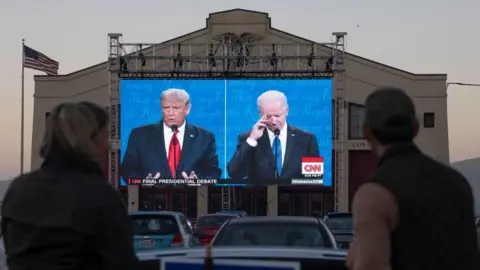
Getty Images Viewers watch a 2020 presidential debate between Joe Biden and Donald Trump. The two will likely face off again in the 2024 US presidential election.Getty ImagesViewers watch a 2020 presidential debate between Joe Biden and Donald Trump. The two will likely face off again this year

US President Joe Biden and his predecessor Donald Trump have both passed the delegate thresholds to clinch their parties’ nominations.

They each won several states in primary elections on Tuesday to propel them over the finish line.

The two 2020 contenders will provide the US with its first rematch in a presidential election for 70 years.

Polling suggests it will be a tight race that will come down to narrow margins in a few key states.

The nominations will be made official at party conventions this summer.

The 81-year-old president said on Tuesday evening that he was “honoured” voters had backed his re-election bid “in a moment when the threat Trump poses is greater than ever”.

Citing positive economic trends, he asserted the US was “in the middle of a comeback”, but faced challenges to its future as a democracy, as well as from those seeking to pass abortion restrictions and cut social programmes.

“I believe that the American people will choose to keep us moving into the future,” Mr Biden said in a statement from his campaign.

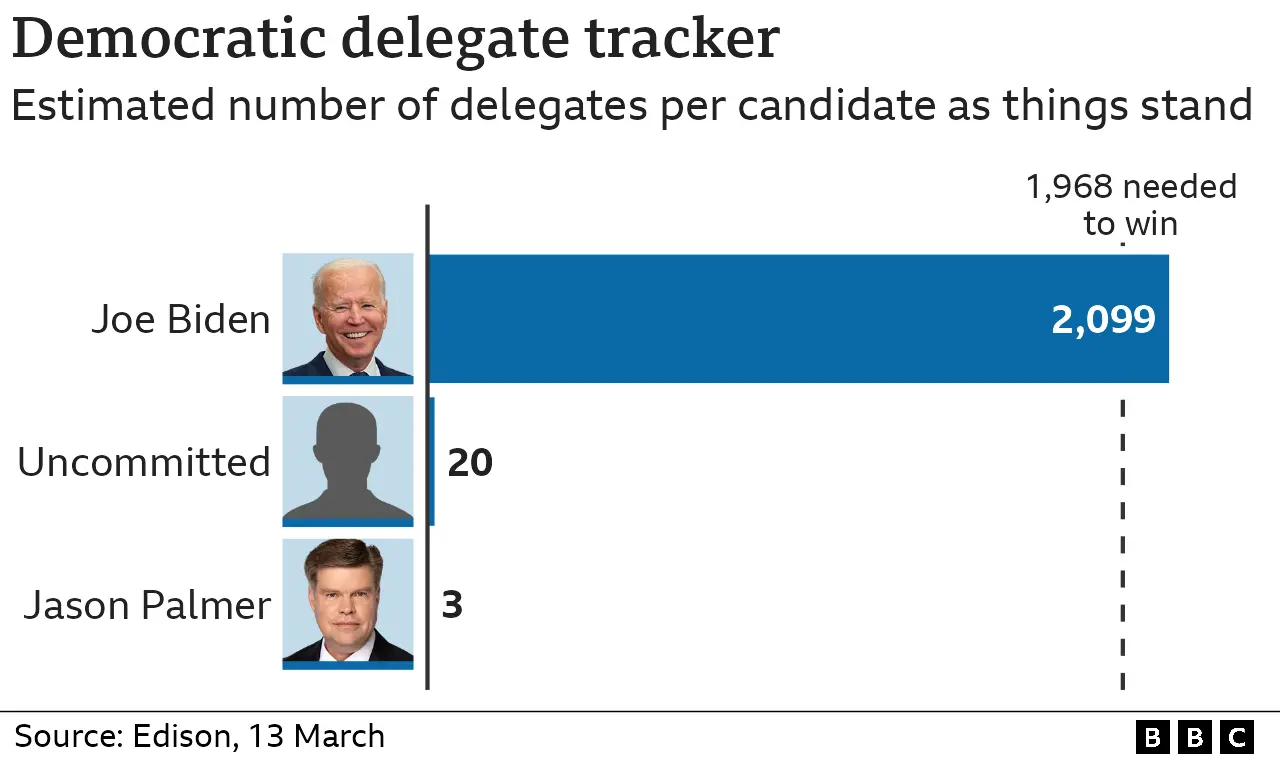
Incumbency gave Mr Biden a natural advantage and he faced no serious challengers for the Democratic nomination.

Despite persistent concerns from voters that his age limits his ability to perform the duties of the presidency, the party apparatus rallied around him.

Meanwhile, Mr Trump, 77, remains very popular with the Republican voter base, which has propelled him to victory in primary after primary over well-funded rivals.

His campaign for a second term in the White House has zeroed in on stricter immigration laws, including a pledge to “seal the border” and implement “record-setting” deportations.

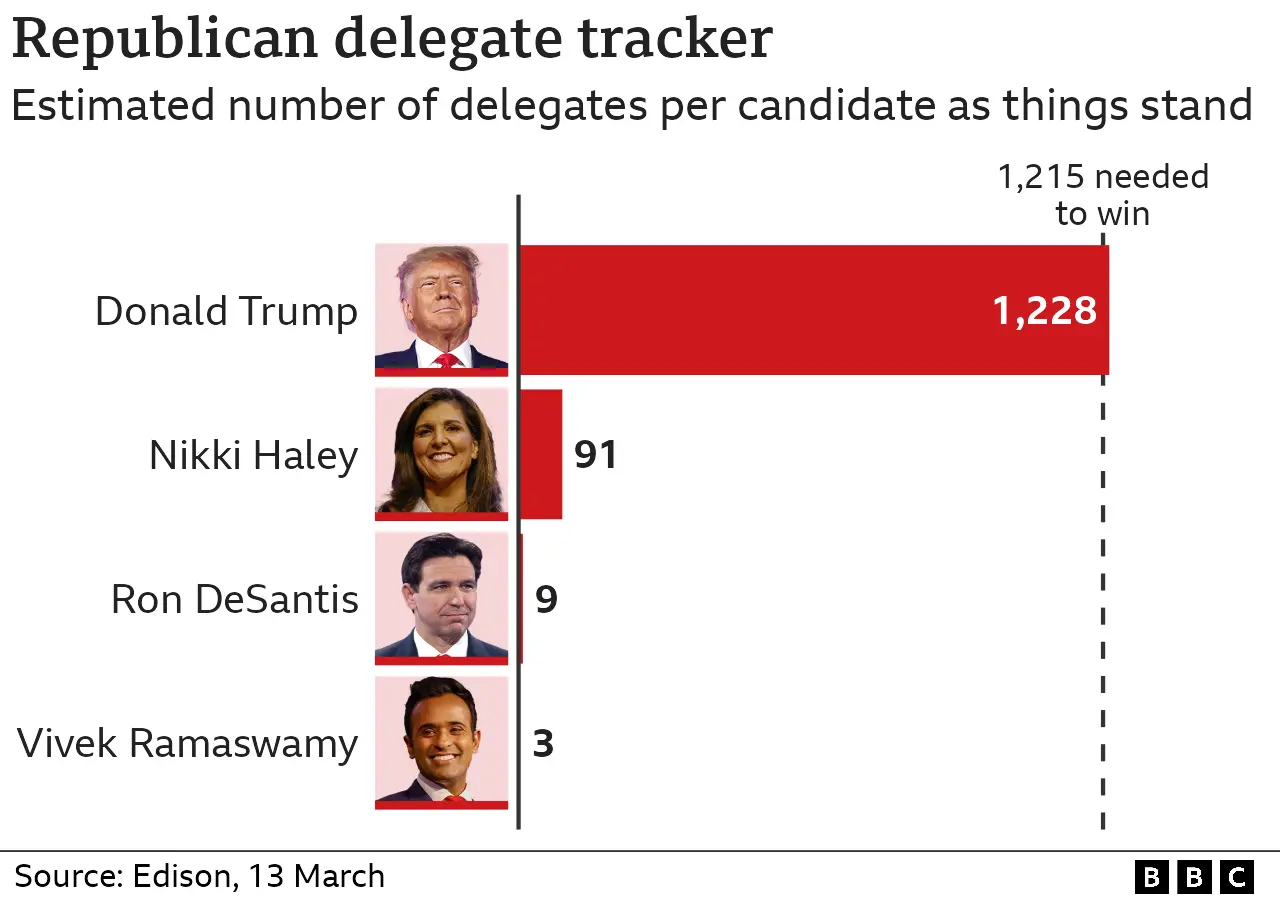
Graphic showing delegates won in Republican race

Mr Trump has also vowed to fight crime, boost domestic energy production, tax foreign imports, end the war in Ukraine and resume an “America first” approach to global affairs.

Tuesday night’s results do not come as a shock, as both men have dominated their races so far.

Both their re-nominations seemed all but predetermined, despite polling that indicates Americans are dissatisfied with the prospect of another showdown between Mr Biden and Mr Trump in November.

The US presidential primaries and caucuses are a state-by-state competition to secure the most party delegates.

line

More on the US election

line

The Democrats and the Republicans have slightly different rules for their primaries, but the process is essentially the same.

Each state is allocated a certain share of party delegates, which are awarded either as a whole to the winning candidate or proportionally, based on the results.

A Republican candidate must secure at least 1,215 of their party’s delegates during the primary season to win their presidential nomination, while a Democrat must secure 1,968.

On Tuesday, Republicans held primaries in Mississippi, Georgia and Washington State, as well as a caucus in Hawaii.

Democrats, meanwhile, held primaries in the states of Georgia, Washington and Mississippi, as well as in the Northern Mariana Islands and for Democrats living abroad.

Graphic showing delegates won in Democratic race

Mr Biden and Mr Trump’s main competitors had dropped out before Tuesday’s primary contests, so the results had been all but certain.

Former UN Ambassador Nikki Haley, Mr Trump’s last remaining rival, dropped out earlier this month after losing 14 states to Mr Trump on Super Tuesday.

Although several more states have yet to hold their primary contests, with Mr Trump and Mr Biden over the delegate threshold, the 2024 general election is now in effect under way.

The US presidential election will be held on 5 November 2024.

A simple guide to the US 2024 election

How does US electoral college choose presidents?

‘It’s like 2020 all over again – with higher stakes’

US election 2024

Donald Trump

United States

Joe Biden