Which European economy stands to suffer the most from US tariffs?

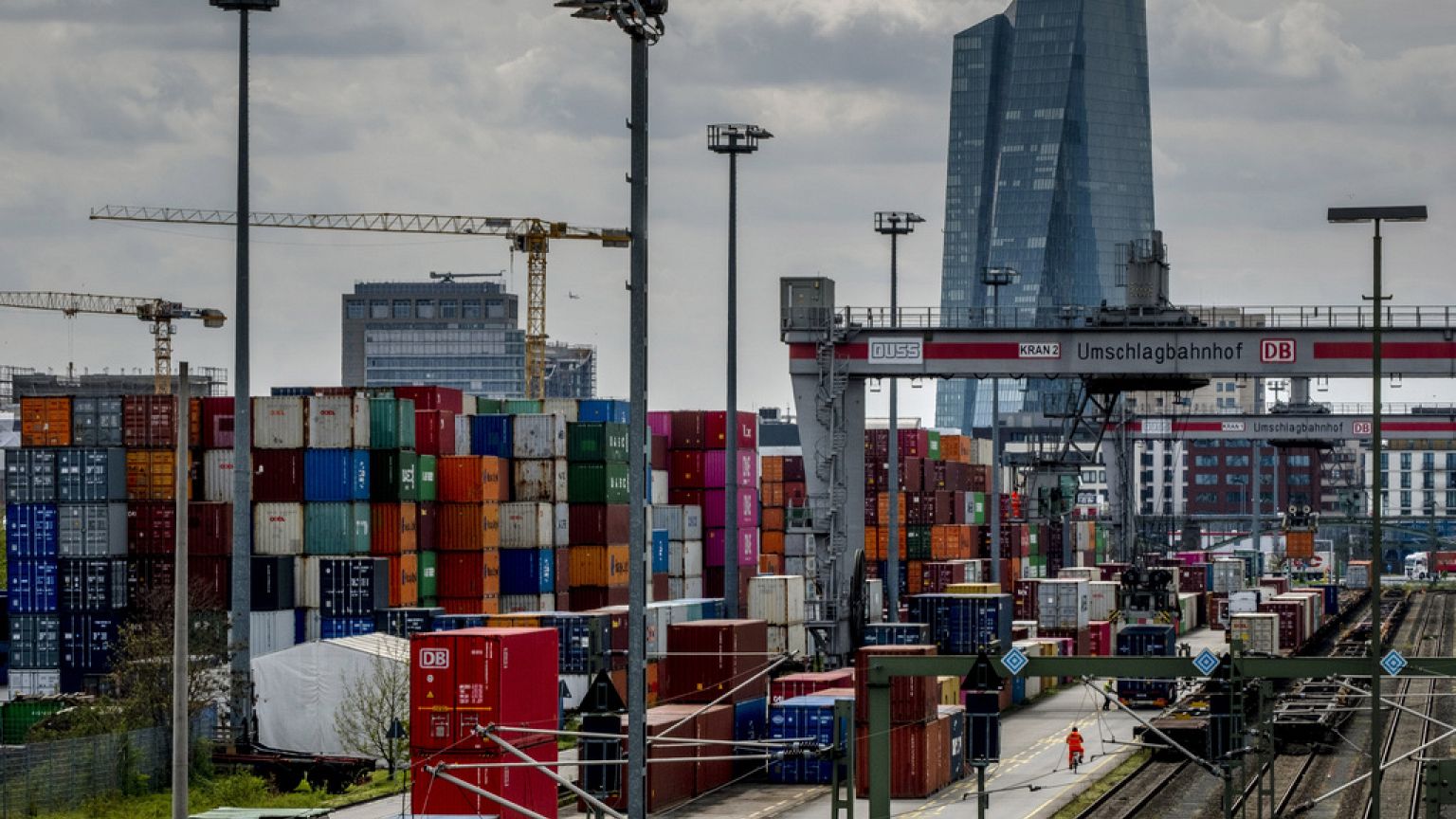
 Containers are piled up at a cargo terminal of Deutsche Bahn in Frankfurt, Germany, Wednesday, April 26, 2023.

How many times will Trump diddle around with his tariff hide and seek. It’s mot a game, Mr. “President.” It’s not “The Apprentice.”

Copyright Michael Probst/Copyright 2023 The AP. All rights reserved

By Doloresz Katanich

Published on 11/07/2025 – 7:30 GMT+2

Share this articleComments

One-fifth of the EU’s exports are heading to the US. Tariffs on the carmaking sector hit the German economy the most, but potential tariffs on the pharmaceutical one could cost substantially to the Irish economy.

Germany and Ireland are standing out as the two most exposed EU economies threatened by higher US tariffs, as Brussels works towards a trade deal with Washington, amid reports that pharmaceutical tariffs could be as high as 200%.

When US President Donald Trump imposed a new 25% tariff on auto imports and car parts in April, Germany was identified as the EU country with the most to lose. Brussels-based think tank Bruegel’s estimation at the time was that tariffs could cost 0.4% of the country’s GDP in the long term.

While awaiting a new EU-US trade deal, other details emerge that could put Ireland, Denmark, and Belgium, as well as other countries, in the crosshairs should Washington target the pharmaceutical sector next. 

Countries with the largest exposure to the US market

The overall impact on the European economy will depend on the actual tariff rate the US settles on and the EU’s response, but the blow will not be spread evenly. 

According to Bruegel, the EU economy is facing significant but manageable macroeconomic consequences.

They estimated in a report in April that, regarding the possible scenarios, the damage could be approximately 0.3% of the EU’s GDP, depending on the outcome of the negotiations. This compares to the 1.1% real GDP growth expected in the bloc in 2025, by the European Commission’s Spring Forecast.

Trade with the US is significant. In 2024, the United States was the largest partner for EU exports of goods, making up 20.6% of all EU goods exports outside the bloc.

Pharmaceuticals account for 15% of the EU’s goods exports to the US. They are followed by the auto sector.

Until there is more clarification on potential US tariffs on the pharma sector’s products, “the auto sector seems to be the most vulnerable to US tariffs as there doesn’t seem to be any major exemptions planned,” said Savary. The industry has been slapped with a 25% tariff in April. 

“Tariffs alone could shave around 8% off total EU trade volumes over the next five years,” said Rory Fennessy, Senior Economist at Oxford Economics, in a recent report.

Countries with the highest value in goods exports to the US, facing the biggest threat to their economies, include Germany, Ireland, Italy, France and the Netherlands. 

The German economy relies heavily on exports, boosted by the country’s motor vehicle sector. Nearly one-quarter (22.7%) of the total German exports are heading to the US. 

“Germany stands out as the major European economy likely to be hit hardest by US tariffs, and we expect GDP growth to slump in the second and third quarters,” Andrew Hunter, Associate Director and Senior Economist at Moody’s Ratings, said to Euronews Business.

Hunter also added that smaller economies, including Austria and others in central and eastern Europe, “which are heavily integrated into Germany’s industrial supply chains, will also be hit hard”.

According to Bruegel, after 2025, the long-term negative impact of the tariffs could be around 0.4% of the GDP in Germany, once “the effect has fully built up and initial short-term effects dissipated,” said Niclas Frederic Poitiers, Research Fellow at Bruegel. “For France, the average effect would be around 0.25% of GDP.”

Related

Uncertainty could lead to lost investments and jobs across the entire 27-member bloc. Hunter said that, “even for those countries where direct exposure to US exports is relatively limited, such as France or Spain, growth is still likely to be weighed down by global weakness and uncertainty.

Regarding long-term impacts, Ireland stands out as one of the most affected countries, as more than half of its goods exports (53.7%) are directed towards the US market. 

A lot depends on whether the pharmaceutical sector will be hit with tariffs. If so, “Ireland will be the EU economy most at risk from these tariffs,” said Mathieu Savary, chief strategist for our European Investment Strategy at BCA Research.

How pharma tariffs could hit the European economy in particular

The research-based pharmaceutical industry is a key asset of the European economy. It is one of Europe’s top-performing high-technology sectors.

It contributed €311 billion in gross value added (GVA) and 2.3 million jobs directly and indirectly to the European Union’s economy in 2022, according to a recent study by PWC. 

And the US market is crucial to the European pharma sector. According to the European Federation of Pharmaceutical Industries and Associations, in 2021, North America accounted for 49.1% of world pharmaceutical sales compared with 23.4% for Europe.

And more than one-third of EU pharma exports are going to the US. 

If the pharma sector is hit by a 25% tariff, as it is expected by Moody’s in the coming months, “most exposed would be a number of smaller European economies like Denmark, Belgium, Slovenia and Ireland, which are generally where we think the risks of recession in Europe are highest,” Hunter said. 

BCA Research’s chief strategist added that in this case, “Ireland is particularly exposed to this risk,” citing that exports to the US represent 18% of Ireland’s GDP, and pharma exports represent nearly 55% of Irish exports. According to BCA, the impact “could curtail 4% to 5% to growth over time”.

Bruegel estimated that Ireland’s cumulative real GDP loss could be 3% by 2028.

The think tank also singled out the country as the most vulnerable regarding the impact of the US tariffs on employment.

Regarding how vulnerable a country is to job losses in light of US tariffs, Bruegel said that Italy was the second most-exposed country, with a high exposure in transport equipment and a high level of exposed employment in fashion and car manufacturing. Italy would also have high exposure in pharmaceuticals.

Would there be a 200% tariff on pharma products?

Trump said on Tuesday that pharmaceutical products imported to the US are facing a 200% tariff, without disclosing any further details. 

According to BCA’s Savary, it is not likely, because “that would massively increase the cost of healthcare for US consumers, which is already a major issue for voters.” 

He sees it as a “strong message to foreign pharma companies to adjust their pricing down and invest into producing their drugs in the US.” Savary expects “that FDIs into the US and drug prices reduction announcements will be the end result of these talks and threats”.

“The pressure is now on for drug companies to expand US production facilities so they are effectively on the doorstep of American customers,” said Dan Coatsworth, investment analyst at AJ Bell.

Trump Doubles Metal Tariffs as He Presses Canada to Become Part of U.S.

BLOG EDITOR: Canada Says it will have None of this! Let see if the delusional Donald will handle this. We are in an alternative universe from anything we’ve seen. The question is who will suffer more but for the U.S. more like what will this first wave of retaliation do to his odd and destructive administration.

The president said he would double tariffs set to go into effect on Wednesday and threatened further levies, as he ramps up economic pressure on America’s closest ally.

Ana Swanson

By Ana Swanson

Ana Swanson covers international trade and reported from Washington.

  • March 11, 2025Updated 11:23 a.m. ET

President Trump escalated his fight with Canada on Tuesday, saying that he would double tariffs on steel and aluminum imports and threatening to inflict even more pain on one of America’s closest traditional allies as he pressed Canada to become part of the United States.

His comments sent jittery markets tumbling, with the S&P 500 down about 1 percent in early morning trading.

In a post on his social media platform, Mr. Trump wrote that Canadian steel and aluminum would face a 50 percent tariff, double what he plans to charge on metals from other countries beginning Wednesday. He said the levies were in response to an additional charge that Ontario placed on electricity coming into the United States, and he threatened more tariffs if Canada didn’t drop various levies it imposes on U.S. dairy and agricultural products.

“If other egregious, long time Tariffs are not likewise dropped by Canada, I will substantially increase, on April 2nd, the Tariffs on Cars coming into the U.S. which will, essentially, permanently shut down the automobile manufacturing business in Canada,” he threatened.

Tariffs in Trump’s second term in office

As of March 6

StatusCountryDescription
In effectFeb. 4China10% on all imports ›
In effectMarch 4Mexico25% on all imports ›
In effectMarch 4Canada25% on most imports, lower rate for energy ›
In effectMarch 4ChinaAdditional 10% on all imports ›
SuspendedMarch 6Canada and MexicoReprieve for goods that fall under the USMCA trade pact ›
PlannedMarch 12World25% on aluminum and steel ›
PlannedMarch 12CanadaAdditional 25% on aluminum and steel ›
PlannedApril 2WorldUnspecified tariff on all agricultural products
PlannedApril 2WorldUnspecified tariff on all foreign cars ›

Source: Peterson Institute for International Economics, Wells Fargo Economic Insights 

The New York Times

Mr. Trump went on to say that “the only thing that makes sense” is for Canada to become the 51st U.S. state.

The moves will significantly escalate a confrontation with one of America’s largest trading partners, and call into question Mr. Trump’s intentions for one of its closest allies. Canadian officials first thought Mr. Trump’s idea of absorbing Canada into the United State was a joke, but they have more recently begun to take the president’s threats seriously.

Mr. Trump spent much of his social media post on Tuesday essentially cajoling Canada to become part of America, writing: “This would make all Tariffs, and everything else, totally disappear. Canadians taxes will be very substantially reduced, they will be more secure, militarily and otherwise, than ever before, there would no longer be a Northern Border problem, and the greatest and most powerful nation in the World will be bigger, better and stronger than ever — And Canada will be a big part of that.”

“The artificial line of separation drawn many years ago will finally disappear, and we will have the safest and most beautiful Nation anywhere in the World,” he added.

Editors’ Picks

Big Drama Cannot Distract From Irrelevant ClothesHelp, I’m Marrying My Co-Worker and No One at Work Knows!Jam Like a King: Charles Releases a Playlist

President Trump said Canadian steel and aluminum would face a 50 percent tariff when coming into the United States.Credit…Nick Iwanyshyn/The Canadian Press, via Associated Press

Last week, Mr. Trump hit Canada and Mexico with sweeping 25 percents on all imports, before walking some — but not all — of those levies back a few days later.

Mr. Trump said the higher metal tariffs on Canada would be a response to a surcharge on electricity it exports to the United States. On Monday, Ontario, Canada’s most populous province, retaliated against Mr. Trump’s tariffs by adding a 25 percent surcharge to the electricity it exports to Michigan, Minnesota and New York.

Canada is in the middle of a political transition as it prepares to swear in a new prime minister, Mark Carney, an economist and central banker, to replace Justin Trudeau, who announced in January that he would be resigning after almost 10 years in office. Mr. Trump’s move would punish the entire country for a retaliation measure taken on by one province.

Vjosa Isai and Danielle Kaye contributed reporting.

Ana Swanson covers trade and international economics for The Times and is based in Washington. She has been a journalist for more than a decade. More about Ana Swanson

How Americans View Russia-Ukraine, Israel-Hamas and China-Taiwan Conflicts


From The Pew Research Center: Americans Weigh In on Foreign Conflicts
Odesa Technical College in Odesa, Ukraine, damaged in a nighttime Russian drone attack on Feb. 8. (Nina Liashonok/Ukrinform/Future Publishing via Getty Images)

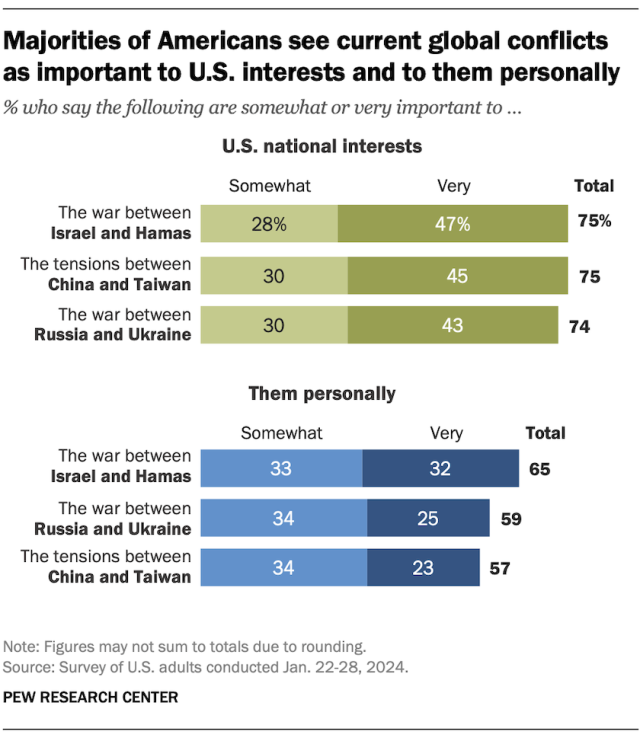
Two years on from Russia’s invasion of Ukraine, 74% of Americans view the war there as important to U.S. national interests – with 43% describing it as very important.

Similar shares see the war between Israel and Hamas (75%) and tensions between China and Taiwan (75%) as important to U.S. national interests, according to a Pew Research Center survey conducted Jan. 22-28.

How we did this

Bar chart showing that majorities of Americans see the Israel-Hamas war, tensions between China and Taiwan, and the war between Russia and Ukraine as important to U.S. interests and to them personally

When asked how important each conflict is to them personally, 59% of Americans say the war between Russia and Ukraine is important to them.

This is similar to the share who say tensions between China and Taiwan (57%) are important to them personally. But it is lower than the share who see the Israel-Hamas war as personally important (65%).

Roughly a third of Americans describe the Israel-Hamas war as very important to them personally, compared with around a quarter for the other two conflicts we asked about.

Differences by party

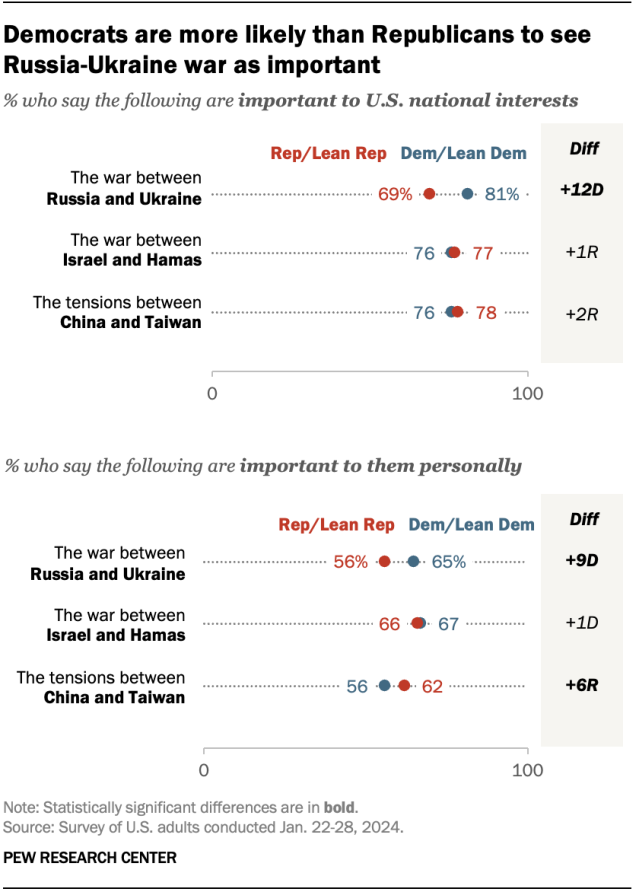
Dot plot chart by party showing that Democrats are more likely than Republicans to see Russia-Ukraine war as important, both to U.S. interests and to them personally

Democrats and Democratic-leaning independents are more likely than Republicans and Republican leaners to see the Russia-Ukraine war as important to U.S. national interests (81% vs. 69%).

Related: About half of Republicans now say the U.S. is providing too much aid to Ukraine

However, Democrats and Republicans are about equally likely to see the Israel-Hamas war (76% vs. 77%) and China-Taiwan tensions (76% vs. 78%) as important to U.S. interests.

Americans at the ideological poles – that is, conservative Republicans and liberal Democrats – are more likely than their more moderate counterparts in each party to view both the Israel-Hamas war and China-Taiwan tensions as important to U.S. interests.

When it comes to the importance of each conflict to them personally, Democrats are more likely than Republicans to say the Russia-Ukraine war is important to them (65% vs. 56%), while Republicans are more likely than Democrats to say this about China-Taiwan tensions (62% vs. 56%). Roughly equal shares of Democrats (67%) and Republicans (66%) say the Israel-Hamas war is personally important to them.

Related: Americans’ Views of the Israel-Hamas War

Differences by age

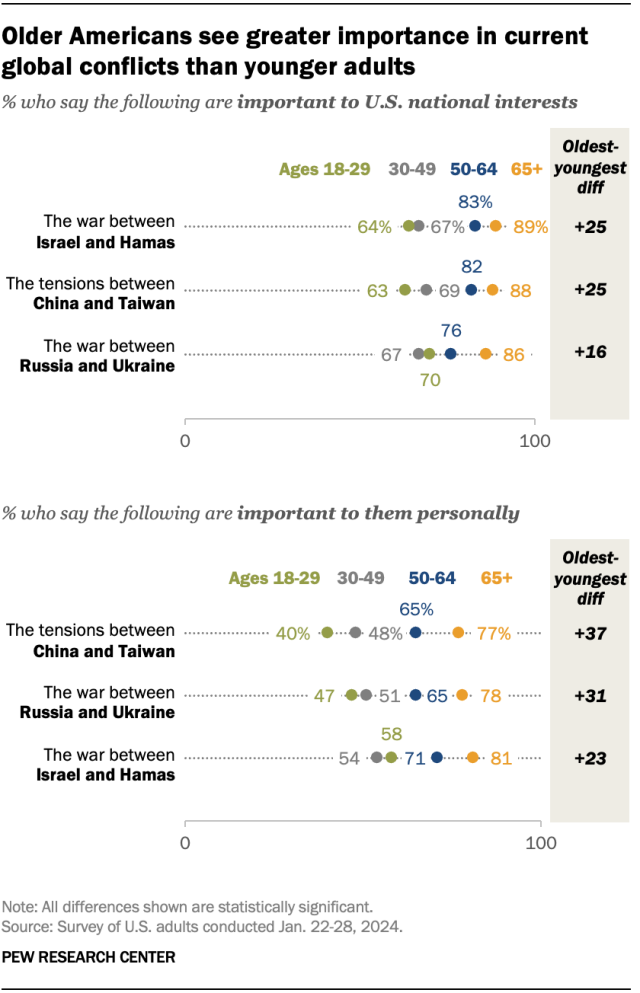
Dot plot chart showing that the oldest Americans are more likely than younger Americans to see the Israel-Hamas war, tensions between China and Taiwan, and the war between Russia and Ukraine as important to U.S. interests and to them personally

For all three conflicts we asked about, the oldest Americans are more likely than younger Americans to perceive them as important to both U.S. national interests and to them personally.

However, even among U.S. adults under 30, a majority (58%) see the Israel-Hamas war as personally important. This is not the case for the Russia-Ukraine war or for the ongoing tensions between China and Taiwan.

Note: Here are the questions used for this analysis, along with responses, and its methodology.