
Has situation in Haiti just gotten unusual US attention?
Antony Blinken arrived in the capital of Port-au-Prince to meet with Haiti’s transitional government amid gang violence.

Published On 6 Sep 20246 Sep 2024
Save articles to read later and create your own reading list.
Secretary of State Antony Blinken has travelled to Haiti to show the United States’ support for a multinational effort to combat gang violence in the Caribbean nation.
Blinken arrived in Port-au-Prince on Thursday, where he met with interim Prime Minister Garry Conille and announced a new surge of humanitarian aid.
list of 3 itemslist 1 of 3
“At this critical moment, we do need more funding, we do need more personnel to sustain and carry out the objectives of this mission,” Blinken told reporters.
Vast stretches of Haiti have fallen under gang control since the assassination of President Jovenel Moise in July 2021. That includes an estimated 80 percent of the capital Port-au-Prince.
The Haitian government has struggled to regain control and maintain peace, amid its own crisis of legitimacy.

Just one day before Blinken’s visit, Haiti’s interim government expanded an existing state of emergency to include the entire country, as the violence spills into its 10 departments.
Sign up for Al Jazeera
Americas Coverage Newsletter
US politics, Canada’s multiculturalism, South America’s geopolitical rise—we bring you the stories that matter.Subscribe

By signing up, you agree to our Privacy Policy
protected by reCAPTCHA
Previously, the state of emergency had only applied to the Ouest department, a populous area where Port-au-Prince is located.
But a spokesperson for Prime Minister Conille said the expanded emergency declaration reflects gang battles unfolding in departments like Artibonite, a large rice-growing region.
The violence has forced a record 578,074 people from their homes in 2024, marking the largest internal, crime-driven displacement crisis in the world, according to the United Nations.
In the first quarter of 2024 alone, an estimated 2,500 were killed or wounded in the continuing violence.
But in June, the government of Kenya sent a first batch of 200 police officers to Haiti, in an effort to prop up the country’s law enforcement. A second group of 200 Kenyan officers arrived the next month, out of an expected total of 1,000.
Still, Blinken warned during his visit that the Kenyan forces alone may not be able to turn the tide against the gang violence.
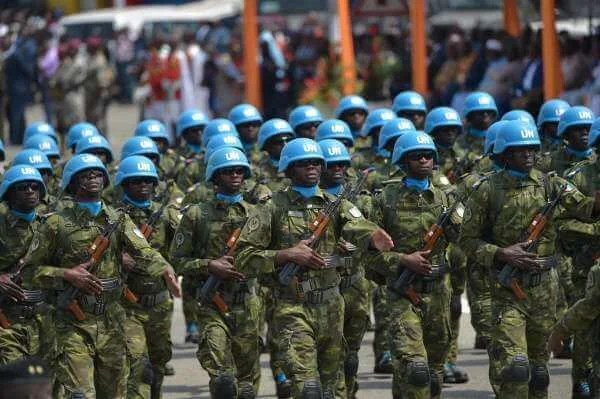
He and other US officials have openly speculated whether a UN peacekeeping force is needed.
But that is a controversial proposition in Haiti, where UN peacekeepers were responsible for a deadly cholera outbreak during their last deployment to the country.
Nearly 10,000 people died as a result of the disease from 2010 to 2019.
The country has also grappled with a long history of foreign intervention, which has left many wary of international forces.

The first step, Blinken said during his visit, was to ensure the international community was prepared to continue supporting the Kenyan forces, who arrived as part of a programme called the Multinational Security Support Mission.
That mission was approved last October for a one-year span. Blinken said it was time for the UN to reconvene and approve an extension.
“The mission itself needs to be renewed,” he said. “That’s what we’re working on right now. But we also want something that’s reliable, that’s sustainable, and we’ll look at every option to do that. A UN peacekeeping mission is one option.”
The US has been the mission’s largest financial supporter, with the administration of President Joe Biden pledging $360m.
An additional $45m in humanitarian aid to Haiti was announced on Thursday.
Blinken also underscored the need for a stable, democratically elected government during his visit. He called on Haitian officials to put in place plans for new general elections next year.
“That is the critical next step,” he said. “We want to make sure Haiti is back on a clear democratic track.”
Haiti has not held federal elections since before President Moise’s assassination. In January 2023, its latest democratically elected officials reached their term limit, with no one to replace them.
The government was run at that point by former Prime Minister Ariel Henry, whom the late Moise appointed shortly before his death. But Henry – an unelected official – was widely unpopular, and local gangs used the distrust in the government to expand their reach and assert their own power.
Henry ultimately stepped down in April, allowing for the establishment of a transitional council tasked with reestablishing democratic norms.
“Much remains to be done, and we’re determined to continue,” Blinken said. “It’s starting to move.”


 fshiels