
The strike set several aircraft on fire, video showed, and dealt a symbolic blow to Moscow’s relentless bombing campaign.
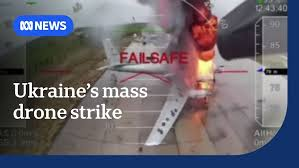
Ukraine Strikes Russian Air Bases in Large-Scale Drone Attack
This is great for Ukrainian morale– STUNNING. Its was a tactical tour de force. The effect on Russia– Russian Revenge might be another thing.
0:58Ukraine launched one of its broadest assaults of the war against air bases inside Russia, targeting sites from eastern Siberia to Russia’s western border.CreditCredit…Anatolii Stepanov/Reuters
By Maria VarenikovaAnastasia KuznietsovaNataliya VasilyevaMarc SantoraDevon Lum and Ephrat Livn NEW YORK TIMES
June 2, 2025
Ukraine said it secretly planted a swarm of drones in Russia and then unleashed them in a surprise attack on Sunday, hitting airfields from eastern Siberia to Russia’s western border.
The strike set several Russian aircraft on fire, stunned the Kremlin and dealt a strategic and symbolic blow to Moscow’s relentless bombing campaign in Ukraine.
Russian officials said that there were no casualties and that other Ukrainian attacks had been repelled.
Here’s what to know about the operation.
What to know
- What happened?
- What more did the Ukrainians say?
- How much damage did Russia’s bombers sustain?
- Why are the strikes significant?
- What did Ukraine hope to gain?
What happened?
Russia’s Defense Ministry said on Sunday that Ukrainian drones had attacked airfields in five regions stretching across five time zones. Several aircraft caught fire in the regions of Murmansk, near the border with Norway, and Irkutsk, in eastern Siberia, the ministry said.
“Some participants of the terrorist attacks were detained,” it said.
Ukraine said that 117 drones were used in the attacks. An official in Ukraine’s security services, known as the S.B.U., said that dozens of aircraft had been damaged in the strikes. The person spoke on the condition of anonymity to discuss a sensitive intelligence operation.
It was not immediately possible to independently confirm the Ukrainian claim or the details from Russia’s Defense Ministry.
Want to stay updated on what’s happening in Russia and Ukraine? Sign up for Your Places: Global Update
, and we’ll send our latest coverage to your inbox.
The New York Times verified videos that showed successful strikes at Olenya air base in the Murmansk region and the Belaya air base in the Irkutsk region. It also verified damage to at least five aircraft — four of them strategic bombers.
What more did the Ukrainians say?
The plan was called Operation Spider’s Web. Drones were planted across Russia, near military bases, the Ukrainian said, and then activated simultaneously.
President Volodymyr Zelensky of Ukraine said on social media Sunday that planning had begun a year and a half ago. He called the results “absolutely brilliant.”
Those involved in the attack, he added, were withdrawn from Russia before it took place.
On Monday, the Ukrainians offered more details about the operation. Over many months, they said, dozens of drones were secretly transported into Russia. They were packed onto pallets inside wooden containers with remote-controlled lids and then loaded onto trucks, an S.B.U. statement said.
Ukrainian officials said the crates were rigged to self-destruct after the drones were released. There was no indication that the drivers of the trucks knew what they were hauling, Ukrainian officials said.

The scale and details of the operation could not be independently verified.
A video verified by The Times shows two drones being launched from containers mounted on the back of a semi-truck less than four miles from the Belaya air base. Both drones fly in the direction of large plumes of smoke rising from the base. Footage recorded shortly afterward shows the same containers ablaze.
Another video shows drones flying less than four miles from the Olenya air base. The person recording could be heard suggesting that the drones had been launched from a truck parked just down the road. The Times could not confirm that those drones had been part of the assaults.
How much damage did Russia’s bombers sustain?
Ukraine said 41 planes had been hit, or about one-third of the strategic cruise-missile carriers at Russian air bases across three time zones. The Times verified that four Tu-95 bombers and one Antonov cargo plane were hit.
Russian military bloggers said the Ukrainian damage estimates were inflated. One influential Russian military blogger, Rybar, put the number of damaged Russian aircraft at 13, including up to 12 strategic bombers.
Western estimates suggest that Russia had slightly more than 60 active Tu-95s and about 20 Tu-160 bombers, according to Col. Markus Reisner, a historian and an officer in the Austrian Armed Forces. “Replacing losses will be very challenging,” he said.
The Ukrainian operation appears to have put a “real dent” in Russia’s ability to launch large salvos of cruise missiles, said Ben Hodges, a retired general who commanded the U.S. Army in Europe. “The surprise that they achieved will have a shock on the system as the Russians try to figure out how these trucks loaded with explosives got so deep inside of Russia,” he added.
Why are the strikes significant?
“This is a stunning success for Ukraine’s special services,” said Justin Bronk, a senior research fellow for air power and technology at the Royal United Services Institute in London.
“If even half the total claim of 41 aircraft damaged/destroyed is confirmed, it will have a significant impact on the capacity of the Russian Long Range Aviation force to keep up its regular large-scale cruise missile salvos against Ukrainian cities and infrastructure, whilst also maintaining their nuclear deterrence and signaling patrols against NATO and Japan,” he said in an email.
The attack in Irkutsk, on the Belaya air base, was also the first time that any place in Siberia had been attacked by Ukraine’s drones since the war began with Russia’s full-scale invasion in February 2022.
The Olenya base in the Murmansk region, which also came under attack, is also one of Russia’s key strategic airfields, hosting nuclear-capable aircraft.
Ukraine had executed ambitious drone attacks on Russian territory before, but Russia had defended against them. In late 2022, Kyiv targeted two airfields hundreds of miles inside Russia using long-range drones. But Russia adapted to such strikes, building protective structures around depots at bases, bringing in more air-defense assets and routinely repositioning its fleet.
Ukraine — which has banked on expanding the use of domestically produced drones — turned to a new approach and, in the process, put together a playbook that others facing off against a more powerful enemy may adopt, as well.
What did Ukraine hope to gain?
The idea behind Operation Spider’s Web was to transport small, first-person-view drones close enough to Russian airfields to render traditional air-defense systems useless, officials said.
The operation ranks as a signature event on par with the sinking of the Russian flagship Moskva early in the war and the maritime drone assaults that forced the Russian Navy to largely abandon the home port of the Black Sea Fleet in Sevastopol, Crimea, which Moscow said in 2014 that it had “annexed.”
Although the full extent of the damage from Ukraine’s strikes on Sunday is unknown, the attacks showed that Kyiv was adapting and evolving in the face of a larger military with deeper resources.
The Ukrainian strikes came a day before Russia and Ukraine met in Istanbul for further peace talks. While Kyiv shared its peace terms with Moscow ahead of the meeting, Russia presented its terms only on Monday. The Ukrainian delegation said it would need a week to review Moscow’s proposal, delaying further discussion.
At a NATO meeting of Baltic and Nordic countries, Mr. Zelensky said on Monday that the operation showed Russia that it was also vulnerable to serious losses and “that is what will push it toward diplomacy.”
But analysts say the attacks are unlikely to alter the political calculus of Russia’s president, Vladimir V. Putin. There was no indication that the attack had changed the Kremlin’s belief that it holds an advantage over Ukraine, as it counts on the weakening resolve of some of Kyiv’s allies and its ability to grind down outnumbered Ukrainian troops.
Maria Varenikova covers Ukraine and its war with Russia.
Marc Santora has been reporting from Ukraine since the beginning of the war with Russia. He was previously based in London as an international news editor focused on breaking news events and earlier the bureau chief for East and Central Europe, based in Warsaw. He has also reported extensively from Iraq and Africa.
Devon Lum is a reporter on the Visual Investigations team at The Times, specializing in open-source techniques and visual analysis.

 fshiels