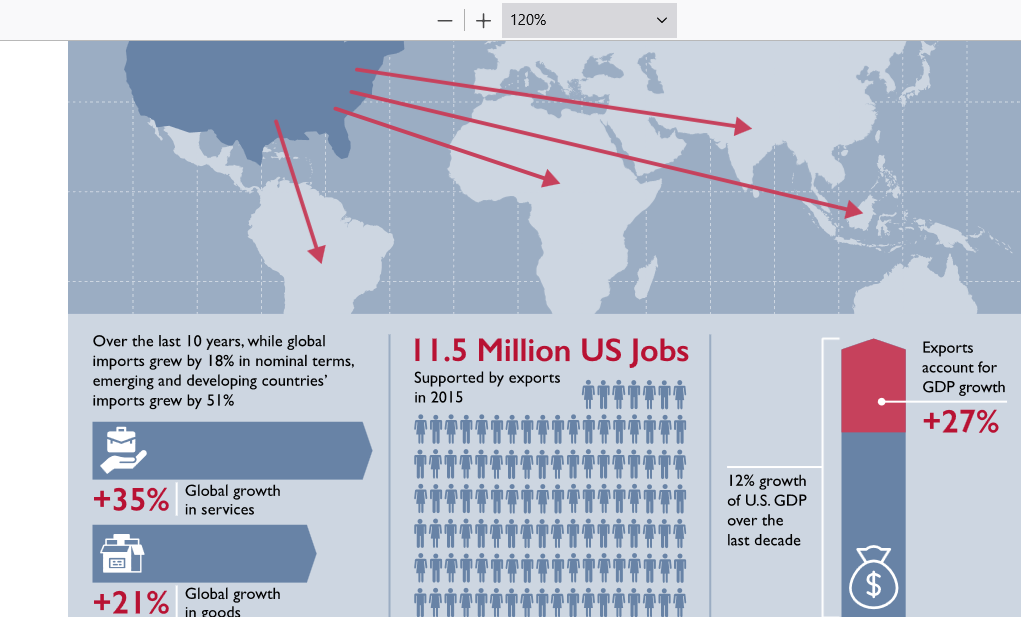
So we are seeing here the ripe fruit of government spendingL The AGENCY for INTERNATIONAL DEVELOPMENT with a whopping $79 bllion dollar budget. This ii cash for food, disease control, democratizing countries that need the services. The budget for an agency that gives humanitarian aid to over 100 countries. This is a fraction of the boated part of the Defense Department’s 800 Billion plus $$$. So this is a microcosm of the Trump adminstration’s priorities.
12 SHARED INTEREST: HOW USAID ENHANCES U.S. ECONOMIC GROWTH |
USAID is committed to improving the equitable access and quality of education in beneficiary
countries. From 2011 to 2015, results under the USAID Education Strategy included the following:
• Quality & learning: USAID expanded the reach of its reading programs from 7 million children
across 19 countries in 2011, to 22.7 million children across 41 countries in 2015. In assessments of
student learning, 1.5 million students (more than half female) demonstrated improved reading skills.
• Access: USAID programs established or improved education in safe learning environments for a total
of 11.8 million individual children and youth in crisis and conflict environments (5.6 million females,
6.2 million males).
• Supporting higher education for innovation and knowledge: The Agency supported 72 joint
research programs between U.S. and host country higher education institutions to advance economic
growth and sustainability through research and innovations in agriculture, energy and health, among
other sectors.
HEALTH
A healthy population is essential for economic growth. Increasing life expectancy by even one year is
estimated to raise the trajectory of GDP per capita by approximately 4 percent.28 And illness has
significant long-term implications for the productivity and output of a country’s economy. Healthy, well-
nourished children miss fewer days of school and learn more. Healthy workers produce more, while
adults with chronic illness may not even enter the labor force. Healthy parents invest more time and
money in raising children. Fewer resources, combined with inadequate social safety nets, mean that
health shocks have significant implications for households in poorer countries. Global health crises and
pandemics also pose a significant threat to economic security—researchers estimate that even at
current treatment levels for HIV/AIDS, the loss in GDP over the next decade could range from 2 to 4
percent in Sub-Saharan Africa.13 SHARED INTEREST: HOW USAID ENHANCES U.S. ECONOMIC GROWTH |
USAID’s Global Health Bureau invests in cutting-edge research for innovative health interventions,
leveraging partnerships and strengthening health-financing systems of developing countries. Highlights
include the following examples:
• In 2015, USAID reached nearly 18 million children globally with nutrition interventions and provided
support to nearly 6.2 million orphans, vulnerable children and families.
• From 2000 to 2015, USAID contributed to an estimated 22 percent decline in tuberculosis-related
mortality and a 21 percent decline in the global incidence of tuberculosis, saving an estimated 49
million lives.
• From 2000 to 2015, USAID contributed to an estimated almost seven million malaria deaths averted
globally and an estimated 71 percent decline in malaria-related mortality in children under five in Sub-
Saharan Africa.
USAID also works to fight pandemics such as HIV/AIDS, Ebola and Zika among others, which
have had profound economic impacts and can contribute to huge losses in human life, capital
and skills. Alongside implementing partners, USAID’s programs contributed to 20 percent fewer HIV
infections than 10 years ago and led to putting more than 15 million people on antiretroviral therapy.
USAID is also a leader in the control and prevention of infectious diseases, an increasingly important
role as emerging diseases such as H5N1, Ebola and Zika threaten our health and economy.
CRISIS RESPONSE: CONFLICTS AND NATURAL DISASTERS
Sudden and unexpected catastrophes can result in a sustained drop in income and can
compromise long-term growth prospects. Stabilizing countries in the face of natural disasters or
conflicts reduces growth volatility, which improves medium and longer term growth trends. Low-income
countries in particular have little redundant infrastructure and lack the economic resources to lessen the
long-term impact of shocks.14 SHARED INTEREST: HOW USAID ENHANCES U.S. ECONOMIC GROWTH |
Conflict takes a tremendous toll on an economy. For example, the Syrian civil war has resulted in
economic losses estimated at $20 to $38 billion in annual GDP capacity. Recovery from this scale of
economic damage takes a long time. The negative impacts resulting from the destruction of
infrastructure linkages necessary for production, trade and transport, as well as employment can persist
for years. Instability from conflict can also pose significant threats to neighboring countries, affecting
regional stability and growth. In addition, outflows of refugees and reductions in human capital
development (particularly in health and education) can roll back development progress. Simulations
estimate that even six years after the end of a civil conflict, GDP per capita will be at least 15 percentage
points lower, on average, than it would have been without the conflict.29
The immediate negative impacts of natural disasters are alleviated with humanitarian aid and
food assistance. In FY 2016, USAID responded to 52 disasters and programmed $1.4 billion in
humanitarian assistance. Funds provided: assistance in active conflicts in Syria, South Sudan, Iraq and
Yemen; drought response in Ethiopia and Southern Africa; and earthquake response in Ecuador. Food
security deficits are often a serious threat to stability during both conflicts and natural disasters. In the
face of food shortages, USAID provides targeted food assistance to address hunger and immediate
assistance needs. USAID also invests in in long-term solutions to food security to reduce the need for
costly food aid in the future and help entire countries become food secure.
Threats to stability can also result from unstable political transitions. USAID manages these threats
with rapid, flexible and immediate assistance, taking advantage of windows of opportunity to build
democracy and peace by working with policymakers and government officials to lay the foundations for
long-term development. USAID deploys election and governance experts to work with officials in
nascent democracies emerging from crisis and political transitions to establish systems for the delivery of
essential services, and institute sound policies that uphold greater transparency and accountability
throughout state and local government.15 SHARED INTEREST: HOW USAID ENHANCES U.S. ECONOMIC GROWTH |
HOW USAID PROGRAMS SUPPORT U.S. SUPPLY CHAINS
AND U.S. JOBS
AGRICULTURAL COMMODITIES
Industries depend on raw materials from overseas. USAID works with partner countries to increase
the production and improve the quality of their exports, including commodities that supply key U.S.
industries. This is a win for development, and a win for jobs in the United States. Sometimes, as in the
case of cacao, supplies from one region (West Africa) are growing in importance for manufacturing
because supplies are diminishing from another region. USAID programs in countries that supply inputs
to U.S. industries can prevent other countries from monopolizing trade in these key commodities,
contributing to national prosperity.
The coffee industry is a good example. This industry accounts for 1.6 percent of our GDP and nearly 1.7
million American jobs, yet little to no coffee is grown in the continental United States. Our geography is
not ideal for it. Through Feed the Future, USAID works closely with U.S. coffee companies and
smallholder farmers to integrate market systems in partner countries and the U.S. Through these
programs, farmers in developing countries can access new markets, and U.S coffee companies have
access to a steady supply of quality coffee. We are also working to combat diseases that threaten global
coffee crops and are helping boost the amount of coffee that reaches markets each year.30
As is the case with coffee, cacao cannot be grown in the continental United States, yet it is essential to
our confectionery industry, which has a direct economic impact of $35 billion a year—including $10
billion in U.S. taxes and $2 billion in exports. Feed the Future programs are designed to grow cocoa
bean exports and improve quality, increasing incomes of smallholder farmers. This benefits U. S.
producers and supports U.S. jobs. The chocolate and cocoa industry provides at least 70,000 U.S. jobs,
involving suppliers, retail, manufacturing and transportation.31 In addition, U.S. chocolate companies16 SHARED INTEREST: HOW USAID ENHANCES U.S. ECONOMIC GROWTH |
further stimulate the domestic economy by sourcing domestically produced ingredients such as sugar
and almonds.
In Indonesia, USAID activities increase the supply, quality and access of spices in partnership with the
U.S. Company, Cooperative Business International (CBI). They increase harvests, improve farmers’
access to international markets and improve the quality of high-value products such as vanilla, pepper,
clove and nutmeg. CBI’s local affiliate, Agri Spice Indonesia, supplies Indonesian spices to Maryland’s
McCormick & Company.32
USAID also helps connect Indonesian farmers to markets, and protect wage workers from exploitation.
The bulk of the world’s rubber is produced in only three countries in Asia, including Indonesia. USAID
works with Indonesia to create environmentally sustainable livelihood opportunities growing rubber
trees, and to improve labor standards on rubber plantations. Rubber is a commodity that states such as
South Carolina depend on to sustain its approximately 12,000 tire manufacturing jobs.
TRADE FACILITATION
Building capacity to expand trade is critical for U.S. businesses to be able to get their goods and
services to, and inputs from, developing countries. The OECD finds that when countries build
capacity to trade efficiently—that is, speedily moving goods across borders—it stimulates growth and
increases incomes. The OECD estimates that with improved trade facilitation, trade costs could be
reduced by 16.5 percent in low-income countries and 17.4 percent in lower middle-income countries,
and that just a one percent reduction in global trade costs would increase worldwide income by over
$40 billion.33
To modernize trading systems, USAID has supported trade facilitation in over 60 countries
globally for more than a decade.34 This work involves: (i) improving customs valuation, automation,
and electronic data interchange, including the automated single window; (ii) introducing risk
management; (iii) promoting legislative reform; (iv) enhancing post-clearance audit; (v) improving logistics
and transport services; and (vi) reducing processing times.
CONCLUSION
Growing the American economy by supporting economic growth in developing countries makes sense.
It is an effective strategy for the U.S. Government. Of course, USAID programs do not support U.S.
economic growth by themselves; they complement other programs financed and implemented by the
countries themselves and other donors that encourage private sector investment and development. And
economic growth depends first and foremost on the policies of the countries themselves, which USAID
works hard to positively influence. When countries are ready to move forward economically, USAID
programs can provide the needed capital, technology, ideas and know-how to assist them in developing
and implementing their economic growth programs as well as improving governance and rule of law. As
noted above, when countries face a shock or crisis, such as a natural disaster, pandemic or an outbreak
of violence, USAID short-term assistance can help minimize the damage and get them back on track so
growth can continue. USAID is both from the American people and for the American people.17 SHARED INTEREST: HOW USAID ENHANCES U.S. ECONOMIC GROWTH |
1 UN, Food and Agriculture Organization (2011). Putting Nature back into Agriculture. http://www.fao.org/news/story/en/item/80096/icode.
2 U.S. Department of State. (2017). “Annual Report to Congress, PEPFAR.” https://www.pepfar.gov/documents/organization/267809.pdf.
3 Arndt, C., Jones, S., & Tarp, F. (2015). “Assessing Foreign Aid’s Long-run Contribution to Growth and Development.” World Development, 69.
4 World Economic Forum (2016-17). “The Global Competitiveness Report.” http://reports.weforum.org/global- competitiveness-index.
5 Agricultural commodities are a major exception but they make up only 10% of total U.S. goods exports.
6 Actio. (2015). “The Size of Boeing’s Supply Chain.” http://blog.actio.net/supply-chain-management/the-size-of- boeing-supply.
7 http://www.scaa.org/?page=resources&d=facts-and-figures.
8 All data in real terms, unless specified. Most figures are on goods exports only, due to gaps in services data.
9 Real growth of U.S. domestic exports (total exports less re-exports) from 2007-2016, calculated from USITC Dataweb, US BEA, and USAID
Foreign Aid Explorer.
10 Calculated from the U.S. Bureau of Economic Analysis.
11 Calculated from IMF Direction of Trade Statistics. World Bank (income classifications).
12 Calculated from USITC Dataweb, World Bank (income classifications).
13 Europe and Eurasia graduates include Bulgaria, Croatia, Czech Republic, Estonia, Hungary, Latvia, Lithuania, Poland, Romania, Slovak Republic
and Slovenia. Calculated from U.N. COMTRADE International Trade Statistics Database, 2016.
14 Calculated from USITC Dataweb and U.S. Bureau of Economic Analysis.
15 Calculated from U.S. Department of Commerce, International Trade Administration.
16 Levine, R. (2005). “Finance and Growth: Theory and Evidence,” Handbook of Economic Growth, 1, 865-934.
17 Figure is calculated from the Credit Management Systems within DCA that monitors all guarantees and partnerships administered through
DCA.
18 U.S. Energy Information Administration. (2013). “International Energy Outlook: Future World Energy Demands Driven by Trends in
Developing Countries.” https://www.eia.gov/todayinenergy/detail.php?id=14011.
19 CDC Development Impact Evaluation. (2016). “Evidence Review: What Are the Links between Power, Economic Growth and Job Creation?”
http://www.cdcgroup.com/Documents/Evaluations/Power%20economic%20growth%20and%20jobs.pdf.
20 $490 billion of capital for new generation capacity and $345 billion for transmission and distribution, from McKinsey & Company, “Brighter
Africa Report 2015.”
21 Energy at USAID. (2016). “Promoting U.S. Prosperity: The Case for Energy Investment Overseas.” USAID, Washington, DC.
22 Timmer, C. P. (2002). “Agriculture and Economic Development,” in Handbook of Agricultural Economics, 2, 1487-1546.
23 USAID (2016). “Progress Report: Growing Prosperity for a Food-secure Future.” https://www.usaid.gov/what-we-do/agriculture-and-food-
security.
24 Field, E. (2007). “Entitled to Work: Urban Property Rights and Labor Supply in Peru.” The Quarterly Journal of Economics, 122(4), 1561-1602.
25 Hanushek, E., & Woessmann, L. (2010). “Education and Economic Growth.” Economics of Education Review, 60-67.
26 Hanushek, E. A. (2013). “Economic Growth in Developing Countries: The Role of Human Capital.” Economics of Education Review, 37, 204-
212.
27 UNESCO (2010). Education Counts: Towards the Millennium Development Goals. Paris.
http://unesdoc.unesco.org/images/0019/001902/190214e.pdf.
28Bloom, D. E., Canning, D., & Sevilla, J. (2004), “The Effect of Health on Economic Growth: A Production Function Approach.” World
Development 32: 1-13.
29 Mueller, H., & Tobias, J. (2016). “The Cost of Violence: Estimating the Economic Impact of Conflict.” IGC Growth Brief Series 007. London:
International Growth Centre.
30 National Coffee Association of USA. (2016). “Understanding the Economic Impact of the U.S. Coffee Industry.”
http://www.ncausa.org/Industry-Resources/Economic-Impact.
31 National Confectioners Association. (2015). “The Economic Impact Leadership of Americas Confectionery Industry.”
http://www.candyusa.com/our-industry/economic-impact-leadership-of-americas-confectionery-industry.
32 NCBA CLUSA. (2015). “Cooperatives Build a Better World.”
33 OECD/WTO (World Trade Organization). (2015). “Aid for Trade at a Glance 2015: Reducing Trade Costs for Inclusive, Sustainable
Growth.” WTO, Geneva/OECD Publishing, Paris.
34 USAID Office of Trade and Regulatory Reform. (2016). “Fact Sheet – USAID Supports Trade Facilitation.” USAID, Washington, DC.18 SHARED INTEREST: HOW USAID ENHANCES U.S. ECONOMIC GROWTH |
ACKNOWLEDGEMENTS
USAID’s Shared Interest paper was developed through a highly consultative process directed by Dr.
Louise Fox, the Agency’s Chief Economist, and by Robyn Broughton of the Bureau for Policy, Planning
and Learning (PPL).
Shared Interest is much stronger as a result of the Agency’s intensive engagement and the multiple
internal and external rounds of review. The team is especially grateful to the many colleagues who took
the time to read the document carefully and to offer their perspectives.
Additional assistance was provided by Pauline Adams (PPL), Emily Benner (PPL), Hope Bryer (PPL), Polly
Byers (PPL), Wendy Coursen (LPA), Mitchell Craft (BFS), Michelle Dworkin (LPA), Jeffrey Haeni (E3),
Upaasna Kaul (PPL), Stephen Kowal (E3), Janeen May (Asia), So-Youn Oh (PPL), Patricia Rader (PPL),
Curt Reintsma (BFS), Jeff Schlandt (USAID Data Service Team), Victoria Stoffberg (PPL), Jeffrey
Szuchman (PPL), Ryan Tramonte (Power Africa), and Susan Wilder (PPL).

 fshiels
Yes, so good of you to put all this in one place, sir!!! peace, sz
LikeLiked by 1 person